eBook - ePub
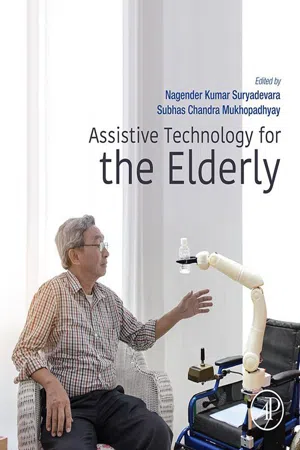
Assistive Technology for the Elderly
- 370 pages
- English
- ePUB (mobile friendly)
- Available on iOS & Android
eBook - ePub
Assistive Technology for the Elderly
About this book
Assistive Technology for the Elderly addresses the intricacies involved in the design and development of assisted technologies for the elderly, covering smart systems such as magnifying book contents, speaking electronic devices, alarms for doors and windows, smart alert bands, panic buttons, medication dispensers and reminders, Wander Gard, physiological parameters monitoring systems and smart home monitoring systems. This book is aimed at those who are responsible for designing assistive technology intended to be used by the elderly. It lays out the technology that is already available and covers user needs and state-of-the-art technologies and methodologies.
- Focuses on practical devices and technology for engineers
- Offers deep coverage of sensor based assistive technologies that are elderly for people with dementia, physical disabilities and people living alone
- Covers assistive technology ecosystems and offers case studies for practical application
Information
1
Access control for Internet of Things—enabled assistive technologies: an architecture, challenges and requirements
Shantanu Pal1, Michael Hitchens1 and Vijay Varadharajan2, 1Department of Computing, Macquarie University, Sydney, NSW, Australia, 2Advanced Cyber Security Engineering Research Centre, University of Newcastle, Callaghan, NSW, Australia
Abstract
There has been a tremendous growth in the use of the Internet of Things (IoT) in recent years. One important application area for the IoT is in the area of assistive technologies. Assistive technology can improve the functional capabilities of persons with disabilities by, for example, improved mobility and accessibility. IoT technologies, by virtue of their ubiquity and edge intelligence, can significantly enhance the provision of such services. IoT systems may deal with large amounts of data. In the assistive technologies context, this data can be particularly sensitive, as it may include health, location, and other highly personal information. Security then becomes a pressing concern in IoT-enabled assistive technology. In the IoT, security and privacy are major challenges due the characteristics of such systems (e.g., resource-constrained nature of the devices and high mobility). Given the large amount of personal data involved, and the potential reliance on IoT devices in the home and in users’ lives, access to data and resources is an important aspect of security in such systems. This chapter provides a discussion of the critical issue of security in IoT-enabled assistive technologies, particularly addressing access control. After identifying the requirements for such a mechanism and detailing a number of use cases, we present a fine-grained access control architecture for use in IoT-enabled assistive technology based on a combination of attributes, roles, and capabilities. We then discuss the issue of access right delegation for such systems. This will allow flexible and dynamic propagation of access rights in a manner suited to the characteristics of these systems. Finally, we outline a set of challenges that are significant when considering issues for security in IoT-enabled assistive technologies and demonstrate how our design satisfies the identified requirements.
Keywords
Internet of Things; assistive technology; access control; delegation; security
1.1 Introduction
The Internet of Things (IoT) enhances the connection between the digital and the physical. This paradigm shift enables us to transform everyday objects into smart objects that are able to sense, process, and act autonomously, fostering the communication between people and things and between the things themselves [1]. We consider things as a set of applications, services, users and their associations. The IoT has a large and growing role to play in many aspects of everyday life.
One of the most important application areas for the IoT is smart health care [2,3]. This seeks to address a myriad of challenges from the rising cost of health-care systems to the development of new applications, infrastructures, technologies, and protocols to assist both patients and caregivers. Personal (portable and mobile) devices have a huge potential to provide better lives for people with disabilities [4–6]. For instance, “BlindeDroid” is an information tracking system that uses smartphones and wireless sensors for building an indoor navigation system for real-time guidance of blind people [7]. This is just one example of how the development of IoT-enabled assistive technologies can improve life for people with disabilities. Other possible application areas include hearing aids, alternative and augmentative communication devices, and mobility assistance [8]. Assistive technologies consist of both hardware and software and can be defined as “a device or system that provides people with practical solutions to everyday life activities” [9]. While there is a growing demand for such systems designing, developing and deploying such assistive technologies at the required scale is challenging, especially when the issues of large systems, for example, heterogeneity and multiple domains of authority, are considered. The IoT has the potential to provide improved services for people with special needs, but the design of such systems will need to take into account contextual requirements, for example, ease of use, privacy, and flexibility [10].
According to the World Bank, 15% of world’s total population is experiencing some form of disability and disability prevalence is higher in developing countries [11]. The World Health Organization (WHO) reports that among these 15% of people, 2%–4% are experiencing a significant amount of difficulties in functioning [12]. We argue that with the increasing stress on global health-care systems, the IoT has the potential to provide better services to people with a disability by providing an emphasis on proactive health monitoring and self-management. IoT-enabled assistive technologies are seen to be powerful tools to help in achieving a better quality of life by increasing independence and improved participation of disabled people in social and economic life [13]. The development of the IoT should enable the seamless integration of service delivery with the specific needs of users. To achieve this will require addressing the technical challenges of providing improved IoT-enabled assistive technology in the specific context of people with special needs. One of these challenges is to provide proper security measure for those devices and the associated data. People with disabilities are likely to place significant value on their data while at the same time being potentially restricted in how they can interact with technology. The provision of security is complicated by the nature of the resource-constrained nature of the devices (e.g., limited battery power, processing capability or even memory storage) as well as the characteristics of such IoT systems (e.g., high mobility and dynamic interaction).
The security needs of IoT-supported assistive technology are myriad and we do not intend to address them all in a single chapter. Instead, we select one area, access control, and use it to illuminate how security can be provided in such systems. Access control is an important issue for IoT assistive technology due to the need to control access to devices and the integrity and confidentiality of patient-critical sensitive data. More significantly, we consider that security in such systems must be provided in a way that is comprehensible to end users—the people requiring the services of assistive technology. Access control includes the specification and enforcement of policies that authorize and authenticate a legitimate user and then ensure that proper access is given to those users for certain resources [14].
In order to address such issues, in this chapter, we first examine the need for access control for IoT-enabled assistive technologies. To demonstrate its practicality, we introduce a policy-based access control architecture that can address access control issues in IoT-enabled assistive technologies. To the best of our knowledge, this is the first research that discusses the access control issues for IoT-enabled assistive technologies. The major contributions of this chapter can be summarized as follows:
- • We examine the potential of IoT-enabled assistive technology and survey some existing proposals.
- • We present a comprehensive discussion of the requirements for IoT-enabled assistive technologies, including the security requirements of such systems.
- • We discuss an access control architecture for IoT-enabled assistive technology. In our architecture, we employ attributes for authenticating a legitimate entity within the system, rather than depending upon a concrete identity of an entity.
- • We outline the need for secure and flexible access right delegation in IoT-enabled assistive technology systems. We illustrate the process of transferring access right information and explore the importance of a secure and flexible delegation within these systems.
- • We provide a list of unique challenges and enumerate some distinctive requirements for IoT-enabled assistive technologies.
The rest of the chapter is organized as follows. In Section 1.2, we discuss the background of our research. This section consists of five major parts. We detail the definition of assistive technology (Section 1.2.1), the emergence of IoT, including its basic architecture and functionality (Section 1.2.2), the importance of IoT-enabled assistive technology (Section 1.2.3), major requirements for IoT-enabled assistive technology (Section 1.2.4), and example use cases (Section 1.2.5). In Section 1.3, we discuss our proposed access control approach in detail. At the beginning, we discuss the importance of IoT access control (Section 1.3.1) and the state-of-the art mechanisms (Section 1.3.2). Next we discuss the access control architectural in detail (Section 1.3.3). We provide a discussion for access right delegation for such IoT-enabled assistive systems in Section 1.3.4. In Section 1.4, we list a set of challenges that need to be addressed to provide a safe, secure, and flexible access control for the IoT-enabled assistive technologies. Finally, we conclude the chapter in Section 1.5 and discuss future works.
1.2 Background
The goal of this section is fivefold. First, we provide a basic introduction to assistive technology. Second, we provide some a primary description of the IoT. Third, we discuss the emergence of IoT-enabled assistive technology. Fourth, we outline major requirements for IoT-enabled assistive technology. Finally, we illustrate some example use cases.
1.2.1 Assistive technology
According to the WHO, assistive technologies and devices can be defined as follows [15]: “assistive devices and technologies are those whose primary purpose is to maintain or improve an individual’s functioning and independence to facilitate participation and to enhance overall well-being. They can also help prevent impairments and secondary health conditions.” According to Ref. [16], assistive technology can be defined as follows: “assistive technology is any item, piece of equipment, software program, or product system that is used to increase, maintain, or improve the functional capabilities of persons with disabilities.” In Ref. [17], the authors define assistive technology as “any product which has the primary purpose to maintain or improve an individual’s functioning and independence, and thereby promote their well-being.” The authors of Ref. [18] refer to assistive technology as “any item, piece of equipment, or product system, whether acquired commercially off the shelf, modified, or customized, that is used to increase, maintain, or improve functional capabilities of individuals with disabilities.”
An assist...
Table of contents
- Cover image
- Title page
- Table of Contents
- Copyright
- List of contributors
- 1. Access control for Internet of Things—enabled assistive technologies: an architecture, challenges and requirements
- 2. An efficient ambient intelligent–assisted people searching for Internet of Things–based health-care system
- 3. Securing the elderly in cyberspace with fingerprints
- 4. Wearable solution for robust fall detection
- 5. Heart sound detection, analysis, and assistive technologies for the elderly
- 6. Assistive sensing technology for the elderly health monitoring
- 7. Assistive technology for garments: an all seasons’ jacket
- 8. Edge computing for visitor identification using eigenfaces in an assisted living environment
- 9. Toward unsupervised multiresident tracking in ambient assisted living: methods and performance metrics
- 10. Significance of digital microfluidic techniques in biomedical devices for healthcare
- 11. Assistive devices for elderly mobility and rehabilitation: review and reflection
- Index
Trusted by 375,005 students
Access to over 1.5 million titles for a fair monthly price.
Study more efficiently using our study tools.
Frequently asked questions
Yes, you can cancel anytime from the Subscription tab in your account settings on the Perlego website. Your subscription will stay active until the end of your current billing period. Learn how to cancel your subscription
No, books cannot be downloaded as external files, such as PDFs, for use outside of Perlego. However, you can download books within the Perlego app for offline reading on mobile or tablet. Learn how to download books offline
Perlego offers two plans: Essential and Complete
- Essential is ideal for learners and professionals who enjoy exploring a wide range of subjects. Access the Essential Library with 800,000+ trusted titles and best-sellers across business, personal growth, and the humanities. Includes unlimited reading time and Standard Read Aloud voice.
- Complete: Perfect for advanced learners and researchers needing full, unrestricted access. Unlock 1.5M+ books across hundreds of subjects, including academic and specialized titles. The Complete Plan also includes advanced features like Premium Read Aloud and Research Assistant.
We are an online textbook subscription service, where you can get access to an entire online library for less than the price of a single book per month. With over 1.5 million books across 990+ topics, we’ve got you covered! Learn about our mission
Look out for the read-aloud symbol on your next book to see if you can listen to it. The read-aloud tool reads text aloud for you, highlighting the text as it is being read. You can pause it, speed it up and slow it down. Learn more about Read Aloud
Yes! You can use the Perlego app on both iOS and Android devices to read anytime, anywhere — even offline. Perfect for commutes or when you’re on the go.
Please note we cannot support devices running on iOS 13 and Android 7 or earlier. Learn more about using the app
Please note we cannot support devices running on iOS 13 and Android 7 or earlier. Learn more about using the app
Yes, you can access Assistive Technology for the Elderly by Nagender Kumar Suryadevara,Subhas Chandra Mukhopadhyay in PDF and/or ePUB format, as well as other popular books in Technology & Engineering & Engineering General. We have over 1.5 million books available in our catalogue for you to explore.