eBook - ePub
Nuclear Reactor Technology Development and Utilization
- 512 pages
- English
- ePUB (mobile friendly)
- Available on iOS & Android
eBook - ePub
Nuclear Reactor Technology Development and Utilization
About this book
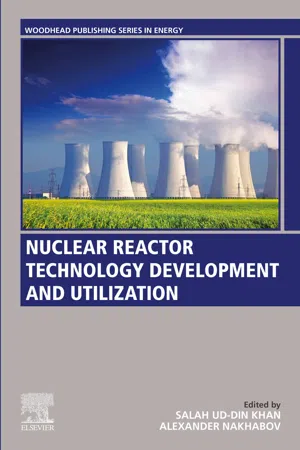
Nuclear Reactor Technology Development and Utilization presents the theory and principles of the most common advanced nuclear reactor systems and provides a context for the value and utilization of nuclear power in a variety of applications both inside and outside a traditional nuclear setting. As countries across the globe realize their plans for a sustainable energy future, the need for innovative nuclear reactor design is increasing, and this book will provide a deep understanding of how these technologies can aid in a region's goal for clean and reliable energy.
Dr Khan and Dr Nakhabov, alongside their team of expert contributors, discuss a variety of important topics, including nuclear fuel cycles, plant decommissioning and hybrid energy systems, while considering a variety of diverse uses such as nuclear desalination, hydrogen generation and radioisotope production. Knowledge acquired enables the reader to conduct further research in academia and industry, and apply the latest design, development, integration, safety and economic guidance to their work and research.
- Combines reactor fundamentals with a contemporary look at evolving trends in the design of advanced reactors and their application to both nuclear and non-nuclear uses
- Analyses the latest research and uses of hybrid systems which bring together nuclear technology with renewable energy technologies
- Presents applications, economic factors and an analysis of sustainability factors in one comprehensive resource
Information
1
Fundamentals of nuclear reactors
Saeed A. Alameri; Ahmed K. Alkaabi Department of Nuclear Engineering, Khalifa University of Science and Technology, Abu Dhabi, United Arab Emirates
Abstract
Nuclear power plants produce energy basically through nuclear fission reactions in nuclear fuel. When fission reactions occur in the fuel material, a large amount of heat is produced along with several neutrons and fission fragments, thus leading to a fission chain reaction and energy production. This chapter provides a basic understanding of nuclear reactor principles. The first part begins with a basic concept of nuclear power plants beginning with the fundamentals and practical applications related to the utilization of nuclear energy from fission. It explains the different types of neutron interaction with matter including neutron attenuation, scattering, and fission. The concepts of neutron diffusion and reactor theory are explained starting with equation of continuity and Fick's law approximation in one-energy group, multigroup, and two-group contexts. Then, a brief introduction to nuclear reactor kinetics including reactor reactivity, neutron life, reactor feedback coefficients, and neutron poisons is explained. The second part of the chapter explains the basic principles of nuclear system thermal hydraulics with single-phase fluid mechanics and heat transfer relevant to nuclear systems. This part includes topics ranging from basic thermal hydraulic characteristics of power reactors to the main classification of nuclear power plants, power cycles and reactor designs, and primary coolant system in various reactor designs. The chapter then discusses thermal design principles and reactor heat generation, which leads to a more focused thermal analysis of nuclear fuel elements including a brief description of the single-phase heat transfer for laminar and turbulent flow in both circular and noncircular subchannels.
Keywords
Nuclear systems; Fission; Neutron diffusion equation; Reactor theory; Thermal hydraulics; Single phase flow; Heat transfer; Single channel
1.1 Part 1: Nuclear reactor principles
Nuclear reactors produce energy through nuclear fission reactions. To understand how fission power is produ...
Table of contents
- Cover image
- Title page
- Table of Contents
- Copyright
- Dedication
- Contributors
- About the editors
- Preface
- Acknowledgments
- 0: Introduction to nuclear power technology
- 1: Fundamentals of nuclear reactors
- 2: Nuclear fuel cycle and decommissioning
- 3: Nuclear reactor safety
- 4: Economics of nuclear power plants
- 5: Small modular reactors
- 6: Generation IV nuclear reactors
- 7: Nuclear desalination
- 8: Nuclear hydrogen
- 9: Engineering materials in advanced space applications
- 10: Nonpower applications of nuclear technology
- 11: Nuclear hybrid energy system
- 12: Nuclear power plant development
- 13: Nuclear-powered space reactor
- 14: Nuclear power plant systems
- Index
Trusted by 375,005 students
Access to over 1.5 million titles for a fair monthly price.
Study more efficiently using our study tools.
Frequently asked questions
Yes, you can cancel anytime from the Subscription tab in your account settings on the Perlego website. Your subscription will stay active until the end of your current billing period. Learn how to cancel your subscription
No, books cannot be downloaded as external files, such as PDFs, for use outside of Perlego. However, you can download books within the Perlego app for offline reading on mobile or tablet. Learn how to download books offline
Perlego offers two plans: Essential and Complete
- Essential is ideal for learners and professionals who enjoy exploring a wide range of subjects. Access the Essential Library with 800,000+ trusted titles and best-sellers across business, personal growth, and the humanities. Includes unlimited reading time and Standard Read Aloud voice.
- Complete: Perfect for advanced learners and researchers needing full, unrestricted access. Unlock 1.5M+ books across hundreds of subjects, including academic and specialized titles. The Complete Plan also includes advanced features like Premium Read Aloud and Research Assistant.
We are an online textbook subscription service, where you can get access to an entire online library for less than the price of a single book per month. With over 1.5 million books across 990+ topics, we’ve got you covered! Learn about our mission
Look out for the read-aloud symbol on your next book to see if you can listen to it. The read-aloud tool reads text aloud for you, highlighting the text as it is being read. You can pause it, speed it up and slow it down. Learn more about Read Aloud
Yes! You can use the Perlego app on both iOS and Android devices to read anytime, anywhere — even offline. Perfect for commutes or when you’re on the go.
Please note we cannot support devices running on iOS 13 and Android 7 or earlier. Learn more about using the app
Please note we cannot support devices running on iOS 13 and Android 7 or earlier. Learn more about using the app
Yes, you can access Nuclear Reactor Technology Development and Utilization by Salah Ud-Din Khan,Alexander V. Nakhabov in PDF and/or ePUB format, as well as other popular books in Technology & Engineering & Industrial Health & Safety. We have over 1.5 million books available in our catalogue for you to explore.