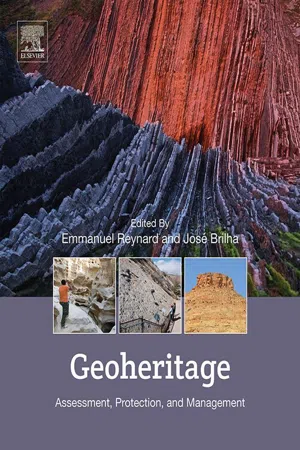
- 482 pages
- English
- ePUB (mobile friendly)
- Available on iOS & Android
eBook - ePub
About this book
For the last 20 years there has been a growing interest in the geosciences for topics related to geoheritage: geoconservation, geotourism and geoparks. Geoheritage: Assessment, Protection, and Management is the first and only reference book to cover these main topics as well as the relationship of geoheritage to other subjects such as landscapes, conservation, and tourism. The book also includes methodologies for assessment, mapping, and visualisation, along with case studies and colour images of some of the most important global geosites. This book is an essential resource for geoscientists, park and geopark managers, tourism and regional planning managers, as well as university students interested in geoheritage, geosites, geomorphosites, geoconservation, and geotourism. It also includes critical information on UNESCO's Global Geoparks, World Heritage and Biosphere Reserve sites, national parks and protected areas in general, land-use planning and nature conservation policies, and in the general contribution of geodiversity for sustainable development.
- Winner of the 2019 AESE Award for Outstanding Publication
- Written by a panel of 46 authors from 14 countries in all continents
- Based on conceptual, methodological, and applied research carried out by academics and practitioners
- Includes 160 colour images and maps of geoheritage sites
- Features six case studies from sites in Africa, Asia, Australia, Europe, North America and South America
Trusted by 375,005 students
Access to over 1.5 million titles for a fair monthly price.
Study more efficiently using our study tools.
Information
Topic
Physical SciencesSubtopic
Geology & Earth SciencesSection III
Geoheritage
Outline
Chapter 4
Geoheritage
Inventories and Evaluation
José Brilha, University of Minho, Braga, Portugal
Abstract
The recognition of what is geoheritage is based on the perception that some geodiversity elements have something that it is unusually important, which means that they have an extra value. Due to this high value, these elements must be protected, particularly when the risk of degradation caused by natural or anthropic factors is critical. This chapter details methods for the identification and inventorying of geoheritage. In addition, in order to prioritise subsequent management actions, the numerical assessment of the geoheritage value and risk of degradation are proposed, based on a set of criteria that intends to decrease the subjectivity inherent to any evaluation procedure.
Keywords
Geoheritage; geoconservation; geodiversity; geosite; inventory; assessment
The conservation of geological sites using a systematic and scientific background seems to have started in the United Kingdom in 1977, after the establishment of the Geological Conservation Review by the Nature Conservancy (Allen et al., 1987; Wimbledon, 1988). However, isolated efforts to protect geological localities were already happening in different countries from the 17th century (for a compilation of examples, see Gray, 2013; Larwood, 2016). A detailed description of more recent protection initiatives in most of the European countries was presented by Wimbledon and Smith-Meyer (2012). A similar analysis for Latin America countries was recently done by Palacio Prieto et al. (2016).
The protection of geological occurrences has always faced a big challenge: with so many rocks occurring all over the Earth’s surface, which ones should be managed in order to be conserved for the benefit of present and future generations? How should outcrops be selected? Which criteria should be used in order to ensure that the chosen localities are really the ones that must be protected?
This chapter aims to give clear answers to these questions. It presents a general perspective about geoheritage, mainly focusing on concepts, terminology, and methods for its inventorying and assessment. It should be stated from the beginning that geoheritage, or geological heritage in its extended form, is materialised by exceptional elements of geodiversity, namely minerals, fossils, rocks, landforms and their landscapes, soils, and active geological and geomorphological processes. Thus, in this chapter, the word ‘geology’ and its derivatives include all Earth sciences domains (mineralogy, petrology, geomorphology, palaeontology, etc.).
This chapter is organised into three sections, each one addressing a particular issue that is especially relevant to an increasing number of newcomers that are becoming interested in geoheritage:
1. What makes an element of geodiversity exceptional?
2. How should the high value of geodiversity elements be identified and characterised?
3. How and why should geoheritage be assessed?
4.1 What Makes an Element of Geodiversity Exceptional?
When something is considered exceptional, typically what is really being appreciated is its high value. Geodiversity elements may have different types of values, starting from those more concrete like the economic, functional, scientific and educational, to the more intangible ones, such as the intrinsic or existence, cultural, and the aesthetic values (Gray, 2013). With the exclusion of the intrinsic or existence value, all other types of value are strongly associated with an anthropogenic vision of nature, particularly in what concerns the use we make of nature. This is what Gray (2013) and Gray et al. (2013) refer to as ‘geosystem services’, i.e., the benefits that society gains from geodiversity elements, including regulating, supporting, provisioning, cultural and knowledge services.
Hence, for a geodiversity element to be considered exceptional, a high value must be assigned to it (Table 4.1). When a geodiversity element is considered important for several types of values, it means that its overall exceptionality is higher. For instance, all types of values can be assigned to the typical landforms of the Uluru-Kata Tjuta National Park in Central Australia, apart from just the cultural one referred to in Table 4.1.
Table 4.1
Examples of Locations Where Geodiversity Elements Have an Exceptional Value. Ex Situ Exemplars of Minerals, Fossils, and Rocks May Also Have All Types of Values, Except the Functional One
| Value | Site/Location | Justification |
| Economic | Escondida Mine (Chile) | Chile is the top copper-producing country in the world. In 2015 this mine alone produced 1148 million metric tons comprising mostly copper concentrate, which generates important revenues for this country |
| Functional | Göreme National Park (Turkey) | The volcanic rocks of Cappadocia sculpted by erosion were used as dwellings, troglodyte villages and underground towns, which constitute the remains of a traditional human habitat dating back to the 4th century |
| Scientific | Basque Coast UNESCO Global Geopark (Spain) | The definition of two Global Boundary Stratotype Sections and Points (GSSPs, lower boundaries of the Selandian Stage and of the Thanetian Stage, both belonging to the Paleocene Series) turns the coastal cliffs of Zumaia into a place with global importance for geosciences |
| Educational | Terras de Cavaleiros UNESCO Global Geopark (Portugal) | The occurrence of a complete ophiolite sequence resulting from the obduction of Palaeothetys oceanic lithosphere over the Allochthonous Basal Complex attracts students from universities of different countries |
| Intrinsic | Volcanoes of Kamchatka (Russia) | Independently of human appreciation, this is one of the areas of higher density and diversity of active volcanoes on Earth |
| Cultural | Uluru-Kata Tjuta National Park (Australia) | The inselbergs of this park form an integral part of the traditional belief system of one of the oldest human societies in the world and it is considered a sacred place for the Anangu Aboriginal people |
| Aesthetic | Iguaçu National Park (Argentina/Brazil) | One of the world’s largest and most impressive waterfalls extending over some 2700 m, attracting about 1.5 million visitors each year to enjoy the natural beauty of the site |
It is generally assumed by society that the main benefit obtained from geodiversity elements is limited to quarrying and mining of geological resources. This is the traditional understanding of what is the goal of geology, always associated with the exploitation of gold, coal, oil, etc. It is unquestionable that our complete dependence on geological resources to maintain the growing consumption of all sorts of products justifies the economic value of rocks and minerals.
However, many geoscientists around the world are trying to demonstrate that there is another way for geodiversity elements to be exploited by society, without the need to open a quarry, a mine or a borehole. In fact, based on their values, geodiversity elements may be used in a nonextractable sustainable way by different users/beneficiaries (Table 4.2). What kind of activities can be supported?
Table 4.2
Examples of Uses of Geodiversity Elements, Besides the Traditional Exploitation of Geological Resources. Each Type of Use Carried Out by Direct Users/Beneficiaries Is Based on Geodiversity Values
| Uses of Geodiversity Elements | Users/Beneficiaries | Values |
| Scientific | • Geoscientists • Social scientists (archaeologists, ethnographers…) | Scientific |
| Cultural | ||
| Educational(formal and informal) | • Students and teachers of different domains are direct users of formal educational activities. • Informal educational actions are addressed to the general public. | Educational (geosciences, social and cultural sciences, etc.) |
| Cultural | ||
| Economic (indirectly) | ||
| Geotourism and recreation | • Nature tourism companies, guides, restaurant and hotel industries, handicraft companies, local cooperatives, rental bus and rent-a-car companies, etc. | Economic |
| Aesthetic | ||
| Cultural |

The scientific and educational use is not restricted to geosciences as it may be also applied to other disciplines.
Firstly, a scientific use carried out by geoscientists to produce meaningful scientific knowledge of how the geosphere works and interacts with other Earth systems (biosphere, hydrosphere and atmosphere). This knowledge ensures the continuous advancement of geosciences with clear benefits for a growing human population that wishes to live safely and healthily. It is considered that a site has scientific value when the research done directly at that location or using samples collected from it has produced significant scientific understanding to allow the advancement of geosciences nationally and internationally (Brilha, 2016). In addition, sites that were relevant for the history of geosciences at the national and international levels may also be considered to have scientific value.
Secondly, an educational use can be applied by geoscience teachers in order to give students a solid knowledge about how planet Earth changes through time. This type of use is also related to the training of new generations of geoscientists.
Finally, certain geodiversity elements may justify a distinct form of economic use based on geotourism and leisure, ...
Table of contents
- Cover image
- Title page
- Table of Contents
- Copyright
- Photo Credit
- List of Contributors
- Biographies
- Acknowledgements
- Section I: Introduction
- Section II: Geodiversity
- Section III: Geoheritage
- Section IV: Geoheritage and Conservation
- Section V: Uses of Geoheritage
- Section VI: Case Studies
- Section VII: Conclusion
- Index
Frequently asked questions
Yes, you can cancel anytime from the Subscription tab in your account settings on the Perlego website. Your subscription will stay active until the end of your current billing period. Learn how to cancel your subscription
No, books cannot be downloaded as external files, such as PDFs, for use outside of Perlego. However, you can download books within the Perlego app for offline reading on mobile or tablet. Learn how to download books offline
Perlego offers two plans: Essential and Complete
- Essential is ideal for learners and professionals who enjoy exploring a wide range of subjects. Access the Essential Library with 800,000+ trusted titles and best-sellers across business, personal growth, and the humanities. Includes unlimited reading time and Standard Read Aloud voice.
- Complete: Perfect for advanced learners and researchers needing full, unrestricted access. Unlock 1.5M+ books across hundreds of subjects, including academic and specialized titles. The Complete Plan also includes advanced features like Premium Read Aloud and Research Assistant.
We are an online textbook subscription service, where you can get access to an entire online library for less than the price of a single book per month. With over 1.5 million books across 990+ topics, we’ve got you covered! Learn about our mission
Look out for the read-aloud symbol on your next book to see if you can listen to it. The read-aloud tool reads text aloud for you, highlighting the text as it is being read. You can pause it, speed it up and slow it down. Learn more about Read Aloud
Yes! You can use the Perlego app on both iOS and Android devices to read anytime, anywhere — even offline. Perfect for commutes or when you’re on the go.
Please note we cannot support devices running on iOS 13 and Android 7 or earlier. Learn more about using the app
Please note we cannot support devices running on iOS 13 and Android 7 or earlier. Learn more about using the app
Yes, you can access Geoheritage by Emmanuel Reynard,José Brilha in PDF and/or ePUB format, as well as other popular books in Physical Sciences & Geology & Earth Sciences. We have over 1.5 million books available in our catalogue for you to explore.