- 390 pages
- English
- ePUB (mobile friendly)
- Available on iOS & Android
eBook - ePub
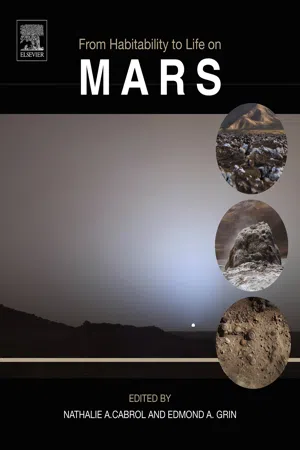
From Habitability to Life on Mars
About this book
From Habitability to Life on Mars explores the current state of knowledge and questions on the past habitability of Mars and the role that rapid environmental changes may have played in the ability of prebiotic chemistry to transition to life. It investigates the role that such changes may have played in the preservation of biosignatures in the geological record and what this means for exploration strategies. Throughout the book, the authors show how the investigation of terrestrial analogs to early Martian habitats under various climates and environmental extremes provide critical clues to understand where, what and how to search for biosignatures on Mars.
The authors present an introduction to the newest developments and state-of-the-art remote and in situ detection strategies and technologies that are being currently developed to support the upcoming ExoMars and Mars 2020 missions. They show how the current orbital and ground exploration is guiding the selection for future landing sites. Finally, the book concludes by discussing the critical question of the implications and ethics of finding life on Mars.
- Edited by the lead on a NASA project that searches for habitability and life on Mars leading to the Mars 2020 mission
- Presents the evidence, questions and answers we have today (including a summary of the current state of knowledge in advance of the ESA ExoMars and NASA Mars 2020 missions)
- Includes contributions from authors directly involved in past, current and upcoming Mars missions
- Provides key information as to how Mars rovers, such as ExoMars and Mars 2020, will address the search for life on Mars with their instrumentation
Information
Topic
Physical SciencesSubtopic
GeophysicsColor Plate 1

Color Plate 2

Chapter 1
Habitability as a Tool in Astrobiological Exploration
Jack D. Farmer
Abstract
While “follow the water” has been an extraordinarily effective strategy in the search for habitable environments in the solar system, astrobiologists will require a more refined approach to exploration during the next phase of exploration when we will begin to target specific habitable sites for deploying a new generation of in situ life detection experiments. Identifying the best sites for in situ experiments or for selecting samples for return to Earth will likely require a more refined knowledge of past and/or present aqueous environments, with an ability to detect HZs at the microscale. Success in detecting extraterrestrial life may require a spatially integrated sampling strategy that includes the ability to measure multiple microenvironmental factors at each study site. Such microscale, multidimensional approaches have been employed in the past by microbial ecologists to refine and quantify biological concepts like the niche. Such approaches may prove useful in more effectively conveying the concept of habitability.
Keywords
Habitability; Astrobiology; Extremophiles; Solar system exploration
1.1 Overview
The exploration strategy currently guiding the search for life in the solar system begins with a short list of the fundamental resources required by terrestrial life. The most important of these requirements is liquid water. Second in importance are sources of biologically essential elements, the so-called CHNOPS elements (required for all living systems), plus a dozen or so transition metals that fulfill important roles in coenzyme functions in cells. Third, life requires sources of energy, obtained through chemical redox reactions. This simple, three-pronged strategy is usually embodied in the phrase “follow the water.” This approach to habitability has served astrobiology well, with recent missions reporting evidence for past and present water on Mars and in the subsurface of tidally heated icy moons (e.g., Enceladus and Europa). While the “follow the water” strategy has proved successful in discovering potentially habitable zones (HZs) of liquid water in these and potentially other extraterrestrial environments, understanding the potential for life to actually develop and persist in these places remains unclear. On Earth, habitability depends on the coexistence of three things: liquid water, energy sources and chemical building blocks. However, it is also clear that, on Earth, life exists within a complex web of ecological interactions that, through evolution, have continually reshaped the origin, nature, and distribution of species. Stated differently, life on Earth is a powerful ecological force that itself shapes habitability.
As a testimonial to the power of eco-evolutionary forces to shape the history of the biosphere, discoveries of extremophiles have revealed that terrestrial life occupies a much broader range of environmental extremes than once thought possible. On planetary surfaces, organisms have evolved metabolic strategies that extract energy from sunlight, over an impressive range of environmental conditions (e.g., temperature, pH, and water activity). Particularly impactful, however, are life forms that do not require sunlight but rather subsist on chemical energy from their surrounding environment. These “chemotrophic” microorganisms are part of an extensive subsurface biosphere that resides in deep subsurface habitats on the Earth. Of particular interest for astrobiological exploration are “chemolithoautotrophic” microorganisms that obtain energy from the chemical by-products of aqueous weathering of mafic crustal rocks. These microbes require no connection to the surface and can exist unseen from surface exploration.
Wh...
Table of contents
- Cover image
- Title page
- Table of Contents
- Copyright
- List of Contributors
- Foreword
- Color Plate 1
- Color Plate 2
- Chapter 1: Habitability as a Tool in Astrobiological Exploration
- Chapter 2: An Origin of Life on Mars?
- Chapter 3: Remote Detection of Phyllosilicates on Mars and Implications for Climate and Habitability
- Chapter 4: Martian Habitability as Inferred From Landed Mission Observations
- Chapter 5: Archean Lakes as Analogues for Habitable Martian Paleoenvironments
- Chapter 6: Evolution of Altiplanic Lakes at the Pleistocene/Holocene Transition: A Window Into Early Mars Declining Habitability, Changing Habitats, and Biosignatures
- Chapter 7: Siliceous Hot Spring Deposits: Why They Remain Key Astrobiological Targets
- Chapter 8: Habitability and Biomarker Preservation in the Martian Near-Surface Radiation Environment
- Chapter 9: UV and Life Adaptation Potential on Early Mars: Lessons From Extreme Terrestrial Analogs
- Chapter 10: Are Recurring Slope Lineae Habitable?
- Chapter 11: The NASA Mars 2020 Rover Mission and the Search for Extraterrestrial Life
- Chapter 12: Searching for Traces of Life With the ExoMars Rover
- Chapter 13: Concluding Remarks: Bridging Strategic Knowledge Gaps in the Search for Biosignatures on Mars—A Blueprint
- Index
Trusted by 375,005 students
Access to over 1.5 million titles for a fair monthly price.
Study more efficiently using our study tools.
Frequently asked questions
Yes, you can cancel anytime from the Subscription tab in your account settings on the Perlego website. Your subscription will stay active until the end of your current billing period. Learn how to cancel your subscription
No, books cannot be downloaded as external files, such as PDFs, for use outside of Perlego. However, you can download books within the Perlego app for offline reading on mobile or tablet. Learn how to download books offline
We are an online textbook subscription service, where you can get access to an entire online library for less than the price of a single book per month. With over 1.5 million books across 990+ topics, we’ve got you covered! Learn about our mission
Look out for the read-aloud symbol on your next book to see if you can listen to it. The read-aloud tool reads text aloud for you, highlighting the text as it is being read. You can pause it, speed it up and slow it down. Learn more about Read Aloud
Yes! You can use the Perlego app on both iOS and Android devices to read anytime, anywhere — even offline. Perfect for commutes or when you’re on the go.
Please note we cannot support devices running on iOS 13 and Android 7 or earlier. Learn more about using the app
Please note we cannot support devices running on iOS 13 and Android 7 or earlier. Learn more about using the app
Yes, you can access From Habitability to Life on Mars by Nathalie A. Cabrol,Edmond A. Grin in PDF and/or ePUB format, as well as other popular books in Physical Sciences & Geophysics. We have over 1.5 million books available in our catalogue for you to explore.