eBook - ePub
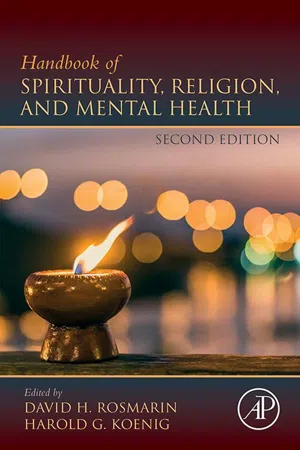
Handbook of Spirituality, Religion, and Mental Health
- 254 pages
- English
- ePUB (mobile friendly)
- Available on iOS & Android
eBook - ePub
Handbook of Spirituality, Religion, and Mental Health
About this book
Research has indicated that spiritual and religious factors are strongly tied to a host of mental health characteristics, in both positive and negative ways. That body of research has significantly grown since publication of the first edition of this book 20 years ago. The seconnd edition of the Handbook of Spirituality, Religion and Mental Health identifies not only whether religion and spirituality influence mental health and vice versa, but also how, why, and for whom. Hence 100% of the book is now revised with new chapters and new contributors. Contents address eight categories of mental disorders, as well as other kay aspects of social, emotional, and behavioral health.
- Provides an authoritative, comprehensive, and updated review of the research on positive and negative effects of spirituality/religion on mental health
- Contains dedicated chapters focused on the relevance of spirituality/religion to mood, anxiety, obsessive-compulsive, psychotic, eating/feeding, alcohol/substance use, behavioral addictions, and pain-related disorders, as well as marriage/family life, suicidality, and end-of-life-care
- Reviews the research on spiritually integrated psychotherapies, and provides basic clinical guidelines for how to effectively address spiritual/religious life in treatment
- Reviews the neurobiology of spiritual/religious experiences as they pertain to mental health
- Covers all major world religions, as well as spiritual identites outside of a religious context
Information
Chapter 1
Spirituality, religion, and mood disorders
Bruno Paz Mosqueiro1, Alexandre de Rezende Pinto2 and Alexander Moreira-Almeida2, 1Postgraduate Program in Psychiatry and Behavioral Sciences (PPGPSQ UFRGS), Universidade Federal do Rio Grande do Sul (UFRGS) and Grupo Hospitalar Conceição, Porto Alegre, RS, Brazil, 2Research Center in Spirituality and Health (NUPES), School of Medicine, Universidade Federal de Juiz de Fora (UFJF), Juiz de Fora, MG, Brazil
Abstract
There is robust evidence that spirituality and religion (S/R) often predict the severity and course of mood disorder symptoms, particularly depression. Effects of S/R on depression are usually positive (i.e. higher levels of S/R are typically associated with lower levels and better recovery from depressive symptoms). Regarding bipolar disorder, the limited evidence available suggests that S/R resources are commonly harnessed by patients, generally with beneficial effects on suicide and quality of life. One of the main mechanisms proposed to explain these relationships is religious coping: Many individuals cope with stressful life events by turning to S/R, which in turn buffers against mood disorder symptoms. Other mechanisms include social support, sense of meaning/purpose, healthy behaviors, and some research has pointed to positive neurobiological effects of S/R on mood disorders. However, there is also consistent evidence to suggest that certain aspects of S/R can also be a source of emotional stress and strain, and thus predict greater symptoms of mood disorders as well as worse quality of life. Perhaps because of these positive and negative relationships, several studies have showed benefits of appropriately incorporating S/R into treatment of mood disorders. This chapter reviews the literature on S/R and mood disorders, and discussed clinical implications of this body of literature.
Keywords
depression; mania; bipolar disorder; religious coping; psychotherapy
Introduction
ruly, it is in the darkness that one finds this light, so when we are in sorrow and distress, then this light is nearest of all to us”
(Eckhart, 1327)
The study of spirituality/religion (S/R) and mental health touches upon questions about profound human needs, involving the search for understanding, meaning, and purpose in the face of suffering, and the search for transcendence across different cultures and in different periods of human history.
Mood disorders, encompassing bipolar and depressive disorders, are currently evidenced as very common and disabling mental illnesses, with serious impact to global health. Major depressive disorder (MDD) affects 300 million people in the world and represents the leading cause of mental health–related diseases worldwide (Herrman et al., 2018). Individuals living with bipolar disorders (BD) experience substantial morbidity and impairment, with an even larger impact in young people, being the sixth leading cause of disability among people aged 10–24 years old in the world (Yatham et al., 2018). The World Mental Health Survey Initiative estimates a lifetime prevalence of BD of around 1.0% (bipolar I and II disorders) and a lifetime prevalence of MDD of 12.8% (Kessler & Bromet, 2013; Merikangas et al., 2011).
S/R represent a very important domain for many, probably most, individuals across different cultures and contexts (Koenig, King, & Carson, 2012). The Pew-Review Templeton Survey identified that 5.8 billion people in the world (84% of the world population) reported a religious affiliation, and for those religious unaffiliated (including atheists, agnostics, and spiritual but not religious people), many held S/R beliefs and practices that often constituted important aspects in their lives (Hackett et al., 2012).
Empirical evidence in the last decades consistently identified mainly positive effects of S/R in mood disorders. S/R beliefs and practices are commonly used coping resources to deal with stressful life events or adversities (Pargament, Koenig, Tarakeshwar, & Hahn, 2004). Furthermore, research indicates that S/R is frequently a source of meaning, resilience, strength, connection, and social support, capable of promoting recovery in many people with MDD and BD. Although less often, S/R may also be a source of conflicts and negative coping (Pargament & Lomax, 2013).
Most patients agreed that health professionals should be sensitive and open to their S/R issues in clinical care (VanderWeele, Balboni, & Koh, 2017). The World Psychiatric Association (WPA) Position Statement on Religion, Spirituality and Psychiatry recommends that S/R should be routinely considered in clinical practice, in a scientifically based, compassionate and culturally sensitive approach (Moreira-Almeida, Sharma, van Rensburg, Verhagen, & Cook, 2016). Understanding how S/R beliefs and practices impact mood disorders, and how to address these issues in a clinical practice, constitutes a central ques...
Table of contents
- Cover image
- Title page
- Table of Contents
- Copyright
- Dedication
- List of contributors
- Foreword
- Introduction
- Chapter 1. Spirituality, religion, and mood disorders
- Chapter 2. Spirituality, religion, and suicide
- Chapter 3. Spirituality, religion, and anxiety disorders
- Chapter 4. Spirituality/religion and obsessive–compulsive-related disorders
- Chapter 5. Spirituality, religion, and psychotic disorders
- Chapter 6. Spirituality, religion, and eating disorders
- Chapter 7. Spirituality/religion and substance use disorders
- Chapter 8. Spirituality/religion and behavioral addictions
- Chapter 9. Spirituality, religion, and marital/family issues
- Chapter 10. Spirituality/religion and pain
- Chapter 11. Spirituality/religion and end-of-life care
- Index
Trusted by 375,005 students
Access to over 1.5 million titles for a fair monthly price.
Study more efficiently using our study tools.
Frequently asked questions
Yes, you can cancel anytime from the Subscription tab in your account settings on the Perlego website. Your subscription will stay active until the end of your current billing period. Learn how to cancel your subscription
No, books cannot be downloaded as external files, such as PDFs, for use outside of Perlego. However, you can download books within the Perlego app for offline reading on mobile or tablet. Learn how to download books offline
Perlego offers two plans: Essential and Complete
- Essential is ideal for learners and professionals who enjoy exploring a wide range of subjects. Access the Essential Library with 800,000+ trusted titles and best-sellers across business, personal growth, and the humanities. Includes unlimited reading time and Standard Read Aloud voice.
- Complete: Perfect for advanced learners and researchers needing full, unrestricted access. Unlock 1.5M+ books across hundreds of subjects, including academic and specialized titles. The Complete Plan also includes advanced features like Premium Read Aloud and Research Assistant.
We are an online textbook subscription service, where you can get access to an entire online library for less than the price of a single book per month. With over 1.5 million books across 990+ topics, we’ve got you covered! Learn about our mission
Look out for the read-aloud symbol on your next book to see if you can listen to it. The read-aloud tool reads text aloud for you, highlighting the text as it is being read. You can pause it, speed it up and slow it down. Learn more about Read Aloud
Yes! You can use the Perlego app on both iOS and Android devices to read anytime, anywhere — even offline. Perfect for commutes or when you’re on the go.
Please note we cannot support devices running on iOS 13 and Android 7 or earlier. Learn more about using the app
Please note we cannot support devices running on iOS 13 and Android 7 or earlier. Learn more about using the app
Yes, you can access Handbook of Spirituality, Religion, and Mental Health by David H. Rosmarin,Harold G. Koenig in PDF and/or ePUB format, as well as other popular books in Psychology & Clinical Psychology. We have over 1.5 million books available in our catalogue for you to explore.