- 1,134 pages
- English
- ePUB (mobile friendly)
- Available on iOS & Android
eBook - ePub
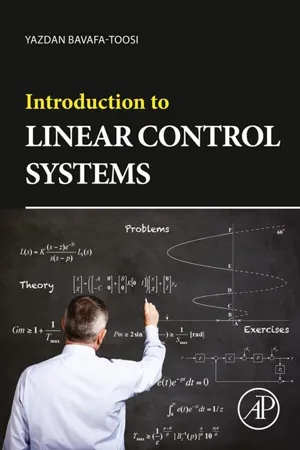
Introduction to Linear Control Systems
About this book
Introduction to Linear Control Systems is designed as a standard introduction to linear control systems for all those who one way or another deal with control systems. It can be used as a comprehensive up-to-date textbook for a one-semester 3-credit undergraduate course on linear control systems as the first course on this topic at university. This includes the faculties of electrical engineering, mechanical engineering, aerospace engineering, chemical and petroleum engineering, industrial engineering, civil engineering, bio-engineering, economics, mathematics, physics, management and social sciences, etc.
The book covers foundations of linear control systems, their raison detre, different types, modelling, representations, computations, stability concepts, tools for time-domain and frequency-domain analysis and synthesis, and fundamental limitations, with an emphasis on frequency-domain methods. Every chapter includes a part on further readings where more advanced topics and pertinent references are introduced for further studies. The presentation is theoretically firm, contemporary, and self-contained. Appendices cover Laplace transform and differential equations, dynamics, MATLAB and SIMULINK, treatise on stability concepts and tools, treatise on Routh-Hurwitz method, random optimization techniques as well as convex and non-convex problems, and sample midterm and endterm exams.
The book is divided to the sequel 3 parts plus appendices.
PART I: In this part of the book, chapters 1-5, we present foundations of linear control systems. This includes: the introduction to control systems, their raison detre, their different types, modelling of control systems, different methods for their representation and fundamental computations, basic stability concepts and tools for both analysis and design, basic time domain analysis and design details, and the root locus as a stability analysis and synthesis tool.
PART II: In this part of the book, Chapters 6-9, we present what is generally referred to as the frequency domain methods. This refers to the experiment of applying a sinusoidal input to the system and studying its output. There are basically three different methods for representation and studying of the data of the aforementioned frequency response experiment: these are the Nyquist plot, the Bode diagram, and the Krohn-Manger-Nichols chart. We study these methods in details. We learn that the output is also a sinusoid with the same frequency but generally with different phase and magnitude. By dividing the output by the input we obtain the so-called sinusoidal or frequency transfer function of the system which is the same as the transfer function when the Laplace variable s is substituted with . Finally we use the Bode diagram for the design process.
PART III: In this part, Chapter 10, we introduce some miscellaneous advanced topics under the theme fundamental limitations which should be included in this undergraduate course at least in an introductory level. We make bridges between some seemingly disparate aspects of a control system and theoretically complement the previously studied subjects.
Appendices: The book contains seven appendices. Appendix A is on the Laplace transform and differential equations. Appendix B is an introduction to dynamics. Appendix C is an introduction to MATLAB, including SIMULINK. Appendix D is a survey on stability concepts and tools. A glossary and road map of the available stability concepts and tests is provided which is missing even in the research literature. Appendix E is a survey on the Routh-Hurwitz method, also missing in the literature. Appendix F is an introduction to random optimization techniques and convex and non-convex problems. Finally, appendix G presents sample midterm and endterm exams, which are class-tested several times.
Information
Subtopic
Automatización en ingenieríaTable of contents
- Cover image
- Title page
- Table of Contents
- Copyright
- Dedication
- Preface
- Acknowledgments
- Part I: Foundations
- Part II: Frequency domain analysis & synthesis
- Part III: Advanced Issues
- Appendices A–G
Trusted by 375,005 students
Access to over 1.5 million titles for a fair monthly price.
Study more efficiently using our study tools.
Frequently asked questions
Yes, you can cancel anytime from the Subscription tab in your account settings on the Perlego website. Your subscription will stay active until the end of your current billing period. Learn how to cancel your subscription
No, books cannot be downloaded as external files, such as PDFs, for use outside of Perlego. However, you can download books within the Perlego app for offline reading on mobile or tablet. Learn how to download books offline
Perlego offers two plans: Essential and Complete
- Essential is ideal for learners and professionals who enjoy exploring a wide range of subjects. Access the Essential Library with 800,000+ trusted titles and best-sellers across business, personal growth, and the humanities. Includes unlimited reading time and Standard Read Aloud voice.
- Complete: Perfect for advanced learners and researchers needing full, unrestricted access. Unlock 1.5M+ books across hundreds of subjects, including academic and specialized titles. The Complete Plan also includes advanced features like Premium Read Aloud and Research Assistant.
We are an online textbook subscription service, where you can get access to an entire online library for less than the price of a single book per month. With over 1.5 million books across 990+ topics, we’ve got you covered! Learn about our mission
Look out for the read-aloud symbol on your next book to see if you can listen to it. The read-aloud tool reads text aloud for you, highlighting the text as it is being read. You can pause it, speed it up and slow it down. Learn more about Read Aloud
Yes! You can use the Perlego app on both iOS and Android devices to read anytime, anywhere — even offline. Perfect for commutes or when you’re on the go.
Please note we cannot support devices running on iOS 13 and Android 7 or earlier. Learn more about using the app
Please note we cannot support devices running on iOS 13 and Android 7 or earlier. Learn more about using the app
Yes, you can access Introduction to Linear Control Systems by Yazdan Bavafa-Toosi in PDF and/or ePUB format, as well as other popular books in Tecnología e ingeniería & Automatización en ingeniería. We have over 1.5 million books available in our catalogue for you to explore.