
eBook - ePub
Tribology of Abrasive Machining Processes
- 600 pages
- English
- ePUB (mobile friendly)
- Available on iOS & Android
eBook - ePub
Tribology of Abrasive Machining Processes
About this book
This book draws upon the science of tribology to understand, predict and improve abrasive machining processes. Pulling together information on how abrasives work, the authors, who are renowned experts in abrasive technology, demonstrate how tribology can be applied as a tool to improve abrasive machining processes.
Each of the main elements of the abrasive machining system are looked at, and the tribological factors that control the efficiency and quality of the processes are described. Since grinding is by far the most commonly employed abrasive machining process, it is dealt with in particular detail.
Solutions are posed to many of the most commonly experienced industrial problems, such as poor accuracy, poor surface quality, rapid wheel wear, vibrations, work-piece burn and high process costs. This practical approach makes this book an essential tool for practicing engineers.
- Uses the science of tribology to improve understanding and of abrasive machining processes in order to increase performance, productivity and surface quality of final products
- A comprehensive reference on how abrasives work, covering kinematics, heat transfer, thermal stresses, molecular dynamics, fluids and the tribology of lubricants
- Authoritative and ground-breaking in its first edition, the 2nd edition includes 30% new and updated material, including new topics such as CMP (Chemical Mechanical Polishing) and precision machining for micro-and nano-scale applications
Information
Part 1
Introduction
1. Introduction
2. Tribosystems of abrasive machining processes
1
Introduction
Chapter Outline
1.1. Abrasive processes
1.1.1. Grinding
1.1.2. Honing
1.1.3. Lapping
1.1.4. Polishing
1.2. Abrasives
1.3. Tribological principles
1.3.1. Two-body abrasion processes
1.3.2. Three-body abrasion processes
1.4. A typical grinding process
1.5. A tribological system
1.5.1. The system concept
1.5.2. Physical mechanisms
1.5.3. Application of abrasive machining tools
1.5.4. Process fluids, tribochemistry, and processed materials
1.5.5. Process trends
References
1.1 Abrasive processes
Abrasive machining processes are manufacturing techniques, which employ very hard granular particles in machining, abrading, or polishing to modify the shape and surface texture of manufactured parts.
A wide range of such processes is mostly used to produce high quality parts to high accuracy and to close tolerances. Examples range from very large parts such as machine slideways to small parts such as contact lenses, needles, electronic components, silicon wafers, and ball bearings.
While accuracy and surface texture requirements are a common reason for selecting abrasive processes, there is another common reason. Abrasive processes are the natural choice for machining and finishing hard materials and hardened surfaces.
Most abrasive processes may be categorized into one of four groups: (i) grinding, (ii) honing, (iii) lapping, and (iv) polishing.
This is not an exhaustive list, but the four groups cover a wide range of processes, which are sufficient for a study of fundamental characteristics of these processes. These four groups are illustrated in Figure 1.1. Grinding and honing are processes which employ bonded or fixed abrasives within the abrasive tool, whereas lapping and polishing employ free abrasive particles, often suspended in a liquid or wax medium.
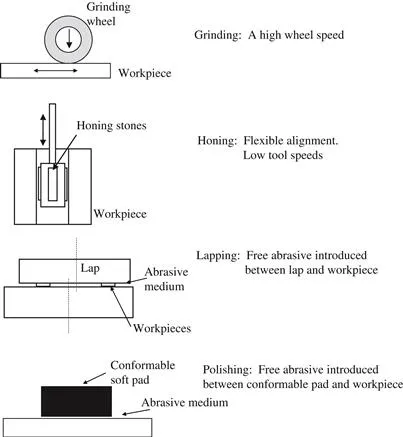
Figure 1.1 Basic principles of grinding, honing, lapping, and polishing.
1.1.1 Grinding
In grinding, the abrasive tool is a grinding wheel, which moves at a high surface speed compared to other machining processes, such as milling and turning. Surface speeds are typically in the range from 20 m/s (4000 ft/min) to 45 m/s (9000 ft/min) in conventional grinding. The grinding wheel consists of abrasive grains bonded together by a softer bonding material, such as vitrified or glassy bonding material, resinoid or plastic material, or metal. The behavior of these different types of abrasive tools differs greatly as described in later chapters.
In high-speed grinding, the wheel moves at speeds up to 140 m/s with wheels especially designed to withstand the high bursting stresses. Speeds greatly in excess of 140 m/s may be employed, but the proportion of applications at such speeds is small due to the expense and sophistication of the machines and techniques involved.
Although grinding can take place without lubrication, wet grinding is preferred wherever possible due to the reduced frictional losses and improved quality of the surfaces produced. Commonly used lubricants include oil in water emulsions and neat oils.
1.1.2 Honing
In honing, the abrasive particles, or grains as they are commonly known, are fixed in a bonded tool as in grinding. The honing process is mainly used to achieve a finished surface in the bore of a cylinder. The honing stones are pressurized radially outward against the bore. Honing is different from grinding in two ways.
First, in honing, the abrasive tool moves at a low speed relative to the workpiece. Typically, the surface speed is 0.2–2 m/s. Combined rotation and oscillation movements of the tool are designed to average out the removal of material over the surface of the workpiece and produce a characteristic “crosshatch” pattern favored for oil retention in engine cylinder bores.
Another difference between honing and grinding is that a honing tool is flexibly aligned to the surface of the workpiece. This means that eccentricity of the bore relative to an outside diameter cannot be corrected.
1.1.3 Lapping
In lapping, free abrasive is introduced between a lap, which may be a cast iron plate, and the workpiece surface. The free abrasive is usually suspended in a liquid medium, such as oil, providing lubrication and helping to transport the abrasive. The lap and the abrasive are both subject to wear. To maintain the required geometry of the lap and of the workpiece surface produced, it is necessary to pay careful attention to the nature of the motions involved to average out the wear across the surface of the lap. Several laps may be employed and periodically interchanged to assist this process.
1.1.4 Polishing
Polishing, like lapping, also employs free abrasive. In this case, pressure is applied on the abrasive through a conformable pad or soft cloth. This allows the abrasive to follow the contours of the workpiece surface and limits the penetration of individual grains into the surface. Polishing with a fine abrasive is a very gentle abrasive action between the grains and the workpiece, thus ensuring a very small scratch depth.
The main purpose of polishing is to modify the surface texture rather than the shape. Highly reflective mirror surfaces can be produced by polishing. Material is removed at a very low rate. Consequently, the geometry of the surface needs to conform to the correct shape or very close to the correct shape before polishing is commenced.
1.2 Abrasives
In all four classes of abrasive machining processes, the abrasive grain is harder than the workpiece at the point of interaction. This means that the grain must be harder than the workpiece at the temperature of the interaction. Since these temperatures of short duration can be...
Table of contents
- Cover image
- Title page
- Table of Contents
- Copyright
- Preface to the first edition
- Preface to the second edition
- About the authors
- Part 1: Introduction
- Part 2: Physical Mechanisms
- Part 3: Application of Abrasive Tools
- Part 4: Process Fluids, Tribo-chemistryand Materials
- Symbols and units
- Glossary
- Index
Trusted by 375,005 students
Access to over 1.5 million titles for a fair monthly price.
Study more efficiently using our study tools.
Frequently asked questions
Yes, you can cancel anytime from the Subscription tab in your account settings on the Perlego website. Your subscription will stay active until the end of your current billing period. Learn how to cancel your subscription
No, books cannot be downloaded as external files, such as PDFs, for use outside of Perlego. However, you can download books within the Perlego app for offline reading on mobile or tablet. Learn how to download books offline
Perlego offers two plans: Essential and Complete
- Essential is ideal for learners and professionals who enjoy exploring a wide range of subjects. Access the Essential Library with 800,000+ trusted titles and best-sellers across business, personal growth, and the humanities. Includes unlimited reading time and Standard Read Aloud voice.
- Complete: Perfect for advanced learners and researchers needing full, unrestricted access. Unlock 1.5M+ books across hundreds of subjects, including academic and specialized titles. The Complete Plan also includes advanced features like Premium Read Aloud and Research Assistant.
We are an online textbook subscription service, where you can get access to an entire online library for less than the price of a single book per month. With over 1.5 million books across 990+ topics, we’ve got you covered! Learn about our mission
Look out for the read-aloud symbol on your next book to see if you can listen to it. The read-aloud tool reads text aloud for you, highlighting the text as it is being read. You can pause it, speed it up and slow it down. Learn more about Read Aloud
Yes! You can use the Perlego app on both iOS and Android devices to read anytime, anywhere — even offline. Perfect for commutes or when you’re on the go.
Please note we cannot support devices running on iOS 13 and Android 7 or earlier. Learn more about using the app
Please note we cannot support devices running on iOS 13 and Android 7 or earlier. Learn more about using the app
Yes, you can access Tribology of Abrasive Machining Processes by Ioan D. Marinescu,W. Brian Rowe,Boris Dimitrov,Hitoshi Ohmori in PDF and/or ePUB format, as well as other popular books in Technology & Engineering & Industrial Engineering. We have over 1.5 million books available in our catalogue for you to explore.