eBook - ePub
Rare Earth and Transition Metal Doping of Semiconductor Materials
Synthesis, Magnetic Properties and Room Temperature Spintronics
- 470 pages
- English
- ePUB (mobile friendly)
- Available on iOS & Android
eBook - ePub
Rare Earth and Transition Metal Doping of Semiconductor Materials
Synthesis, Magnetic Properties and Room Temperature Spintronics
About this book
Rare Earth and Transition Metal Doping of Semiconductor Material explores traditional semiconductor devices that are based on control of the electron's electric charge.
This book looks at the semiconductor materials used for spintronics applications, in particular focusing on wide band-gap semiconductors doped with transition metals and rare earths. These materials are of particular commercial interest because their spin can be controlled at room temperature, a clear opposition to the most previous research on Gallium Arsenide, which allowed for control of spins at supercold temperatures.
Part One of the book explains the theory of magnetism in semiconductors, while Part Two covers the growth of semiconductors for spintronics. Finally, Part Three looks at the characterization and properties of semiconductors for spintronics, with Part Four exploring the devices and the future direction of spintronics.
- Examines materials which are of commercial interest for producing smaller, faster, and more power-efficient computers and other devices
- Analyzes the theory behind magnetism in semiconductors and the growth of semiconductors for spintronics
- Details the properties of semiconductors for spintronics
Information
Topic
Physical SciencesSubtopic
Quantum TheoryPart One
Theory of magnetism in III-V semiconductors
1
Computational nanomaterials design for nanospintronics
Room-temperature spintronics applications
H. Katayama-Yoshida, K. Sato, T. Fukushima, A. Masago, and M. Seike Osaka University, Osaka, Japan
Abstract
This chapter describes the current status of the computational nanomaterial design: the room-temperature spintronics applications in 3d-transition-metal-doped dilute magnetic semiconductors (DMS), d0 ferromagnetism in nontransition-metal and defect-doped DMS, and rare-earth-metal-doped semiconductors including the efficient (linear and circular-polarized) light-emitting diodes based upon the codoping methods. On the basis of ab initio electronic structure calculations, we propose the ferromagnetic mechanisms and magnetic-control methods, and design the spintronics materials by controlling the magnetic interactions upon the impurities codoping and the electric-field gating. The multihierarchical simulations of ab initio calculations for magnetism and the Monte Carlo simulations provide accurate estimation of Curie temperatures (TC) of DMS. Using the self-organized spinodal nanodecomposition in two-dimensional (2D) and three-dimensional (3D) crystal growth conditions, we design 2D Konbu phases and 3D Dairiseki phases, which are promising candidates for the room-temperature spintronics applications with the high-blocking temperature in the nanomagnets and high-efficiency luminescent centers. We can expect high-TC Dairiseki phase in DMS by the 3D spinodal nanodecomposition, where the ferromagnetic percolation path increases dramatically upon the spinodal nanodecomposition if the concentration of the transition metal is above the percolation limit. The comparisons of our design and predictions with the available experimental data are presented.
Keywords
Codoping; Curie temperature; d0 ferromagnetism; Dairiseki phase; Konbu phase; Light-emitting diodes; Spinodal decomposition; Superparamagnetism; Zener's double-exchange interaction; Zener's p-d exchange interaction1.1. Introduction
Electrons are always carrying the charge (e−), electron mass (me), and spin (S = 1/2) that are caused by the relativistic quantum mechanics. The e− of electron can carry the charge current (electric and magnetic fields), the me of electron can carry the heat (kinetic energy), and the S can carry the spin current (angular momentum) in the condensed matter (see Fig. 1.1). Today's consumer electronics strongly depends on the achievements in silicon-based microelectronics that enable a high degree of system integration based on Si-CMOS technology. However, this technology will reach its limits in terms of energy consumption and system integration by around 2020. To go beyond these limitations, we need to develop, for instance, more energy-efficient (nonvolatile), high-speed (THz), and higher-density (Tbit/Inch2) nanoscale-size system-integrated devices that utilize the spin property of the charged carriers (spintronics), as schematically depicted in Fig. 1.1. Other technologies that have been proposed to overcome the limitation of Si-CMOS technology are moltronics (molecular-electronics), quantronics (quantum-electronics), and atomtronics (atom-switching electronics) [1–4].
In parallel to the to these new classes of electronics, we also need to develop bottom-up nanotechnology to fabricate the functional nanosuperstructures, including self-organized nanocrystal growth methods as alternatives to the top-down nanotechnology such as Si-CMOS-based nanolithography. In this chapter, we propose the self-organized nanosuperstructure fabrication method based on the spinodal nanotechnology by controlling the dimensionality (2D or 3D) of the crystal growth. We discuss the design and realization of Konbu phase by 2D crystal growth and Dairiseki phase by 3D crystal growth conditions, combined with the shape controlled by vapor pressure modulation.
The most probable candidate for the new class of electronics to go beyond the limitation of Si-CMOS technology is semiconductor nanospintronics, by combining the spin- and charge-degree of freedoms based on the already exciting semiconductor nanotechnology. This was developed during the last half-century and is now very sophisticated, where we can control the spin–spin interaction by electric-field gating combined with the fabrication method of Si-CMOS technology and spin-degree of freedom. However, we need the realistic semiconductor nanospintronics materials for devices that should have the super-high Curie temperature (TC) > 1000 K in order to avoid the spin fluctuation and the instability of the magnetization caused by the weak magneto-crystal anisotropy or shape anisotropy at the room temperature (T = 300 K) for the realization of realistic semiconductor nanospintronics for industrial applications. For the realization of semiconductor nanospintronics, we should design and realize (1) the super-high- TC ferromagnetic semiconductors (TC > 1000 K) in which we can control the spin–spin interaction from ferromagnetic to antiferromagnetic (or paramagnetic) by the electric-field gating, or (2) the superparamagnetic nanostructure materials with super-high blocking temperature (TB > 1000 K) caused by the magneto-crystal anisotropy or shape anisotropy in which we can control the magnetic spin–spin interaction from ferromagnetic to paramagnetic in the nanosuperstructures of magnetic semiconductors by the electric-field gating (see Fig. 1.2).
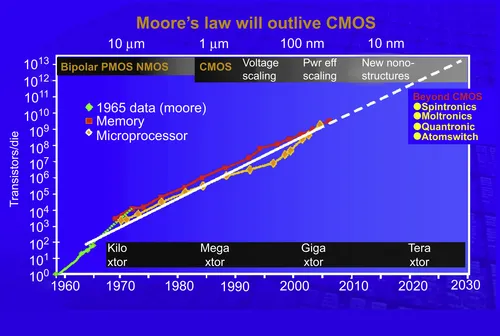
Figure 1.1 Illustration of Gordon Moore's law for Si-CMOS-based semiconductor memory and microprocessor. Past progress of memory and microprocessor is based on this law. Around 2020, Si-CMOS technology is reaching the dead-end and physical fabrication limits on energy consumption and the size effect in the electric-field gating. The candidate to go beyond the Si-CMOS technology may be spintronics, moltronics, quantronics, or atomtronics.
To design and realize these nanospintronics materials based on ab initio electronic structure calculation and multiscale simulation for the design and fabrication of self-organized nanosuperstructures, semiconductor nanospintronics materials, and also nanospintronics devices, we have developed the Computational Nano...
Table of contents
- Cover image
- Title page
- Table of Contents
- Related titles
- Copyright
- List of contributors
- Woodhead Publishing Series in Electronic and Optical Materials
- Part One. Theory of magnetism in III-V semiconductors
- Part Two. Magnetic semiconductors based on rare earth/transition metals
- Part Three. Properties of magnetic semiconductors for spintronics
- Index
Trusted by 375,005 students
Access to over 1.5 million titles for a fair monthly price.
Study more efficiently using our study tools.
Frequently asked questions
Yes, you can cancel anytime from the Subscription tab in your account settings on the Perlego website. Your subscription will stay active until the end of your current billing period. Learn how to cancel your subscription
No, books cannot be downloaded as external files, such as PDFs, for use outside of Perlego. However, you can download books within the Perlego app for offline reading on mobile or tablet. Learn how to download books offline
Perlego offers two plans: Essential and Complete
- Essential is ideal for learners and professionals who enjoy exploring a wide range of subjects. Access the Essential Library with 800,000+ trusted titles and best-sellers across business, personal growth, and the humanities. Includes unlimited reading time and Standard Read Aloud voice.
- Complete: Perfect for advanced learners and researchers needing full, unrestricted access. Unlock 1.5M+ books across hundreds of subjects, including academic and specialized titles. The Complete Plan also includes advanced features like Premium Read Aloud and Research Assistant.
We are an online textbook subscription service, where you can get access to an entire online library for less than the price of a single book per month. With over 1.5 million books across 990+ topics, we’ve got you covered! Learn about our mission
Look out for the read-aloud symbol on your next book to see if you can listen to it. The read-aloud tool reads text aloud for you, highlighting the text as it is being read. You can pause it, speed it up and slow it down. Learn more about Read Aloud
Yes! You can use the Perlego app on both iOS and Android devices to read anytime, anywhere — even offline. Perfect for commutes or when you’re on the go.
Please note we cannot support devices running on iOS 13 and Android 7 or earlier. Learn more about using the app
Please note we cannot support devices running on iOS 13 and Android 7 or earlier. Learn more about using the app
Yes, you can access Rare Earth and Transition Metal Doping of Semiconductor Materials by Volkmar Dierolf,Ian Ferguson,John M Zavada in PDF and/or ePUB format, as well as other popular books in Physical Sciences & Quantum Theory. We have over 1.5 million books available in our catalogue for you to explore.