eBook - ePub
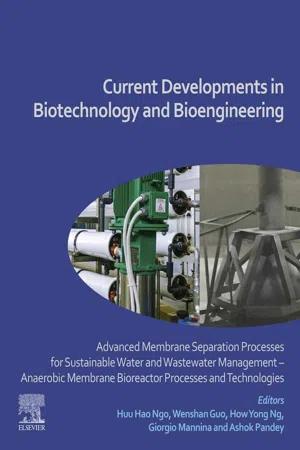
Current Developments in Biotechnology and Bioengineering
Advanced Membrane Separation Processes for Sustainable Water and Wastewater Management – Anaerobic Membrane Bioreactor Processes and Technologies
- 432 pages
- English
- ePUB (mobile friendly)
- Available on iOS & Android
eBook - ePub
Current Developments in Biotechnology and Bioengineering
Advanced Membrane Separation Processes for Sustainable Water and Wastewater Management – Anaerobic Membrane Bioreactor Processes and Technologies
About this book
Current Developments in Biotechnology and Bioengineering: Advanced Membrane Separation Processes for Sustainable Water and Wastewater Management –Anaerobic Membrane Bioreactor Processes and Technologies gives an up-to-date review on research developments of AnMBR systems (including hybrid systems) in wastewater treatment in terms of pollutants removal, nutrients recovery and energy production, as well as the achievement of energy efficiency of the process itself. The current challenges that hinder the application and industrialization of AnMBR technology, knowledge gaps and future research perspectives are also explained and discussed with potential strategies for solving problems.
The book is a potential resource for engineers, scientists, educators, students and general public to understand the current developments and future prospects in field of AnMBR research.
- Covers different aspects of AnMBR in wastewater treatment, such as fundamental knowledge, process design and evaluation, operation and optimization and applications
- Focuses on different AnMBR configurations and systems/hybrid systems in treating a large variety of wastewaters
- Provides state-of-the-art technology development of AnMBR technology, advantages and challenges, as well as the strategies to overcome the limitations
- Includes AnMBR technology in removing the priority substances (PSs) and emerging contaminants of environmental concern, as well as an evaluation of energy potentials in wastewater treatment
Information
1
Anaerobic membrane bioreactors—An introduction
Wenshan Guo; Mohd Atiqueuzzaman Khan; Huu Hao Ngo; Md Abu Hasan Johir; Long D. Nghiem; Bing-jie Ni Centre for Technology in Water and Wastewater, School of Civil and Environmental Engineering, University of Technology Sydney, ULTIMO, NSW, Australia
Abstract
Anaerobic membrane bioreactors (AnMBRs) have been widely employed for treating waste streams from different sources. The current application of AnMBR is limited due to a variety of technical issues, limited product recovery, and energy intensive operation. The conventional design of the AnMBR is currently unable to remove a wide range of emerging pollutants and nutrients from waste streams. Additionally, the major AnMBR product—methane—has been identified as endangering the environment. In most AnMBR systems, the energy recovered from producing methane has not exceeded the energy requirement of the AnMBR. However, more recent developments in this field have improved the overall performance and energy efficiency significantly. The most recent developments include design modifications, integration of physical/chemical separation processes, and bioelectrochemical systems (BES) in comparison to the traditional single-stage design. Research on controlling membrane fouling has also contributed to improvements in the performance of AnMBRs.
Keywords
Anaerobic membrane bioreactors; Status and development; Design modification; Integrated system; Membrane fouling control
1 Introduction
Resource recovery, low-energy requirement, and effective removal of a wide range of pollutants are the major advantages of using anaerobic membrane bioreactors (AnMBR) technology. It involves the utilization of waste materials in energy production, and at the same time removes nonbiodegradable components from different waste streams. Over the past few years, this technology has been extensively studied for improving performance and enhanced product recovery. Although the findings under lab-scale operations have shown much promise, not all of these have been replicated in full-scale operations due to important economic considerations.
A conventional AnMBR design involves a combination of anaerobic digestion and membrane separation technology. The anaerobic digestion process helps to degrade the organic materials and nutrients in the waste stream, coupled with the membrane process, which separates the remaining pollutants left after biological degradation. Hydrolysis, acidogenesis, acetogenesis, and methanogenesis are the four major stages of anaerobic digestion. These are illustrated in Fig. 1.

The current focus on product recovery from the AnMBR is mainly a biogas containing methane and carbon dioxide. The production of biogas depends on the reaction rate in various anaerobic stages, bioreactors’ operating conditions, and above all the concentration of intermediate compounds like volatile fatty acids (VFA) and biohydrogen. Most recently, alternative AnMBR models have proven that they are technically able to produce VFA or biohydrogen, but the application of these models in the full-scale scenarios is still limited [1, 2].
Currently, the overall energy efficiency of the AnMBR system has improved significantly through the introduction of bioelectrochemical systems (BES). The energy produced by hybrid AnMBR systems integrated with microbial fuel cell (MFC) or microbial electrolysis cell (MEC) has exceeded the total energy requirement of the AnMBR. Design modifications like pretreatment methods, multiple stage design, and particle spurging have contributed to improving the resource recovery, and AnMBR operating issues like membrane fouling and process inhibition. However, the environmental impacts caused by the current AnMBR designs are significantly high. Both methane and carbon dioxide produced from the AnMBR are greenhouse gasses that increase the problem of global warming. Additionally, the negative environmental impacts caused by dissolved methane have also been overlooked in current AnMBR operations.
Different pre- and post-treatment processes have been effective in increasing the hydrolysis of organic components in the feed solution of the AnMBR. This has helped improve the percentage of methane in the final biogas produced. Posttreatment methods applied to capture dissolved methane have contributed to improving both the product recovery, and reduced the environmental impacts of an AnMBR at the same time. However, only a limited number of research studies have addressed the issue of reducing the initial cost of installation of the AnMBR [2]. This chapter discusses the current issues, and the most recent developments that have evolved over the last few years in AnMBR technology. Energy consumption, product revenue along with the technical and environmental issues are discussed in the first part of this chapter. The second half contains mainly design modifications, improvements in pollutant removal, and the latest developments in membrane fouling control.
2 The current status of AnMBRs
The current status of AnMBR technology can be evaluated by focusing on the technical efficiency of performance in terms of product recovery, pollutants removal, and energy efficiency. Anaerobic digestion is a slow process and the overall efficiency of this process depends on the microbial activities related to biodegradation of organic pollutants. Different inhibiting factors are still active; these affect to a great extent the overall efficiency of the anaerobic process. Additionally, the product and resource recovery along with the energy consumption are discussed in this section.
2.1 Technical status
AnMBR technology includes the provision of waste treatment and energy recovery at the same time. Common organic substances, nutrients, and trace pollutants are removed through this process from the waste solution originating from different sources. Research has demonstrated that current AnMBRs have already achieved high COD removal efficiencies. For nitrogen and phosphorus removal, there is still room for improvement as the conventional design does not include the removal of phosphates and ammonium. Chemical additives have significantly improved COD removal performance and biogas production for this process. For example, FeCl3 has been experimented on in a pilot-scale AnMBR where the COD removal efficiency increased from 79.9% to 93.7% [2, 3]. Aggregation of soluble organic materials is one of the positive impacts caused by adding Fe in anaerobic process where the aggregated components are retained by the membrane module. Addition of Fe also increases the cell metabolism and enzymic activities of anaerobic microorganisms that improves the biodegradation of organic components during treatment of any waste streams. AnMBR technology is generally favored over the aerobic counterparts that can only produce small quantities of biosolids. A typical AnMBR can produce biosolids in a range between 0.16 and 0.46 g VSS/g CODremoved [2, 3]. For example, adding coagulants like FeCl3 can actually increase the production of biosolids. The problem can be more severe in treating toxic organic waste streams that are not biodegradable through anaerobic digestion [3].
However, the lack of efficiency with the current AnMBR system in treating different organic and pharmaceutical components still remains. The removal efficiency of pharmaceutical components...
Table of contents
- Cover image
- Title page
- Table of Contents
- Copyright
- Contributors
- Editors biography
- Preface
- 1: Anaerobic membrane bioreactors—An introduction
- 2: Anaerobic membrane bioreactors: Basic process design and operation
- 3: Challenges and opportunities for anaerobic membrane bioreactors
- 4: Biofouling management in anaerobic membrane bioreactors
- 5: Advanced anaerobic membrane bioreactors: Performance enhancers and their hybrid systems
- 6: Anaerobic membrane bioreactors for domestic wastewater treatment
- 7: Anaerobic membrane bioreactors for industrial wastewater treatment
- 8: Anaerobic membrane bioreactors for emerging pollutants removal
- 9: Anaerobic membrane bioreactors for antibiotic wastewater treatment
- 10: Anaerobic osmotic membrane bioreactor for wastewater treatment and reclamation
- 11: Anaerobic dynamic membrane bioreactors (AnDMBRs) for wastewater treatment
- 12: Nutrient recovery in anaerobic membrane bioreactors
- 13: Energy production in anaerobic membrane bioreactors: Opportunities and challenges
- 14: Anaerobic membrane bioreactors for sustainable and energy-efficient municipal wastewater treatment
- 15: Anaerobic membrane reactors for biohydrogen production
- Index
Trusted by 375,005 students
Access to over 1.5 million titles for a fair monthly price.
Study more efficiently using our study tools.
Frequently asked questions
Yes, you can cancel anytime from the Subscription tab in your account settings on the Perlego website. Your subscription will stay active until the end of your current billing period. Learn how to cancel your subscription
No, books cannot be downloaded as external files, such as PDFs, for use outside of Perlego. However, you can download books within the Perlego app for offline reading on mobile or tablet. Learn how to download books offline
Perlego offers two plans: Essential and Complete
- Essential is ideal for learners and professionals who enjoy exploring a wide range of subjects. Access the Essential Library with 800,000+ trusted titles and best-sellers across business, personal growth, and the humanities. Includes unlimited reading time and Standard Read Aloud voice.
- Complete: Perfect for advanced learners and researchers needing full, unrestricted access. Unlock 1.5M+ books across hundreds of subjects, including academic and specialized titles. The Complete Plan also includes advanced features like Premium Read Aloud and Research Assistant.
We are an online textbook subscription service, where you can get access to an entire online library for less than the price of a single book per month. With over 1.5 million books across 990+ topics, we’ve got you covered! Learn about our mission
Look out for the read-aloud symbol on your next book to see if you can listen to it. The read-aloud tool reads text aloud for you, highlighting the text as it is being read. You can pause it, speed it up and slow it down. Learn more about Read Aloud
Yes! You can use the Perlego app on both iOS and Android devices to read anytime, anywhere — even offline. Perfect for commutes or when you’re on the go.
Please note we cannot support devices running on iOS 13 and Android 7 or earlier. Learn more about using the app
Please note we cannot support devices running on iOS 13 and Android 7 or earlier. Learn more about using the app
Yes, you can access Current Developments in Biotechnology and Bioengineering by Huu Hao Ngo,Wenshan Guo,How Yong Ng,Giorgio Mannina,Ashok Pandey in PDF and/or ePUB format, as well as other popular books in Technology & Engineering & Chemical & Biochemical Engineering. We have over 1.5 million books available in our catalogue for you to explore.