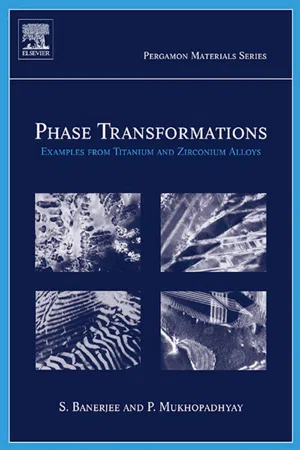
eBook - ePub
Phase Transformations
Examples from Titanium and Zirconium Alloys
- 840 pages
- English
- ePUB (mobile friendly)
- Available on iOS & Android
eBook - ePub
Phase Transformations
Examples from Titanium and Zirconium Alloys
About this book
The terms phase transitions and phase transformations are often used in an interchangeable manner in the metallurgical literature.
In Phase Transformations, transformations driven by pressure changes, radiation and deformation and those occurring in nanoscale multilayers are brought to the fore. Order-disorder transformations, many of which constitute very good examples of continuous transformations, are dealt with in a comprehensive manner.
Almost all types of phase transformations and reactions that are commonly encountered in inorganic materials are covered and the underlying thermodynamic, kinetic and crystallographic aspects elucidated.
- Shows readers the advancements in the field - due to enhanced computing power and superior experimental capability
- Drawing upon the background and the research experience of the authors, bringing together a wealth of experience
- Written essentially from a physical metallurgists view point
Information
Chapter 7
Diffusional Transformations
List of Symbols
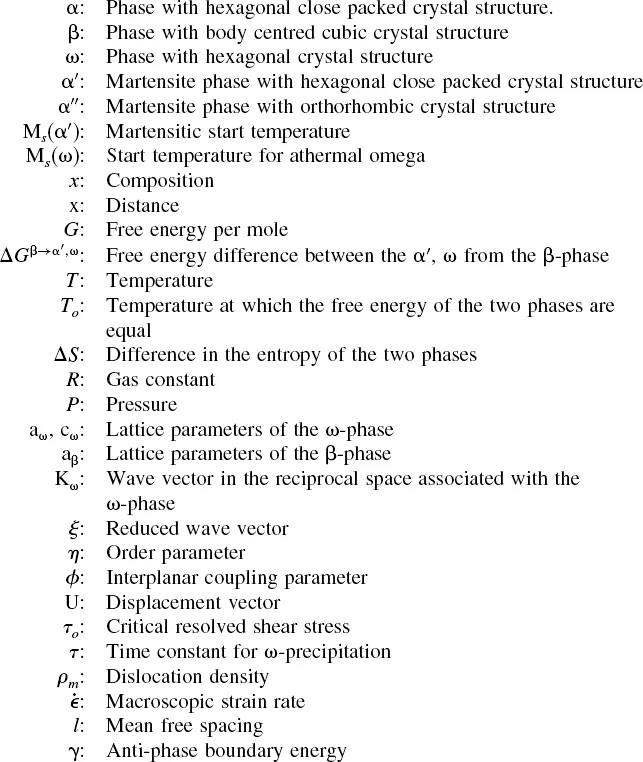
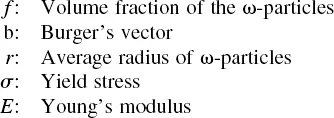
7.1 Introduction
Diffusion of atoms plays a dominant role in a variety of phase transformations in alloys, intermetallics and ceramics. As pointed out in Chapter 2, diffusional transformations can be further classified into several types, primarily on the basis of the diffusion distances involved in these. One may ask whether there is any special reason for studying diffusional transformations in Ti- and Zr-based systems in the context of gaining an understanding of this class of transformations, in general. The answer to such a question is strongly affirmative in view of the following points:
(1) Nearly all types of diffusional transformations are encountered in Ti- and Zr-based metallic and ceramic systems.
(2) As will be shown in this chapter, the β → α transformation in Ti- and Zr-based alloys essentially follows the Burgers orientation relation, irrespective of whether the transformation is diffusional or martensitic. Therefore, these systems offer a unique opportunity for making a comparison between the characteristic features of transformations occurring by martensitic and diffusional mechanisms. Crystallographic and morphological details, thermodynamic and kinetic information and a knowledge of the nature of interface structures in relation to the β → a transformation are all available for both martensitic and diffusional transformations. A comparative study of these, therefore, leads to a better understanding of the mechanism of such transformations in general.
(3) The α/β interfaces in Ti- and Zr-based alloys have proved to be considerably more amenable to detailed TEM investigations than such interfaces in many other alloy systems.
(4) Diffusion of substitutional atoms in the β-phase exhibits an anomalous behaviour, due to which some of these transformations are seen to occur at unusually fast rates. Such transformations are somewhat unique and are not generally encountered in other alloy systems.
(5) Precipitation reactions in ceramics have been studied most exhaustively in those based on ZrO2. It is, therefore, very suitable as a prototype system for studying diffusional transformations in ceramics.
(6) The issue of the participation of shear in several hybrid diffusional–displacive transformations has attracted renewed attention in current literature. Transformations in some Ti- and Zr-based systems exhibit novel features and provide new insight in connection with such hybrid processes.
The wide variety of diffusional transformations in these systems and the depth of understanding achieved through numerous studies undertaken on them have made this field quite fascinating as will be illustrated in this chapter. The first section of this chapter focuses on the phenomenon of diffusion in the α- and the β-phases, including anomalous diffusion in the latter, and interdiffusion in different alloy systems. The general principles pertaining to the formation of intermetallic compounds and intermediate phases, either equilibrium or metastable, in the interdiffusion zones of diffusion couples of dissimilar metals have been discussed. The applications of these general principles in rationalizing the formation of intermediate phases in diffusion couples between Zr or Ti on one side and Al, Ni or Fe on the other have been addressed.
The tendency towards phase separation in the β-phase field is a controlling factor in a number of phase reactions such as spinodal decomposition in the β-phase, monotectoid reactions, tempering of martensite and even in α- or ω-precipitation in a β-matrix. All these aspects will be covered under the section on phase separation.
The precipitation of α-plates in the β-matrix has been a subject of a number of studies, primarily due to the adherence to the orientation relation between the two phases and to the simple nature of the α/β interface. Different morphological variations of the α-plates are described and the mechanisms involved in their formation are discussed. The importance of the invariant line strain in dictating the growth direction has been duly emphasized.
Massive transformations occur in a number o...
Table of contents
- Cover image
- Title page
- Table of Contents
- Pergamon Materials Series
- Front Matter
- Copyright page
- Dedication
- Foreword
- Preface
- Acknowledgements
- Phases and Crystal Structures
- Classification of Phase Transformations
- Solidification, Vitrification, Crystallization and Formation of Quasicrystalline and Nanocrystalline Structures
- Martensitic Transformations
- Ordering in Intermetallics
- Transformations Related to Omega Structures
- Diffusional Transformations
- Interstitial Ordering
- Epilogue
- Index
Trusted by 375,005 students
Access to over 1.5 million titles for a fair monthly price.
Study more efficiently using our study tools.
Frequently asked questions
Yes, you can cancel anytime from the Subscription tab in your account settings on the Perlego website. Your subscription will stay active until the end of your current billing period. Learn how to cancel your subscription
No, books cannot be downloaded as external files, such as PDFs, for use outside of Perlego. However, you can download books within the Perlego app for offline reading on mobile or tablet. Learn how to download books offline
Perlego offers two plans: Essential and Complete
- Essential is ideal for learners and professionals who enjoy exploring a wide range of subjects. Access the Essential Library with 800,000+ trusted titles and best-sellers across business, personal growth, and the humanities. Includes unlimited reading time and Standard Read Aloud voice.
- Complete: Perfect for advanced learners and researchers needing full, unrestricted access. Unlock 1.5M+ books across hundreds of subjects, including academic and specialized titles. The Complete Plan also includes advanced features like Premium Read Aloud and Research Assistant.
We are an online textbook subscription service, where you can get access to an entire online library for less than the price of a single book per month. With over 1.5 million books across 990+ topics, we’ve got you covered! Learn about our mission
Look out for the read-aloud symbol on your next book to see if you can listen to it. The read-aloud tool reads text aloud for you, highlighting the text as it is being read. You can pause it, speed it up and slow it down. Learn more about Read Aloud
Yes! You can use the Perlego app on both iOS and Android devices to read anytime, anywhere — even offline. Perfect for commutes or when you’re on the go.
Please note we cannot support devices running on iOS 13 and Android 7 or earlier. Learn more about using the app
Please note we cannot support devices running on iOS 13 and Android 7 or earlier. Learn more about using the app
Yes, you can access Phase Transformations by Srikumar Banerjee,Pradip Mukhopadhyay in PDF and/or ePUB format, as well as other popular books in Technology & Engineering & Physical & Theoretical Chemistry. We have over 1.5 million books available in our catalogue for you to explore.