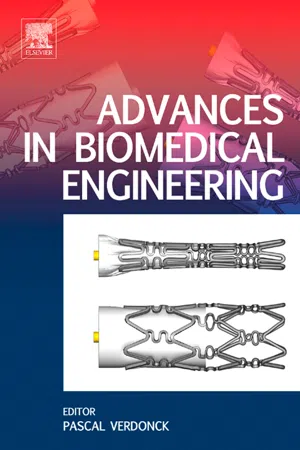
- 320 pages
- English
- ePUB (mobile friendly)
- Available on iOS & Android
eBook - ePub
Advances in Biomedical Engineering
About this book
The aim of this essential reference is to bring together the interdisciplinary areas of biomedical engineering education. Contributors review the latest advances in biomedical engineering research through an educational perspective, making the book useful for students and professionals alike. Topics range from biosignal analysis and nanotechnology to biophotonics and cardiovascular medical devices.
- Provides an educational review of recent advances
- Focuses on biomedical high technology
- Features contributions from leaders in the field
Information
Chapter 1. Review of Research in Cardiovascular Devices
This chapter has been illustrated with the experimental data obtained in the Institute of Heart Prostheses, FCSD, Zabrze. The research was supported by the Polish State Committee for Scientific Research and Foundation. The author thanks his numerous collaborators, including R. Kustosz, M. Koźlak, P. Kostka, Z. Małota, L. Podsędkowski, Z. Religa, and M. Jakubowski (special thanks for excellent photography), who prepared the artwork of this chapter.
An explosion in multidisciplinary research, combining mechanical, chemical, and electrical engineering with physiology and medicine, during the 1960s created huge advances in modern health care. In cardiovascular therapy, lifesaving implantable defibrillators, ventricular assist devices, catheter-based ablation devices, vascular stent technology, and cell and tissue engineering technologies have been introduced. The latest and leading technology presents robots intended to keep the surgeon in the most comfortable, dexterous, and ergonomic position during the entire procedure. The branch of the medical and rehabilitation robotics includes the manipulators and robots providing surgery, therapy, prosthetics, and rehabilitation. This chapter provides an overview of research in cardiac surgery devices.
1. Introduction
Remarkable advances in biomedical engineering create new possibilities of help for people with heart diseases. This chapter provides an overview of research in cardiac surgery devices. An explosion in multidisciplinary research, combining mechanical, chemical, and electrical engineering with physiology and medicine, during the 1960s created huge advances in modern health care. This decade opened new possibilities in aerospace traveling and in human body organ replacement. Homo sapiens after World War II trauma became not only the hero of mind and progress but also the creator of the culture of freedom. Computed tomographic (CT) scanning was developed at EMI Research Laboratories (Hayes, Middlesex, England) funded in part by the success of EMI’s Beatles records. Modern medical imaging techniques such as CT, nuclear magnetic resonance (NMR), and ultrasonic imaging enable the surgeon to have a very precise representation of internal anatomy as preoperative scans. It creates possibilities of realizing new intervention methods, for instance, the very popular bypass surgery. It was a revolution in disease diagnosis and generally in medicine. In cardiovascular therapy, lifesaving implantable defibrillators, ventricular assist devices (VADs), catheter-based ablation devices, vascular stent technology, and cell and tissue engineering technologies have been introduced.
Currently, the number of people on Earth is more than 6 billion: increasingly lesser number of living organisms and about million increasingly more “intelligent” robots accompany them.
Robotics, a technical discipline, deals with the synthesis of certain functions of the human using some mechanisms, sensors, actuators, and computers. Among many types of robotics is the medical and rehabilitation robotics – the latest but rapidly developing branch at present, which includes the manipulators and robots providing surgery, therapy, prosthetics, and rehabilitation. They help fight pareses in humans and can also fulfill the role of a patient’s assistant. Rehabilitation manipulators can be steered using ergonomic user interfaces – e.g., the head, the chin, and eye movements. The “nurse” robots for patients and physically challenged persons’ service are being developed very quickly. Partially or fully robotic devices help in almost all life actions, such as person moving or consuming meals, simple mechanical devices, science education, and entertainment activities. HelpMate, an already existing robot-nurse, moving on the hospital corridors and rooms delivers meals, helps find the right way, etc.
On the one hand, robots are created that resemble the human body in appearance (humanoids), able to direct care; on the other hand, robotic devices are constructed – telemanipulators – controlled by the human tools allowing to improve the precision of human tasks. Robots such as ISAC (Highbrow Soft Arm Control) or HelpMate can replace several functions of the nurse, who will give information, help find the way, bring the medicines and the meal. In case of lack of qualified staff, to provide care for hospice patients at home, these robots will be of irreplaceable help.
Robotic surgery was born out of microsurgery and endoscopic experience. Minimally invasive interventions require a multitude of technical devices: cameras, light sources, special tools (offering the mechanical efficiency and tissue coagulation for preventing bleeding), and insufflations (thanks to advances in computer engineering, electronics, optics, materials, and miniaturization). The mobility of instruments is decreased [from seven, natural for human arm, to four degrees of freedom (DOFs)] due to the invariant point of insertion through the patient’s body wall. Across the world, physicians and engineers are working together toward developing increasingly effective instruments to enable surgery using the latest technology. The leading technology presents robots intended to keep the surgeon in the most comfortable, dexterous, and ergonomic position during the entire procedure. The surgery is complex and requires precise control of position and force. The basic advantages of minimally invasive robot-aided surgery are safe, reliable, and repeatable operative results with less patient pain, trauma, and recovery time. Conventional open-heart surgery requires full median sternotomy, which means cracking of sternum, compromising pulmonary function, and considerable loss of blood.
Milestones in the Evolution of Cardiac Devices
Table
1628 William Harvey, St Bartholomew’s Hospital, London, presented his theory of the circulatory system. He described the function of the heart, arteries, and veins. It is considered to be one of the greatest advances in medicine. 1812 Julien-Jean Cesar LeGallois, a French physician, proposed the idea of artificial circulation. 1882 German von Schröder introduced the first bubble oxygenator. 1929 Werner Forssmann, a German surgeon, developed the technique of cardiac catheterization, the first to document right heart catheterization in humans using radiographic techniques (won the Nobel Prize in 1956). 1934 Dr Michael DeBakey invented the DeBakey pump (peristaltic). 1937 Artificial heart designed by the Soviet scientist W.P. Demichow was first successfully applied on the dog for 5.5 h. 1949 IBM developed the Gibbon Model I heart–lung machine, delivered to Jefferson Medical College, Philadelphia, PA, USA. It consisted of DeBakey pumps and film oxygenator. 1952 Paul Zoll developed the first cardiac pacemaker. 1952 Charles Hufnagel sewed an artificial valve into a patient’s aorta. 1953 Dr John H. Gibbon, Jr, Jefferson Medical College Hospital, Philadelphia, PA, USA, first successfully applied extracorporeal circulation in an 18-year-old female with an atrial septal defect. 1953 Dr Michael DeBakey, Baylor University, Houston, TX, USA, implanted a seamless, knit Dacron tube for surgical repairs and/or replacement of occluded vessels or vascular aneurysms. 1957 Wild et al. reported the use of ultrasound to visualize the heart noninvasively. 1957 Dr C. Walton Lillehei and Earl Bakken, an electronic engineer, developed the first portable pacemaker. Bakken later formed the Medtronics Corporation. 1957 Drs William Kolff and Tetsuzo Akutsu at the Cleveland Clinic implanted the first artificial heart in a dog. The animal survived for 90 min. 1958 Dr Mason Sones, a cardiologist at the Cleveland Clinic Foundation, developed coronary angiography. 1960s Semm et al. developed laparoscopic instrumentation. 1960 Dr Albert Starr, an Oregon surgeon, developed the Starr–Edwards heart valve. One of the most successful heart valves produced until the late 1970s. 1967 René Favaloro, an Argentine surgeon in the United States, performed the first coronary bypass operation using the patient’s native saphenous vein as an autograft. 1967 Christiaan Barnard performed the first heart transplantation. 1968 A. Kantrowitz et al. performed the first clinical trial in a man with intra-aortic balloon pumping. 1969 Dr Denton Cooley, Texas Heart Institute, Houston, TX, USA, implanted a total artificial heart (TAH) designed by Domingo Liotta. The device served as a “bridge” to heart transplantation until a donor heart was found, for 64 h. The heart transplant functioned for an additional 32 h until the patient died of pneumonia. 1971 White – ECMO on newborn babies using veno-venous bypass for up to 9 days. 1975 A. Gruentzing developed the first balloon catheter. 1975 Dr Willem Kolff, University of Utah, designed a nuclear-powered artificial heart (Westinghouse Corporation). 1975 BioMedicus BioPump (Centrifugal) introduced for clinical applications. 1975 Computerized axial tomography, the “CAT scanner”, was introduced. 1977 Newer generations of mechanical prostheses included the monoleaflet (Medtronic-Hall) and the bileaflet (St Jude Medical). 1979 The Jarvik TAH was designed using a flexible four-layer diaphragm and a structural design that fits in the human chest. This design was a larger 100 cc version of today’s CardioWest TAH–t, which is 70 cc. 1981 Dr Denton Cooley implanted another pneumatically driven artificial heart designed by Dr Akutsu. This artificial heart was used for 27 h as a “bridge” to cardiac transplantation. 1982 Dr William DeVries implanted the Jarvik 7 into Barney Clark, DDS. Dr Clark lived for 112 days. 1984 Baby girl Faye’s native heart, Loma Linda Medical Center, was explanted and replaced with a baboon heart. She survived for 3 weeks. 1984 First human implant and successful bridge-to-transplant – a Novacor® LVAS. 1985 The FDA gave approval for Hershey Medical Center to perform six PennState artificial heart implants as bridges to human heart transplantations. This heart is no longer used with human subjects. 1985 At the University of Arizona, Dr Jack Copeland implanted a prototype TAH in a patient who had rejected a recently transplanted heart. 1986 The first atherectomy devices that remove material from the vessel wall were introduced. 1987 Introduction of the first use of coronary stent (by 1997, more than 1 million angioplasties had been performed worldwide). 1990 First LVAS patient discharged home with a Novacor LVAS. 1990–1992 The FDA had withdrawn the Investigational Device Exemption (IDE) from Symbion for the clinical study of the Jarvik TAH. Symbion subsequently donated the TAH technology to University Medical Center (UMC), Tucson, AZ, USA, which reincorporated the company and renamed it CardioWest. 1994 First FDA-approved robot for assisting surgery [automated endoscopic system for optimal positioning (AESOP) produced by Computer Motion (CM; Goleta, CA, USA)]. 1994 FDA approved the pneumatically driven HeartMate® LVAD (Thoratec Corporation, Burlington, MA, USA) for bridge to transplantation (the first pump with textured blood-contacting surfaces). 1994 HeartMate LVAS has been approved as a bridge to cardiac transplantation. 1996 REMATCH Trial (Randomized Evaluation of Mechanical Assistance for the Treatment of Congestive Heart failure, E. Rose principal investigator) initiated with HeartMate® VE (Thoratec Corp.). Results published in 2002 showed mortality reduction of 50% at 1 year as compared to patients receiving optimal medical therapy. 1998 Simultaneous FDA approval of HeartMate VE (Thoratec Corporation, Burlington, MA, USA) and Novacor LVAS (World Heart Corporation, Ontario, Canada), electrically powered, wearable assist systems for bridge to transplantation, utilized in more than 4000 procedures to 2002. Till now, we can estimate 4500 HeartMate XVE, more than 440 IVAD (Implantable Ventricular Assist Device) and more than 1700 Novacor in this kind of blood pump. 1998 First clinical application of next-generation continuous-flow assist devices. DeBakey (MicroMed Inc.) axial-flow pump implanted by R. Hetzer, G. Noon, and M. DeBakey. 1998 Carpentier and Loulmet performed first in the world endoscopic operation of single bypass graft between left internal thoracic artery and left anterior descending (LITA–LAD) and first operation inside the heart – mitral valve plastic and atrial septal defect closure was performed ...
Table of contents
- Copyright
- Brief Table of Contents
- Table of Contents
- List of Figures
- List of Tables
- Preface
- List of Contributors
- Chapter 1. Review of Research in Cardiovascular Devices
- BibliographyReferences
- Chapter 2. Biomechanical Modeling of Stents
- BibliographyReferences
- Chapter 3. Signal Extraction in Multisensor Biomedical Recordings
- BibliographyReferences
- Chapter 4. Fluorescence Lifetime Spectroscopy and Imaging of Visible Fluorescent Proteins
- BibliographyReferences
- Chapter 5. Monte Carlo Simulations in Nuclear Medicine Imaging
- BibliographyReferences
- Chapter 6. Biomedical Visualization
- BibliographyReferences
- Appendix Color Plates
Trusted by 375,005 students
Access to over 1.5 million titles for a fair monthly price.
Study more efficiently using our study tools.
Frequently asked questions
Yes, you can cancel anytime from the Subscription tab in your account settings on the Perlego website. Your subscription will stay active until the end of your current billing period. Learn how to cancel your subscription
No, books cannot be downloaded as external files, such as PDFs, for use outside of Perlego. However, you can download books within the Perlego app for offline reading on mobile or tablet. Learn how to download books offline
Perlego offers two plans: Essential and Complete
- Essential is ideal for learners and professionals who enjoy exploring a wide range of subjects. Access the Essential Library with 800,000+ trusted titles and best-sellers across business, personal growth, and the humanities. Includes unlimited reading time and Standard Read Aloud voice.
- Complete: Perfect for advanced learners and researchers needing full, unrestricted access. Unlock 1.5M+ books across hundreds of subjects, including academic and specialized titles. The Complete Plan also includes advanced features like Premium Read Aloud and Research Assistant.
We are an online textbook subscription service, where you can get access to an entire online library for less than the price of a single book per month. With over 1.5 million books across 990+ topics, we’ve got you covered! Learn about our mission
Look out for the read-aloud symbol on your next book to see if you can listen to it. The read-aloud tool reads text aloud for you, highlighting the text as it is being read. You can pause it, speed it up and slow it down. Learn more about Read Aloud
Yes! You can use the Perlego app on both iOS and Android devices to read anytime, anywhere — even offline. Perfect for commutes or when you’re on the go.
Please note we cannot support devices running on iOS 13 and Android 7 or earlier. Learn more about using the app
Please note we cannot support devices running on iOS 13 and Android 7 or earlier. Learn more about using the app
Yes, you can access Advances in Biomedical Engineering by Pascal Verdonck in PDF and/or ePUB format, as well as other popular books in Technology & Engineering & Biology. We have over 1.5 million books available in our catalogue for you to explore.