eBook - ePub
Current Developments in Biotechnology and Bioengineering
Resource Recovery from Wastes
- 516 pages
- English
- ePUB (mobile friendly)
- Available on iOS & Android
eBook - ePub
Current Developments in Biotechnology and Bioengineering
Resource Recovery from Wastes
About this book
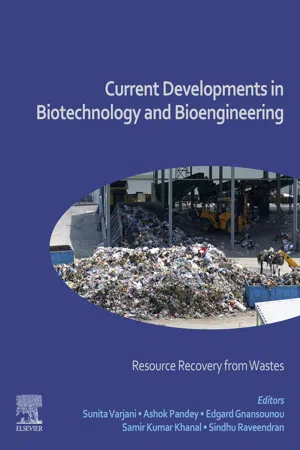
Current Developments in Biotechnology and Bioengineering: Resource Recovery from Wastes includes the latest and innovative research and technological developments in the biotechnology and bioengineering pertaining to various resource(s) recovery from wastes. The contents are organized into two broader sections covering resource recovery from industrial wastewater and resource recovery from solid wastes. Sections cover energy, bioproducts, nutrients, municipal food wastes, electronic wastes, agricultural waste and others. The state-of-the-art situation, potential advantages and limitations are also provided, along with strategies to overcome limitations. This book is a useful guide into research demands in solid and liquid waste treatment and management for environmental/economic sustainability.
- Provides state-of-art information and applications on microbiological and biotechnological interventions for resource recovery
- Covers municipal food wastes, electronic wastes and agricultural wastes
- Reviews current information relating to bioremediation
- Contains recent information, clearly illustrated with tables, figures and pictures
- Outlines different technological and biological aspects of resource recovery from industrial waste and effluents
Information
Section 1
General
Chapter 1
Resource recovery from waste
an introduction
Sunita Varjani 1 , Ashok Pandey 2 , Edgard Gnansounou 3 , Samir Khanal 4 , and Raveendran Sindhu 5 1 Gujarat Pollution Control Board, Gandhinagar, India 2 Centre for Innovation and Translational Research, CSIR-Indian Institute of Toxicology Research, Lucknow, India 3 Bioenergy and Energy Planning Research Group, IIC, ENAC, Ecole Polytechnique Fédérale de Lausanne, Lausanne, Switzerland 4 Department of Molecular Biosciences and Bioengineering, University of Hawaii at Manoa, Honolulu, HI, United States 5 Microbial Processes and Technology Division, CSIR-National Institute for Interdisciplinary Science and Technology, Trivandrum, India
Abstract
A large volume of solid and liquid waste is generated due to industrial and urban/suburban/agricultural activities. Management and handling of waste generated is nowadays burning issue for local authorities not only in urban areas, i.e., municipalities, but also in other regions in any country. With increasing urbanization and industrialization, generation of waste/wastewater appropriate disposal, treatment, and/or recycling are posing more challenges as the treatment and disposal costs huge amount in terms of money. However, conceiving the fact that “waste” word is placed wrongly and that it is a resource, resource recovery from wastes has emerged as thrust area of research and management as it offers huge environment and social sustainability potentials. Current researches globally are focusing on the recovery of various resources such as energy, bioproducts, nutrients, metals from waste/wastewater generated by anthropogenic activities, etc. This information needs to be discussed in the present context, and the future perspectives should be explored; most importantly, it should reveal current status, with state-of-the-art information and possibilities for technological exploitation. This chapter elaborates the recovery of various resources from solid and/or liquid waste.
Keywords
Bioproducts; Energy; Industrial wastewater; Resource recovery; Solid waste; Valorization
1. Introduction
The rapid increase in population and urbanization has contributed to increased amount of agricultural, industrial, food, and municipal solid waste (MSW), as well as industrial wastewater [1–6]. Intense anthropogenic activities and consumerist culture generate millions of tons of wastes worldwide every day [2]. Waste can be defined as everything that is no longer used that needs to be disposed. When any raw material is to produce another product for use in day-to-day life, after the processing left over material is termed as waste [1,5]. Human activities produce voluminous waste products, which is in some way depended on the need for their lifestyle [4,6,7]. Because man-made such wastes become overloaded beyond capacity of natural recycling processes, they must be managed according to their effect on environment and human health [7,8]. Although wastes are rich in nutrients, organic compounds, and energy, they are not properly managed and exploited toward recovery and reuse. On one hand, efficient resource recovery and reuse can create sustainable livelihood, on the other hand, it supports green economy by reducing waste and improves general environmental health and recovery of cost [3,5,7,8]. Hence, there is a need to recycle and reuse the waste produced from different sources in an efficient manner. Feasible techniques to produce pollution-less products create a new way for environmental and economic sustainability [1,4,6,8,9].
2. Energy and bioproduct recovery from industrial wastewater
Anaerobic digestion (AD) is one of the best ways to recover energy from solid and liquid wastes. AD can be defined as a bioprocess for conversion of organic waste into an energy-rich gas [10], i.e., methane, produced as biogas, which is a mixture of methane and carbon dioxide. Methane can be a good renewable energy resource to replace the dwindling conventional energy sources [11]. In-depth knowledge and research work about different anaerobic treatment systems, its microbiology and biochemistry, operating parameters, anaerobic treatment of industrial wastewaters using anaerobic reactors, and simulation of reactors for methane production are of great relevance for various kinds of domestic and industrial wastes [11–13]. Apart from biogas production, electricity and heat from different types of wastewater are of great interest with a point of view from a cleaner production [12]. To develop an integrated process and economically viable processes and technologies, life cycle assessment and cost analysis are important research perspectives to understand long-term benefits of biogas production technology [10,12–15].
Microbial fuel cells (MFCs) are yet another important systems that could be used to recover energy from waste streams. It is also referred as bioelectrochemical systems (BESs) that represent a way to simultaneously recover energy from wastewater and in the process bring down the level of contamination. MFC/BES systems could be effectively used to produce hydrogen from industrial wastewater [5,15,16].
Wastewater treatment operations are usually expensive unit operation, requiring high energy inputs [14,17,18]. Decrease in energy use can yield significant natural, financial, and social advantages [16,19]. Thus, energy recovery from wastewater along with their treatment could offer development of sustainable bioprocesses employing AD or MFC/BES [15,16,19,20].
3. Nutrient recovery from industrial wastewater
Nitrogen recovery in the form of organic fertilizers and microbial protein from microalgae, nitrous oxide, or ammonium using processes such as BES, salt crystallization, and membrane technologies has been studied largely all over the world [21–23]. The recovered nitrous oxide can act as an effective oxidant for combustion fuels [23]. The recovered ammonium can be used for fertilizer production [24]. However, there are knowledge gaps and technoeconomic challenges to develop biological nitrogen recovery, which needs to be addressed [21,23–25].
In case of sewage sludge treatment and reutilization, recovery of volatile fatty acids (VFAs) by AD seems to be a promising technology [26,27]. Fundamental aspects and actual developments and future perspectives for VFA production from sewage sludge by anaerobic fermentation need to be critically studied [26,28–30].
4....
Table of contents
- Cover image
- Title page
- Table of Contents
- Copyright
- Contributors
- Preface
- Section 1. General
- Resource recovery from industrial wastewater
- Resource recovery from solid wastes
- Index
Trusted by 375,005 students
Access to over 1.5 million titles for a fair monthly price.
Study more efficiently using our study tools.
Frequently asked questions
Yes, you can cancel anytime from the Subscription tab in your account settings on the Perlego website. Your subscription will stay active until the end of your current billing period. Learn how to cancel your subscription
No, books cannot be downloaded as external files, such as PDFs, for use outside of Perlego. However, you can download books within the Perlego app for offline reading on mobile or tablet. Learn how to download books offline
Perlego offers two plans: Essential and Complete
- Essential is ideal for learners and professionals who enjoy exploring a wide range of subjects. Access the Essential Library with 800,000+ trusted titles and best-sellers across business, personal growth, and the humanities. Includes unlimited reading time and Standard Read Aloud voice.
- Complete: Perfect for advanced learners and researchers needing full, unrestricted access. Unlock 1.5M+ books across hundreds of subjects, including academic and specialized titles. The Complete Plan also includes advanced features like Premium Read Aloud and Research Assistant.
We are an online textbook subscription service, where you can get access to an entire online library for less than the price of a single book per month. With over 1.5 million books across 990+ topics, we’ve got you covered! Learn about our mission
Look out for the read-aloud symbol on your next book to see if you can listen to it. The read-aloud tool reads text aloud for you, highlighting the text as it is being read. You can pause it, speed it up and slow it down. Learn more about Read Aloud
Yes! You can use the Perlego app on both iOS and Android devices to read anytime, anywhere — even offline. Perfect for commutes or when you’re on the go.
Please note we cannot support devices running on iOS 13 and Android 7 or earlier. Learn more about using the app
Please note we cannot support devices running on iOS 13 and Android 7 or earlier. Learn more about using the app
Yes, you can access Current Developments in Biotechnology and Bioengineering by Sunita Varjani,Ashok Pandey,Edgard Gnansounou,Samir Kumar Khanal,Sindhu Raveendran in PDF and/or ePUB format, as well as other popular books in Tecnologia e ingegneria & Ingegneria chimica e biochimica. We have over 1.5 million books available in our catalogue for you to explore.