- 528 pages
- English
- ePUB (mobile friendly)
- Available on iOS & Android
eBook - ePub
About this book
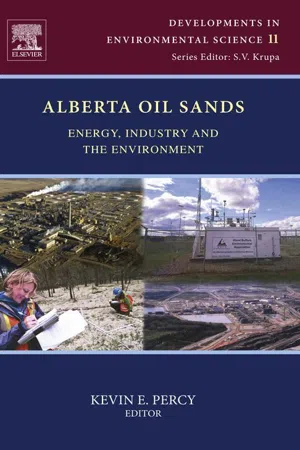
At 170 billion barrels, Canada's Oil Sands are the third largest reserves of developable oil in the world. The Oil Sands now produce about 1.6 million barrels per day, with production expected to double by 2025 to about 3.7 million barrels per day. The Athabasca Oil Sands Region (AOSR) in northeastern Alberta is the largest of the three oil sands deposits. Bitumen in the oil sands is recovered through one of two primary methods – mining and drilling. About 20 per cent of the reserves are close to the surface and can be mined using large shovels and trucks. Of concern are the effects of the industrial development on the environment. Both human-made and natural sources emit oxides of sulphur and nitrogen, trace elements and persistent organic compounds. Of additional concern are ground level ozone and greenhouse gases.
Because of the requirement on operators to comply with the air quality regulatory policies, and to address public concerns, the not-for-profit, multi-stakeholder Wood Buffalo Environmental Association (WBEA) has since 1997 been closely monitoring air quality in AOSR. In 2008, WBEA assembled a distinguished group of international scientists who have been conducting measurements and practical research on various aspects of air emissions and their potential effects on terrestrial receptors. This book is a synthesis of the concepts and results of those on-going studies. It contains 19 chapters ranging from a global perspective of energy production, measurement methodologies and behavior of various air pollutants during fossil fuel production in a boreal forest ecosystem, towards designing and deploying a multi-disciplinary, proactive, and long-term environmental monitoring system that will also meet regulatory expectations.
- Covers measurement of emissions from very large industrial sources in a region with huge international media profile
- Validation of measurement technologies can be applied globally
- The new approaches to ecological monitoring described can be applied in other forested regions
Information
Table of contents
- Cover image
- Title page
- Table of Contents
- Copyright
- Developments in Environmental Science
- Contributors
- Acknowledgments
- Preface
- Introduction
- Introduction to the Book Series
- Chapter 1. Energy Production: A Global Perspective
- Chapter 2. Energy Developments in Canada’s Oil Sands
- Chapter 3. Energy and Environment: Toward Achieving the Balance in Alberta
- Chapter 4. Air Quality in the Athabasca Oil Sands Region 2011
- Chapter 5. Development and Application of Statistical Approaches for Reducing Uncertainty in Ambient Air Quality Data
- Chapter 6. Co-measurement of Volatile Organic and Sulfur Compounds in the Athabasca Oil Sands Region by Dual Detector Pneumatic Focusing Gas Chromatography
- Chapter 7. Overview of Real-World Emission Characterization Methods
- Chapter 8. Measurement of Real-World Stack Emissions with a Dilution Sampling System
- Chapter 9. Applying the Forest Health Approach to Monitoring Boreal Ecosystems in the Athabasca Oil Sands Region
- Chapter 10. Ecological Analogues for Biomonitoring Industrial Sulfur Emissions in the Athabasca Oil Sands Region, Alberta, Canada
- Chapter 11. Tracing Industrial Nitrogen and Sulfur Emissions in the Athabasca Oil Sands Region Using Stable Isotopes
- Chapter 12. Air Quality Modeling in the Athabasca Oil Sands Region
- Chapter 13. WBEA Receptor Modeling Study in the Athabasca Oil Sands
- Chapter 14. Method for Extraction and Multielement Analysis of Hypogymnia physodes samples from the Athabasca Oil Sands Region
- Chapter 15. Coupling Lead Isotopes and Element Concentrations in Epiphytic Lichens to Track Sources of Air Emissions in the Athabasca Oil Sands Region
- Chapter 16. Mercury Concentration and Isotopic Composition of Epiphytic Tree Lichens in the Athabasca Oil Sands Region
- Chapter 17. Measurement of Polynuclear Aromatic Hydrocarbons (PAHs) in Epiphytic Lichens for Receptor Modeling in the Athabasca Oil Sands Region (AOSR): A Pilot Study
- Chapter 18. Receptor Modeling of Epiphytic Lichens to Elucidate the Sources and Spatial Distribution of Inorganic Air Pollution in the Athabasca Oil Sands Region
- Chapter 19. Concluding Remarks
- Index
Trusted by 375,005 students
Access to over 1.5 million titles for a fair monthly price.
Study more efficiently using our study tools.
Frequently asked questions
Yes, you can cancel anytime from the Subscription tab in your account settings on the Perlego website. Your subscription will stay active until the end of your current billing period. Learn how to cancel your subscription
No, books cannot be downloaded as external files, such as PDFs, for use outside of Perlego. However, you can download books within the Perlego app for offline reading on mobile or tablet. Learn how to download books offline
Perlego offers two plans: Essential and Complete
- Essential is ideal for learners and professionals who enjoy exploring a wide range of subjects. Access the Essential Library with 800,000+ trusted titles and best-sellers across business, personal growth, and the humanities. Includes unlimited reading time and Standard Read Aloud voice.
- Complete: Perfect for advanced learners and researchers needing full, unrestricted access. Unlock 1.5M+ books across hundreds of subjects, including academic and specialized titles. The Complete Plan also includes advanced features like Premium Read Aloud and Research Assistant.
We are an online textbook subscription service, where you can get access to an entire online library for less than the price of a single book per month. With over 1.5 million books across 990+ topics, we’ve got you covered! Learn about our mission
Look out for the read-aloud symbol on your next book to see if you can listen to it. The read-aloud tool reads text aloud for you, highlighting the text as it is being read. You can pause it, speed it up and slow it down. Learn more about Read Aloud
Yes! You can use the Perlego app on both iOS and Android devices to read anytime, anywhere — even offline. Perfect for commutes or when you’re on the go.
Please note we cannot support devices running on iOS 13 and Android 7 or earlier. Learn more about using the app
Please note we cannot support devices running on iOS 13 and Android 7 or earlier. Learn more about using the app
Yes, you can access Alberta Oil Sands by in PDF and/or ePUB format, as well as other popular books in Technology & Engineering & Chemical & Biochemical Engineering. We have over 1.5 million books available in our catalogue for you to explore.