- 576 pages
- English
- ePUB (mobile friendly)
- Available on iOS & Android
eBook - ePub
About this book
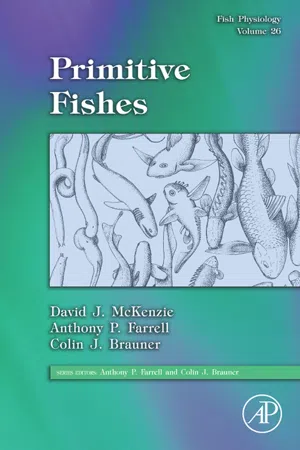
Primitive fishes are a relatively untapped resource in the scientific search for insights into the evolution of physiological systems in fishes and higher vertebrates. Volume 26 in the Fish Physiology series presents what is known about the physiology of these fish in comparison with the two fish groups that dominate today, the modern elasmobranchs and the teleosts. Chapters include reviews on what is known about cardiovascular, nervous and ventilatory systems, gas exchange, ion and nitrogenous waste regulation, muscles and locomotion, endocrine systems, and reproduction. Editors provide a thorough understanding of how these systems have evolved through piscine and vertebrate evolutionary history.
Primitive Fishes includes ground-breaking information in the field, including highlighs of the most unusual characteristics amongst the various species, which might have allowed these fishes to persist virtually unchanged through evolutionary time. This volume is essential for all comparative physiologists, fish biologists, and paleontologists.
- Provides an analysis of the evolutionary significance of physiological adaptations in "ancient fishes"
- Offers insights on the evolution of higher vertebrates
- The only single source that presents an in-depth discussion of topics related to the physiology of ancient fishes
Information
Subtopic
PhysiologyIndex
Biological SciencesGas Transport and Exchange
Abstract
Gas exchange is a prerequisite of vertebrate life. In terms of structural and functional diversity and habitats occupied, extant teleosts clearly outcompete extant primitive fishes; however, there are a few aspects related to gas exchange that may have contributed to the survival of these primitive fishes. Most of the primitive fishes either have the ability to breath air, have the ability to tolerate aerial exposure (and in some cases estivate), or are tolerant to aquatic hypoxia. Many of the bimodal breathers retain fully functional gills, which at times allow strictly aquatic breathing over prolonged periods which may be important for aerial predator avoidance or surviving ice cover in temperate climates. While air breathing is important for surviving aquatic hypoxia, it is also important in enhancing O2 uptake during exercise. Living primitive fishes occupy strategic positions in the evolutionary tree of vertebrates and may shed light on the evolution of blood O2 and CO2 transport characteristics. Evolutionary reconstruction indicates that the increase in the Bohr–Haldane effect in primitive ray‐finned fishes was followed first by a gradual increase in the magnitude of the Root effect and then a gradual reduction in specific Hb buffer value. This was followed by the evolution of a choroid rete mirabile and ocular O2 secretion in the last common ancestor of Amia calva and teleosts. Finally, the adrenergic red blood cell Na+/H+ exchanger was never present in primitive ray‐finned fishes or primitive teleosts and only evolved in advanced teleosts. No such evolutionary trends are observed in primitive lobe‐finned fishes.
1 Introduction
The uptake of O2 from the environment and elimination of metabolically produced CO2 are prerequisites of vertebrate life. A great deal is known about the differences in O2 and CO2 transport and exchange between water and air‐breathing vertebrates; however, this stems largely from studies on teleost fishes in the former, and mammals in particular in the latter. Fishes possess great diversity in gas exchange strategy, ranging from completely water breathing to obligate air breathing, and thus occupy a crucial phylogenetic position in the transition of life from water to land which has large implications for gas exchange (Dejours, 1988; Graham, 1997). Relatively little in relation to O2 and CO2 transport and exchange is preserved within the fossil record, and consequently, reconstruction of the evolution of gas exchange is limited largely to studies on extant species. In the following sections, primitive fishes will be discussed going backward in time from the closest living relatives of teleosts to successively more distantly related groups of primitive fishes. We first discuss the relative roles of the respective gas‐exchange surfaces [gills, skin, and air‐breathing organs (ABOs)] to O2 and CO2 exchange in each primitive fish group. We then discuss general aspects of O2 and CO2 exchange, largely on the basis of what is known in teleosts and then what is known for primitive fishes. Finally, we discuss how this information on primitive fishes helps to identify some general trends in the evolution of vertebrate blood gas transport characteristics.
2 Partitioning of O2 and CO2 Exchange Across the Respiratory Surfaces
In typical water‐breathing teleosts, the gills are the predominant surface for both O2 and CO2 exchange; but in some cases, there can be appreciable O2 uptake across the skin. Many of the primitive fish groups discussed in this chapter contain species that are facultative or obligate air‐breathers. Thus, the gills, skin, and ABOs are all potential sites for gas exchange in many primitive fishes. There has been considerable interest and research conducted on the morphologies of the respective gas exchange structures (see Chapter 4, this volume) and a great number of direct measurements of the relative role and efficiency of each structure to both O2 and CO2 exchange, which are briefly summarized below. In most air‐breathing fishes studied to date, there appears to be a spatial separation of O2 and CO2 exchange. That is, the majority of O2 uptake may occur across the ABO, and the majority of CO2 excreted across the gills and/or skin. This is largely related to the fact that the capacitance coefficient for CO2 does not change much between water and air, while that for O2 is 20‐ to 30‐fold higher (depending on the temperature) in air than water (Dejours, 1988). Because ventilation‐rate volume (ventilation frequency × volume) of gas exchangers in fish is largely regulated to secure adequate O2 uptake, ventilation‐rate volume of the ABO in an air‐breather is greatly reduced relative to that of the gills in a water‐breather. The reduced ventilation‐rate volume is sufficient for O2 uptake, but insufficient for CO2 elimination across the ABO, and consequently CO2 diffuses out across the gills and/or skin (Dejours, 1988; Graham, 1997). The spatial uncoupling of O2 and CO2 transport has interesting implications for gas exchange in fish, given that at least in most teleost fishes there is a tight interaction between O2 and CO2 exchange that resides at the level of Hb in the red blood cell (RBC) (Jensen, 1989; Brauner and Randall, 1996, 1998; Brauner and Val, 1996; Nikinmaa, 2001).
Air breathing not only permits fishes to survive exposure to aquatic hypoxia but also allows them to maintain normal levels of metabolism and activity in aquatic hypoxia, provided O2 taken up in the ABO is not subsequently lost across the gills. Consequently, many air‐breathing fishes possess circulatory adaptations in the gills. Of the four gill arches, efferent vessels from the third and fourth arches give rise to the pulmonary artery leading to the ABO, and venous return from the ABO is direct to the heart. The first and second gill arches lead exclusively to the dorsal aorta. The creation of a double circulatory loop is most developed in the obligate air‐breathing lungfishes but present to some degree in some of the other groups described below (reviewed in Graham, 1997). Those primitive fishes that are not air‐breathers tend to be tolerant of aerial exposure and/or aquatic hypoxia and thus are very tolerant of adverse environments. The following sections review the limited information that ex...
Table of contents
- Cover image
- Title page
- Table of Contents
- Living Primitive Fishes and Fishes From Deep Time
- Cardiovascular Systems in Primitive Fishes
- Nervous and Sensory Systems
- Ventilatory Systems
- Gas Transport and Exchange
- Ionic, Osmotic, and Nitrogenous Waste Regulation
- Locomotion in Primitive Fishes
- Peripheral Endocrine Glands. I. The Gastroenteropancreatic Endocrine System and the Thyroid Gland
- Peripheral Endocrine Glands. II. The Adrenal Glands and the Corpuscles of Stannius
- Why Have Primitive Fishes Survived?
- Series Editors
- Contributors to Volume 26
- Preface
- Index
- Contents of Previous Volumes
Trusted by 375,005 students
Access to over 1.5 million titles for a fair monthly price.
Study more efficiently using our study tools.
Frequently asked questions
Yes, you can cancel anytime from the Subscription tab in your account settings on the Perlego website. Your subscription will stay active until the end of your current billing period. Learn how to cancel your subscription
No, books cannot be downloaded as external files, such as PDFs, for use outside of Perlego. However, you can download books within the Perlego app for offline reading on mobile or tablet. Learn how to download books offline
Perlego offers two plans: Essential and Complete
- Essential is ideal for learners and professionals who enjoy exploring a wide range of subjects. Access the Essential Library with 800,000+ trusted titles and best-sellers across business, personal growth, and the humanities. Includes unlimited reading time and Standard Read Aloud voice.
- Complete: Perfect for advanced learners and researchers needing full, unrestricted access. Unlock 1.5M+ books across hundreds of subjects, including academic and specialized titles. The Complete Plan also includes advanced features like Premium Read Aloud and Research Assistant.
We are an online textbook subscription service, where you can get access to an entire online library for less than the price of a single book per month. With over 1.5 million books across 990+ topics, we’ve got you covered! Learn about our mission
Look out for the read-aloud symbol on your next book to see if you can listen to it. The read-aloud tool reads text aloud for you, highlighting the text as it is being read. You can pause it, speed it up and slow it down. Learn more about Read Aloud
Yes! You can use the Perlego app on both iOS and Android devices to read anytime, anywhere — even offline. Perfect for commutes or when you’re on the go.
Please note we cannot support devices running on iOS 13 and Android 7 or earlier. Learn more about using the app
Please note we cannot support devices running on iOS 13 and Android 7 or earlier. Learn more about using the app
Yes, you can access Fish Physiology: Primitive Fishes by in PDF and/or ePUB format, as well as other popular books in Biological Sciences & Physiology. We have over 1.5 million books available in our catalogue for you to explore.