- 250 pages
- English
- ePUB (mobile friendly)
- Available on iOS & Android
eBook - ePub
About this book
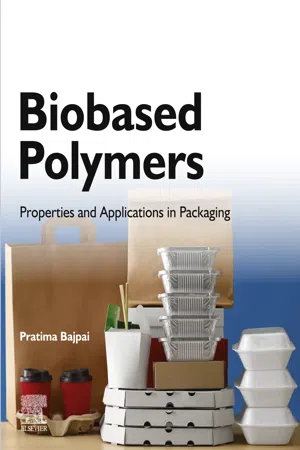
Biobased Polymers: Properties and Applications in Packaging looks at how biopolymers may be used in packaging as a potential green solution. The book addresses bio-based feedstocks, production processes, packaging types, recent trends in packaging, the environmental impact of bio-based polymers, and legislative demands for food contact packaging materials. Chapters explore opportunities for biopolymers in key end-use sectors, the penetration of biopolymer based concepts in the packaging market, and barriers to widespread commercialization.
As the development of bio-based material is an important factor for sustainably growing the packaging industry, these recent trends in consumer markets are extremely important as we move towards greener packaging. Hence, this resource is an invaluable addition on the topic.
- Offers a comprehensive introduction to the subject for researchers interested in bio-based products, green and sustainable chemistry, polymer chemistry and materials science
- Covers the market for bio-based materials
- Includes discussions on legislative demands for food contact packaging materials
- Describes interesting new technologies, including nanotechnology approaches
Information
Chapter 1
Background and introduction
Abstract
The packaging industry currently relies strongly on the use of petroleum-derived plastic materials, which raises some concerns from both economic and environmental perspectives. Furthermore, because of their lack of biodegradability, petroleum-based products can pose significant waste disposal problems in some areas. The development of biobased material is an important factor for sustainable growth of packaging industry. Recent trends in consumer markets have been moving toward greener packaging. The issue of sustainability has been high for the last several years, encouraging industry to develop sustainable alternatives for preserving resources for future generations. The successful use of renewable biological materials for the production of packaging materials will satisfy a number of the major objectives. This chapter presents general background and introduction on biobased polymers.
Keywords
Biomaterials; Bioplastics; Coating; Composites; Fibers; Packaging; Paper; Renewable material
“The packaging industry currently, depends strongly on the petroleum-based plastics which cause concerns to future in relevance with both environment and the economy” (Shahzad Tariq, 2013). The shortage of raw materials also creates a threat to the availability, cost of raw materials and their biodegradability (Gustafsson et al., 2011).
There are several reasons to search out alternatives to petroleum-based plastics: depletion of fossil fuels, a wildly unsteady oil price, the need to reduce carbon emissions, an accumulation of plastic waste, and the need for packaging materials having new characteristics. In response, researchers have developed a whole new generation of plant or plant-waste-based packaging materials, some having characteristics such as breathability or antimicrobial properties. There are already countless applications for them.
The European Union (EU) market for packaging has a value of about 127 billion US dollars and has about 40 percent of the global packaging market (Shahzad Tariq. 2013). The European packaging materials can be broken down as contribution from glass with 8%, metal 14%, paper 42%, and plastic 36% (Global Packaging Alliance, 2013).
Furthermore, petroleum-based products lack biodegradability. This can cause substantial waste disposal problems in certain areas (de Vlieger, 2003; Robertson, 2008; Franz and Welle, 2003). Packaging is becoming a very important part of our daily life. The utilization of packaging materials is continuously increasing with time. It is expected that in the future the market will grow globally. Packaging products produced from renewable substrates currently represent only about 2% of the market: traditional fiber-based packaging is not included.
“Substantial attention is now being given to the concept of sustainable development. The commonly accepted definition of sustainable development is development that meets the needs of the present without compromising the ability of future generations to meet their own needs” (World Commission on Environment and Development's report “Our Common Future,” 1987) (www.sustainabledevelopment2015.org/AdvocacyToolkit/.../92-our-common-future). For a transition to a higher level of sustainability development, it is very important to make a number of technological and social changes, and one of these is to develop alternative resources of raw materials.
Sustainable development is becoming the core commitment to create shared value by increasing world access to the best quality available in food and beverages while focusing on staying being eco-friendly. One project is led by a Swedish firm, Innventia, a partly government industrial research company, with the aim to explore the niche in biobased/ecofriendly packaging materials. Food packaging is a large and complex market, providing protection, tamper resistance, and special physical, chemical, or biological requirements. Most, if not all of this, can be handled by biobased materials. Focusing alone on the sustainable development of the packaging material is not enough and is shortsighted. That is why the industry has increased the communication efforts to realize the pros and cons on the whole chain, i.e., raw materials to processing to wholesale and retail to use and finally to disposal.
For sustainable growth of the packaging industry, it is very important to develop high-performance sustainable raw materials. The sustainable packaging sector is growing at a faster rate as compared to the overall packaging industry. Studies conducted by several research institutions in Germany and Sweden show that from a carbon footprint perspective, packaging materials from forest resources can deliver several benefits in comparison to conventional plastics or glass packages. Paperboard due to its renewability is better than glass or plastic containers for packaging of liquids (Wellenreuther et al., 2010; Jelse et al., 2011). Furthermore, the weight of biobased packaging is lower. This property is favorable from a transportation point of view. The final products are usually reused (Hohenthal and Veuro, 2011). Consumers usually like fiber-based packaging as it is eco-friendly.
Biopolymers used as dispersion coating on paper or paperboard for use in packaging and bioplastics with the same intended use offer enough barrier properties for fats, but generally have only reasonable water vapor barrier properties. Poor mechanical properties, inadequate heat resistance, and high sensitivity to moisture as compared to plastics obtained from petroleum are other weak points. Furthermore, to become competitive it is essential that biopackaging solutions should be economically feasible and can be included in the industrial processes.
It is important to remember that the role of packaging now revolves about around three concepts—environmental, economic, and social—covering the aspects of sustainability. The recent trends in EU packaging markets show an interest of moving toward what is called “green” packaging, i.e., using recyclable and recycled materials, reduced material usage, and polymers extracted from biomass. The accomplishment has been driven by EU directives for the evolution of eco-friendly packaging solutions in the EU (Parker, 2008). Some of the research groups that have pursued packaging from renewable materials are SustainPack, SustainComp, Food Biopack project, SUNPAP, FlexPakRenew, RenewFunccBarr, and VTT ( Johansson et al., 2012; Shahzad Tariq, 2013).
The Food Biopack project provided information on the production and use of biopackaging materials for the food industry, covering the entire perspective from properties of biomaterials to food packaging considerations, life cycle analysis, ecological impacts, as well as market issues (Weber, 2000a,b).
SustainPack has dealt with improvements in a range of packaging functionalities. Self-healing coatings were developed for maintaining the barrier properties of packages when subjected to external stress (Andersson et al., 2009). Other problems that were addressed included printed electronics for communication, nanosized thin top layers for improved barrier performance, and cellulose fibers for reinforcement (Robertsson, 2008; Amberg-Schwab and Kleebauer, 2007; Aucejo, 2005 ...
Table of contents
- Cover image
- Title page
- Table of Contents
- Copyright
- Dedication
- List of figures
- List of tables
- Preface
- Acknowledgments
- Chapter 1. Background and introduction
- Chapter 2. Description of biobased polymers
- Chapter 3. Properties of biobased packaging material
- Chapter 4. Packaging types
- Chapter 5. Biobased polymers in packaging
- Chapter 6. Recent trends in packaging of food products
- Chapter 7. Environmental impact of biobased polymers
- Chapter 8. Legislation for food contact materials
- Chapter 9. Market for biobased packaging material
- Chapter 10. Emerging sources of biopolymers
- Chapter 11. Emerging technology—nanotechnology
- Chapter 12. Future prospects
- Index
Trusted by 375,005 students
Access to over 1.5 million titles for a fair monthly price.
Study more efficiently using our study tools.
Frequently asked questions
Yes, you can cancel anytime from the Subscription tab in your account settings on the Perlego website. Your subscription will stay active until the end of your current billing period. Learn how to cancel your subscription
No, books cannot be downloaded as external files, such as PDFs, for use outside of Perlego. However, you can download books within the Perlego app for offline reading on mobile or tablet. Learn how to download books offline
Perlego offers two plans: Essential and Complete
- Essential is ideal for learners and professionals who enjoy exploring a wide range of subjects. Access the Essential Library with 800,000+ trusted titles and best-sellers across business, personal growth, and the humanities. Includes unlimited reading time and Standard Read Aloud voice.
- Complete: Perfect for advanced learners and researchers needing full, unrestricted access. Unlock 1.5M+ books across hundreds of subjects, including academic and specialized titles. The Complete Plan also includes advanced features like Premium Read Aloud and Research Assistant.
We are an online textbook subscription service, where you can get access to an entire online library for less than the price of a single book per month. With over 1.5 million books across 990+ topics, we’ve got you covered! Learn about our mission
Look out for the read-aloud symbol on your next book to see if you can listen to it. The read-aloud tool reads text aloud for you, highlighting the text as it is being read. You can pause it, speed it up and slow it down. Learn more about Read Aloud
Yes! You can use the Perlego app on both iOS and Android devices to read anytime, anywhere — even offline. Perfect for commutes or when you’re on the go.
Please note we cannot support devices running on iOS 13 and Android 7 or earlier. Learn more about using the app
Please note we cannot support devices running on iOS 13 and Android 7 or earlier. Learn more about using the app
Yes, you can access Biobased Polymers by Pratima Bajpai in PDF and/or ePUB format, as well as other popular books in Technology & Engineering & Chemical & Biochemical Engineering. We have over 1.5 million books available in our catalogue for you to explore.