- 540 pages
- English
- ePUB (mobile friendly)
- Available on iOS & Android
eBook - ePub
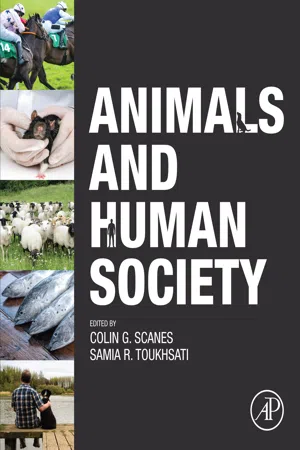
Animals and Human Society
About this book
Animals and Human Society provides a solid, scientific, research-based background to advance understanding of how animals impact humans. Animals have had profound effects on people from the earliest times, ranging from zoonotic diseases, to the global impact of livestock, poultry and fish production, to the influences of human-associated animals on the environment (on extinctions, air and water pollution, greenhouse gases, etc.), to the importance of animals in human evolution and hunter -gatherer communities.As a resource for both science and non-science, Animals and Human Society can be used as a text for courses in Animals and Human Society or Animal Science, or as supplemental material for Introduction to Animal Science. It offers foundational background to those who may have little background in animal agriculture and have focused interest on companion animals and horses. The work introduces livestock production (including poultry and aquaculture) but also includes coverage of companion and lab animals. In addition, animal behavior and animal perception are covered.Animals and Human Society is likewise an excellent resource for researchers, academics, or students newly entering a related field or coming from another discipline and needing foundational information, as well as interested laypersons looking to augment their knowledge on the many impacts of animals in human society.
- Features research-based and pedagogically sound content, with learning goals and textboxes to provide key information
- Challenges readers to consider issues based on facts rather than polemics
- Poses ethical questions and raises overall societal impacts
- Balances traditional animal science with companion animals, animal biology, zoonotic diseases, animal products, environmental impacts and all aspects of human/animal interaction
Information
Topic
MedicineSubtopic
Veterinary MedicineChapter 1
Animal Perception Including Differences With Humans
Colin G. Scanes University of Wisconsin–Milwaukee, Milwaukee, WI, United States
Summary
There are similarities and marked differences between how animals and humans perceive their environment. Animals and humans perceive sound, light, chemicals (taste and smell), touch, and the earth’s magnetic field. In comparing humans with animals, there are differences in the following:
• Auditory perception: Ultrasonic sound (high frequencies of sound) is detected by some animals, such as cats, bats, rats, and mice, but not by humans. Moreover, there is spatial location of the source of sound in humans, but it is much more highly developed in some animals with the pinnae (external ears) capable of partial rotation.
• Light/visual perception (sight): This encompasses trichromatic vision in humans and Old World monkeys and great apes, but not in nonprimate mammals; these having dichromatic vision. In addition, birds and some mammals, such as dogs, have the ability to detect ultraviolet light. In contrast, humans do not. There are differences also in the eyes of nocturnal versus diurnal animals and their location. In mammals there seems to be an absence of extraretinal light reception unlike in birds.
• Chemoreception: Humans have a full repertoire of taste receptors while some animals lack some or all taste receptors. Most mammals have a well-developed vomeronasal chemoreception with humans having little or none. Humans have reduced olfactory chemoreception even compared to other primates. Some mammals have highly developed olfaction. Homing pigeons use odor detection.
• Tactile perception (touch): Many mammals have vibrissae (tactile hairs) but these are not present in humans.
• Other senses: In birds, there is magnetoreception detecting the direction of the Poles to aid migration. This does not appear to be the case in mammals.
Keywords
perception
senses
hearing
sight
taste
odor
smelling
tactile reception
magnetoreception
1.1. Introduction
Humans and animals use their senses to perceive the environment to locate food, water, mates, shelter, dangers, such as predators, or to communicate betwe...
Table of contents
- Cover
- Title page
- Table of Contents
- Copyright
- List of Contributors
- Preface
- Chapter 1: Animal Perception Including Differences With Humans
- Chapter 2: Animal Attributes Exploited by Humans (Nonfood Uses of Animals)
- Chapter 3: Animal Products and Human Nutrition
- Chapter 4: Hunter–Gatherers
- Chapter 5: Animals and Hominid Development
- Chapter 6: The Neolithic Revolution, Animal Domestication, and Early Forms of Animal Agriculture
- Chapter 7: Animal Agriculture: Livestock, Poultry, and Fish Aquaculture
- Chapter 8: Invertebrates and Their Use by Humans
- Chapter 9: Animals in the Military
- Chapter 10: Animals in Entertainment
- Chapter 11: Animals and Religion, Belief Systems, Symbolism and Myth
- Chapter 12: Animals as Companions
- Chapter 13: Animals in Medicine and Research
- Chapter 14: Animals and Human Disease: Zoonosis, Vectors, Food-Borne Diseases, and Allergies
- Chapter 15: Pest Animals
- Chapter 16: Parasites
- Chapter 17: Invasive Species
- Chapter 18: Impact of Agricultural Animals on the Environment
- Chapter 19: Human Activity and Habitat Loss: Destruction, Fragmentation, and Degradation
- Chapter 20: Animal Welfare and Animal Rights
- Chapter 21: Animal Extinctions
- Index
Trusted by 375,005 students
Access to over 1.5 million titles for a fair monthly price.
Study more efficiently using our study tools.
Frequently asked questions
Yes, you can cancel anytime from the Subscription tab in your account settings on the Perlego website. Your subscription will stay active until the end of your current billing period. Learn how to cancel your subscription
No, books cannot be downloaded as external files, such as PDFs, for use outside of Perlego. However, you can download books within the Perlego app for offline reading on mobile or tablet. Learn how to download books offline
Perlego offers two plans: Essential and Complete
- Essential is ideal for learners and professionals who enjoy exploring a wide range of subjects. Access the Essential Library with 800,000+ trusted titles and best-sellers across business, personal growth, and the humanities. Includes unlimited reading time and Standard Read Aloud voice.
- Complete: Perfect for advanced learners and researchers needing full, unrestricted access. Unlock 1.5M+ books across hundreds of subjects, including academic and specialized titles. The Complete Plan also includes advanced features like Premium Read Aloud and Research Assistant.
We are an online textbook subscription service, where you can get access to an entire online library for less than the price of a single book per month. With over 1.5 million books across 990+ topics, we’ve got you covered! Learn about our mission
Look out for the read-aloud symbol on your next book to see if you can listen to it. The read-aloud tool reads text aloud for you, highlighting the text as it is being read. You can pause it, speed it up and slow it down. Learn more about Read Aloud
Yes! You can use the Perlego app on both iOS and Android devices to read anytime, anywhere — even offline. Perfect for commutes or when you’re on the go.
Please note we cannot support devices running on iOS 13 and Android 7 or earlier. Learn more about using the app
Please note we cannot support devices running on iOS 13 and Android 7 or earlier. Learn more about using the app
Yes, you can access Animals and Human Society by Colin G. Scanes,Samia Toukhsati in PDF and/or ePUB format, as well as other popular books in Medicine & Veterinary Medicine. We have over 1.5 million books available in our catalogue for you to explore.