- 192 pages
- English
- ePUB (mobile friendly)
- Available on iOS & Android
eBook - ePub
Molecular Evolutionary Models in Drug Discovery
About this book
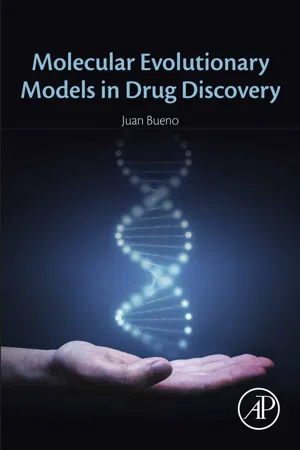
Molecular Evolutionary Models in Drug Discovery explores the application of evolutionary molecular models in drug discovery in which secondary metabolites play a fundamental role. Secondary metabolites are not produced in isolation, they are the result of the interaction of genes, metabolism and the environment. The book examines the role of secondary metabolites as leads in drug discovery and on the development of a rational bioprospecting model for new medicines based on the evolution of secondary metabolism. These evolutionary models are part of biological systems and are the most reliable expression of the functioning of living beings.
- Examines the integration and application of evolutionary models in the pharmaceutical industry to create new drug development platforms
- Investigates the biotechnological prospecting of secondary metabolites and their potential use in the discovery of new drugs
- Evaluates the ecosystem of living beings and how its molecular adaptation might improve the success of therapies
Information
Topic
MedicineSubtopic
Pharmacology Chapter 1
Molecular evolution: The origins of interaction
Abstract
Molecular evolution involves the process by which changes occur through the generations of cellular molecules such as DNA, RNA, and proteins. The origin of these changes is determined from the origin of life by the connection networks established by living beings. In a similar way, these modifications are due to the adaptation that organisms make to their environment, which is initially phenotypic, in preparation for the genotypic type alterations that characterize the evolutionary processes. It is when accumulating innovations that biological systems acquire greater complexity, which directs towards the specialization and the conformation of multicellular organisms. Likewise, these adaptive processes finally achieve that the protocells gain their properties of replication and self-sustainability due to the development of primary metabolic processes regulated by secondary metabolites. Equally, these secondary metabolites, as they obtain increasing biological activity, become a determining factor in coevolution and adaptation within ecosystems. This is how these processes of evolution, developed in large periods of biological interaction, can be the basis for the creation of a new model of biotechnological applications that use metabolic networks and their connections as a source of innovation. Finally, the objective of this chapter is to open the introduction to the knowledge and central theme of this book, on how to understand evolution and its concepts for the study and application of new approaches that can boost the development of industrial biochemistry and biomedicine.
Keywords
Evolution; Biological molecules; Secondary metabolism; Holobiont; Biocenosis
Acknowledgments
The author wants to thank P.S. Bird for his accompaniment and wise advice in ecosystem niches during the writing of this chapter.
It was in these circumstances… in which he analyzed Don Quixote’s dilemma of whether to follow the path of arms (praxis, action) or the path of letters (poiesis, creation, production), I understood for the first time the power of the word “poiesis” and invented the word that we needed: autopoiesis. This was a word without a history, a word that could directly mean what takes place in the dynamics of the autonomy proper to living systems.
Humberto Maturana (1928–) and Francisco Varela (1946–2001)
Only love expands intelligence. To live in love is to accept the other and the conditions of his existence as a source of richness, not as opposition, restriction or limitation.
Humberto Maturana (1928–)
1.1 Introduction
The study of the evolution of biological molecules itself is nothing other than the evaluation of quasicrystals or aperiodic crystals (Maciá, 2005). This aperiodic order (orderly but without symmetry) has been the key to diversity and evolution since the appearance of the first molecules that had the capacity to self-replicate and with the ability to obtain memory patterns for future living systems (Jacobs & Frenkel, 2016; Zenil, 2013). Thus, prebiotic chemistry, like all forms, has physical laws that determine it, such as the state of the matter (Cleaves, 2018; Spitzer, Pielak, & Poolman, 2015), but the set of these laws that allow the origin of life from the interaction of molecules requires the nonlinearity of the dynamic process as well as the chaos that chance induces (Detrain & Deneubourg, 2006; Longo, Montévil, & Kauffman, 2012; Strogatz, 2018). That is why starting from molecular evolution as a primordial that is nourished by the interaction and communication between biological systems and their environment is probably the gateway to a set of foundations that will regulate a future series of biotechnological applications (Barge et al., 2017; Wagner & Rosen, 2014). In this way, the game of biological macromolecules is established through interaction and communication that ultimately achieves the storage of useful information (Massey & Mishra, 2018).
This information on complex biological systems will determine the appearance of replicators that will initiate adaptive mutation processes when they come into contact with the environment and its changes (Ma'ayan, 2017; Melkikh, 2014). This is how molecular evolution will modulate phenotypic changes in different species as a means to achieve this adaptation (Chevin & Beckerman, 2012; Harms & Thornton, 2013). These challenges are also used as a means of molecular innovation that increases chemical diversity and resilience capacity to assume the external pressure that will allow evolutionary success (López-Maury, Marguerat, & Bähler, 2008). Finally, the macromolecules were diversified into the correspondence between the information represented by the genome and the functionality represented by the genotype both in their constant exchange of the environment (Sharov, 2014). Additionally, the thermodynamic flow that establishes the self-sustainability of the molecular evolution process must be taken into account to elucidate fluxomics in the production of metabolites, both primary and secondary (Kleidon, Malhi, & Cox, 2010). This is how the methods of evolutionary engineering appear as a consilient platform to develop chemical diversity of the capacity to use the adaptive potential for the species (Arnold, 2015; Shepelin, Hansen, Lennen, Luo, & Herrgård, 2018); all this comes from the study of social interactions between living organisms, which evolved from the exercise in communication as a means of survival (Flemming et al., 2016). The objective of this chapter will be to analyze the physical, chemical, and biological systems that make up the molecular interaction and that constitute a factor of evolution whose foundations will be applied in evolutionary engineering models.
1.2 Aperiodic crystals and biological molecules
The organization of complex biological systems is bound to the laws of physics, in particular to quantum mechanics, which establishes the capacity for innovation and evolution of species in thermodynamic flows (Katsnelson, Wolf, & Koonin, 2018). In this way, the primordial/prebiotic soup composed of aperiodic crystals (conformed molecules in a nonperiodic ordered structure) capable of self-replicating were fundamental for the appearance of the first symbiotic cell or protobiont that came into interaction (Fig. 1) (Longo, Montévil, Sonnenschein, & Soto, 2015). Also, the physical and chemical properties of these molecules predispose to their micro-scale organization what preprogrammed their use in different cellular functions in the guise of an evolutionary geometry that lost periodicity or symmetry when they are represented in a three-dimensional space like regular crystals (Fig. 2) (Jorgenson, Mohammed, Agrawal, & Schulman, 2017; Murr, 2015). Likewise, these structures capable of carrying information are the link between an abiotic world and the emergence of life (Varn & Crutchfield, 2016; Wills, 2016). Equally, it is very important to take into account the emergence of autocatalytic sets, in which the symbiotic protobiont emerges from a group of molecules that formed a cooperative network that self-replicated together (Walker, 2017). Additionally, the autocatalytic network will be established as it acquires a state of homeostatic organization that allows it to configure a complex biosystem (Eskov, Filatova, Eskov, & Gavrilenko, 2017); in other words, it becomes self-sustaining and by compartmentalizing, it acquires the characteristics of a protocell (Hordijk, Naylor, Krasnogor, & Fellermann, 2018). Consequently, in the present living cells, the fact of being a nonperiodic molecular structure allows the interaction and the union of lengths,...
Table of contents
- Cover image
- Title page
- Table of Contents
- Copyright
- Dedication
- Preface
- Chapter 1: Molecular evolution: The origins of interaction
- Chapter 2: Thermodynamics of secondary metabolism: The triumph of living systems
- Chapter 3: Natural products and molecular networks
- Chapter 4: Chemical evolution: Life as the lab of the universe
- Chapter 5: Autopoietic symbiogenesis in secondary metabolism
- Chapter 6: Metabolomics of epigenetics: A history of the integrome
- Chapter 7: Systems biology, drug development, and clinical outcomes
- Chapter 8: Toxical autopoiesis
- Chapter 9: Autocatakinesis systems in drug discovery
- Chapter 10: Biophysics applications in drug discovery: Working toward a new integrative model
- Index
Trusted by 375,005 students
Access to over 1.5 million titles for a fair monthly price.
Study more efficiently using our study tools.
Frequently asked questions
Yes, you can cancel anytime from the Subscription tab in your account settings on the Perlego website. Your subscription will stay active until the end of your current billing period. Learn how to cancel your subscription
No, books cannot be downloaded as external files, such as PDFs, for use outside of Perlego. However, you can download books within the Perlego app for offline reading on mobile or tablet. Learn how to download books offline
Perlego offers two plans: Essential and Complete
- Essential is ideal for learners and professionals who enjoy exploring a wide range of subjects. Access the Essential Library with 800,000+ trusted titles and best-sellers across business, personal growth, and the humanities. Includes unlimited reading time and Standard Read Aloud voice.
- Complete: Perfect for advanced learners and researchers needing full, unrestricted access. Unlock 1.5M+ books across hundreds of subjects, including academic and specialized titles. The Complete Plan also includes advanced features like Premium Read Aloud and Research Assistant.
We are an online textbook subscription service, where you can get access to an entire online library for less than the price of a single book per month. With over 1.5 million books across 990+ topics, we’ve got you covered! Learn about our mission
Look out for the read-aloud symbol on your next book to see if you can listen to it. The read-aloud tool reads text aloud for you, highlighting the text as it is being read. You can pause it, speed it up and slow it down. Learn more about Read Aloud
Yes! You can use the Perlego app on both iOS and Android devices to read anytime, anywhere — even offline. Perfect for commutes or when you’re on the go.
Please note we cannot support devices running on iOS 13 and Android 7 or earlier. Learn more about using the app
Please note we cannot support devices running on iOS 13 and Android 7 or earlier. Learn more about using the app
Yes, you can access Molecular Evolutionary Models in Drug Discovery by Juan Bueno in PDF and/or ePUB format, as well as other popular books in Medicine & Pharmacology. We have over 1.5 million books available in our catalogue for you to explore.