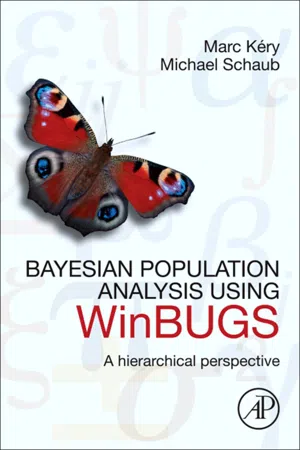
eBook - ePub
Bayesian Population Analysis using WinBUGS
A Hierarchical Perspective
- 554 pages
- English
- ePUB (mobile friendly)
- Available on iOS & Android
eBook - ePub
Bayesian Population Analysis using WinBUGS
A Hierarchical Perspective
About this book
Bayesian statistics has exploded into biology and its sub-disciplines, such as ecology, over the past decade. The free software program WinBUGS, and its open-source sister OpenBugs, is currently the only flexible and general-purpose program available with which the average ecologist can conduct standard and non-standard Bayesian statistics.
- Comprehensive and richly commented examples illustrate a wide range of models that are most relevant to the research of a modern population ecologist
- All WinBUGS/OpenBUGS analyses are completely integrated in software R
- Includes complete documentation of all R and WinBUGS code required to conduct analyses and shows all the necessary steps from having the data in a text file out of Excel to interpreting and processing the output from WinBUGS in R
Information
Table of contents
- Cover image
- Table of Contents
- Front Matter
- Copyright
- Dedication
- Foreword
- Preface
- Acknowledgments
- Chapter 1. Introduction
- Chapter 2. Brief Introduction to Bayesian Statistical Modeling
- Chapter 3. Introduction to the Generalized Linear Model
- Chapter 4. Introduction to Random Effects
- Chapter 5. State-Space Models for Population Counts
- Chapter 6. Estimation of the Size of a Closed Population from Capture–Recapture Data
- Chapter 7. Estimation of Survival from Capture–Recapture Data Using the Cormack–Jolly–Seber Model
- Chapter 8. Estimation of Survival Using Mark-Recovery Data
- Chapter 9. Estimation of Survival and Movement from Capture–Recapture Data Using Multistate Models
- Chapter 10. Estimation of Survival, Recruitment, and Population Size from Capture–Recapture Data Using the Jolly–Seber Model
- Chapter 11. Estimation of Demographic Rates, Population Size, and Projection Matrices from Multiple Data Types Using Integrated Population Models
- Chapter 12. Estimation of Abundance from Counts in Metapopulation Designs Using the Binomial Mixture Model
- Chapter 13. Estimation of Occupancy and Species Distributions from Detection/Nondetection Data in Metapopulation Designs Using Site-Occupancy Models
- Chapter 14. Concluding Remarks
- Appendix 1. A List of WinBUGS Tricks
- Appendix 2. Two Further Useful Multistate Capture–Recapture Models
- References
- Index
Trusted by 375,005 students
Access to over 1.5 million titles for a fair monthly price.
Study more efficiently using our study tools.
Frequently asked questions
Yes, you can cancel anytime from the Subscription tab in your account settings on the Perlego website. Your subscription will stay active until the end of your current billing period. Learn how to cancel your subscription
No, books cannot be downloaded as external files, such as PDFs, for use outside of Perlego. However, you can download books within the Perlego app for offline reading on mobile or tablet. Learn how to download books offline
Perlego offers two plans: Essential and Complete
- Essential is ideal for learners and professionals who enjoy exploring a wide range of subjects. Access the Essential Library with 800,000+ trusted titles and best-sellers across business, personal growth, and the humanities. Includes unlimited reading time and Standard Read Aloud voice.
- Complete: Perfect for advanced learners and researchers needing full, unrestricted access. Unlock 1.5M+ books across hundreds of subjects, including academic and specialized titles. The Complete Plan also includes advanced features like Premium Read Aloud and Research Assistant.
We are an online textbook subscription service, where you can get access to an entire online library for less than the price of a single book per month. With over 1.5 million books across 990+ topics, we’ve got you covered! Learn about our mission
Look out for the read-aloud symbol on your next book to see if you can listen to it. The read-aloud tool reads text aloud for you, highlighting the text as it is being read. You can pause it, speed it up and slow it down. Learn more about Read Aloud
Yes! You can use the Perlego app on both iOS and Android devices to read anytime, anywhere — even offline. Perfect for commutes or when you’re on the go.
Please note we cannot support devices running on iOS 13 and Android 7 or earlier. Learn more about using the app
Please note we cannot support devices running on iOS 13 and Android 7 or earlier. Learn more about using the app
Yes, you can access Bayesian Population Analysis using WinBUGS by Marc Kéry,Michael Schaub,Marc Kery in PDF and/or ePUB format, as well as other popular books in Biological Sciences & Ecology. We have over 1.5 million books available in our catalogue for you to explore.