- 214 pages
- English
- ePUB (mobile friendly)
- Available on iOS & Android
eBook - ePub
About this book
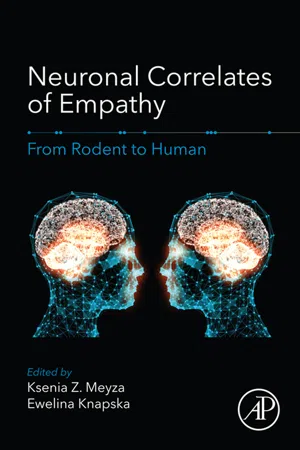
Neuronal Correlates of Empathy: From Rodent to Human explores the neurobiology behind emotional contagion, compassionate behaviors and the similarities in rodents and human and non-human primates. The book provides clear and accessible information that avoids anthropomorphisms, reviews the latest research from the literature, and is essential reading for neuroscientists and others studying behavior, emotion and empathy impairments, both in basic research and preclinical studies. Though empathy is still considered by many to be a uniquely human trait, growing evidence suggests that it is present in other species, and that rodents, non-human primates, and humans share similarities.
- Examines the continuum of behavioral and neurobiological responses between rodents—including laboratory rodents and monogamic species—and humans
- Contains coverage of humans, non-human primates, and the emerging area of rodent studies
- Explores the possibility of an integrated neurocircuitry for empathy
Information
Chapter 1
Introduction–Empathy Beyond Semantics
Ewelina Knapska
Ksenia Z. Meyza Nencki Institute of Experimental Biology, Polish Academy of Sciences, Warsaw, Poland
From the second half of the 18th and throughout the 19th century, philosophers discussed our ability to “feel into” works of art and nature as an explanatory account of the phenomenological immediacy of our aesthetic experiences. According to these theories, aesthetic appreciation of objects was achieved by projecting one’s own imagined feelings onto the world (https://plato.stanford.edu/entries/empathy/). It is, however, a German philosopher, Theodor Lipps (1851–1914), who is remembered as the father of the first scientific theory of Einfühlung (literally meaning “feeling-into”). Lipps broadened the meaning of this term from a concept of philosophical aesthetics to a central category of social sciences by explaining how people understand the mental states of others. He adapted Hume’s concept of “sympathy,” a process that allows the contents of “the minds of men” to become “mirrors to one another”. According to Lipps, the unconscious process of Einfühlung, entailed a sense of merging the observer with the observed (Montag, Gallinat, & Heinz,2008). The resonance was achieved by “inner imitation” based on an innate disposition for motor mimicry, that is, triggering processes that give rise to similar kinaesthetic sensations in both the observer and the observed target. Lipps regarded recognition, not only of emotions expressed in bodily gestures or facial expressions, but of all mental activities (intellectual empathy) as being based on inner imitation. Although considered speculative in his time, Lipps’s theory of “inner imitation” has some reflection in present-day concepts to be discussed in detail later.
The term Einfühlung, translated as empathy from the Greek έμπάθεια (empatheia) and literally meaning έν (en), “in/at” + πάθοζ (pathos) ”passion/suffering,” was introduced into the English language by the psychologist Edward Titchener in 1909. As its debut in the English language, empathy has been discussed mainly from the clinical perspective of nursing, psychotherapy, and psychiatry and has received more attention from health care professionals and philosophers than neuropsychologists. Social cognition in humans, the psychological processes that allow us to make inferences about other people’s intentions, feelings, and thoughts, did not begin to attract the attention of researchers until the 1980s. A revival of scientific interest in social psychological phenomena started in 1985 with the publication of “Social Brain. Discovering the Networks of the Mind.” by Michael Gazzaniga (Gazzaniga,1985). This was the first modern attempt to link social behavior with the function of the brain.
In psychology, empathy has been traditionally a subject of study in the domain of social cognitive neuroscience rather than social neuroscience. The latter is centered on understanding the brain structures involved in social motivation including the amygdala, hypothalamus, brainstem, and basal ganglia, rather than on cognitive processing. Social cognitive neuroscience, on the other hand, deals with higher-order cognitive processes found predominantly in humans and nonhuman primates and is related to associative cortical areas (Easton & Emery,2004). The exploration of neuronal mechanisms of social interactions started with single-unit recordings in the cortex of primates. Studies in the 1980s and 90s produced several important discoveries: for instance, identification of neurons in the anterior temporal cortex that were selective to social stimuli, such as faces (Bruce, Desimone, & Gross,1981; Perrett, Rolls, & Caan,1982) and neurons in the superior temporal sulcus that responded to the presence of socially significant motion, such as eye gaze movement (Perrett etal.,1989). Giacomo Rizzolatti’s group, conducting single-unit recordings from macaque premotor a...
Table of contents
- Cover
- Title page
- Table of Contents
- Copyright
- Dedication
- List of Contributors
- Preface
- Chapter 1: Introduction–Empathy Beyond Semantics
- Chapter 2: The Vicarious Brain: Integrating Empathy and Emotional Learning
- Chapter 3: The Neural Bases of Empathy in Humans
- Chapter 4: Neural Correlates of Empathy in Humans, and the Need for Animal Models
- Chapter 5: Ethological Approaches to Empathy in Primates
- Chapter 6: Mirror Neurons, Embodied Emotions, and Empathy
- Chapter 7: The Neurobiological Influence of Stress in the Vole Pair Bond
- Chapter 8: The Social Transmission of Associative Fear in Rodents—Individual Differences in Fear Conditioning by Proxy
- Chapter 9: Neuronal Correlates of Remote Fear Learning in Rats
- Chapter 10: Lost in Translation: Improving Our Understanding of Pain Empathy
- Chapter 11: Relief From Stress Provided by Conspecifics: Social Buffering
- Chapter 12: Helping Behavior in Rats
- Chapter 13: Challenging Convention in Empathy Research: Developing a Mouse Model and Initial Neural Analyses
- Chapter 14: Lack of Empathy—Mouse Models
- Chapter 15: Future Directions, Outstanding Questions
- Index
Trusted by 375,005 students
Access to over 1.5 million titles for a fair monthly price.
Study more efficiently using our study tools.
Frequently asked questions
Yes, you can cancel anytime from the Subscription tab in your account settings on the Perlego website. Your subscription will stay active until the end of your current billing period. Learn how to cancel your subscription
No, books cannot be downloaded as external files, such as PDFs, for use outside of Perlego. However, you can download books within the Perlego app for offline reading on mobile or tablet. Learn how to download books offline
Perlego offers two plans: Essential and Complete
- Essential is ideal for learners and professionals who enjoy exploring a wide range of subjects. Access the Essential Library with 800,000+ trusted titles and best-sellers across business, personal growth, and the humanities. Includes unlimited reading time and Standard Read Aloud voice.
- Complete: Perfect for advanced learners and researchers needing full, unrestricted access. Unlock 1.5M+ books across hundreds of subjects, including academic and specialized titles. The Complete Plan also includes advanced features like Premium Read Aloud and Research Assistant.
We are an online textbook subscription service, where you can get access to an entire online library for less than the price of a single book per month. With over 1.5 million books across 990+ topics, we’ve got you covered! Learn about our mission
Look out for the read-aloud symbol on your next book to see if you can listen to it. The read-aloud tool reads text aloud for you, highlighting the text as it is being read. You can pause it, speed it up and slow it down. Learn more about Read Aloud
Yes! You can use the Perlego app on both iOS and Android devices to read anytime, anywhere — even offline. Perfect for commutes or when you’re on the go.
Please note we cannot support devices running on iOS 13 and Android 7 or earlier. Learn more about using the app
Please note we cannot support devices running on iOS 13 and Android 7 or earlier. Learn more about using the app
Yes, you can access Neuronal Correlates of Empathy by Ksenia Z. Meyza,Ewelina Knapska in PDF and/or ePUB format, as well as other popular books in Biological Sciences & Neuroscience. We have over 1.5 million books available in our catalogue for you to explore.