- 304 pages
- English
- ePUB (mobile friendly)
- Available on iOS & Android
eBook - ePub
Advances in Quaternary Entomology
About this book
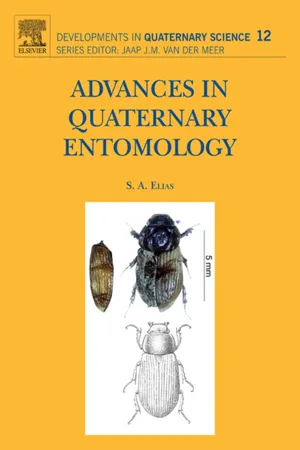
Advances in Quaternary Entomology addresses the science of fossil insects by demonstrating their immense contribution to our knowledge of the paleoenvironmental and climatological record of the past 2.6 million years. In this comprehensive survey of the field, Scott A. Elias recounts development of scholarship, reviews the fossil insect record from Quaternary deposits throughout the world, and points to rewarding areas for future research. The study of Quaternary entomology is becoming an important tool in understanding past environmental changes. Most insects are quite specific as to habitat requirements, and those in non-island environments have undergone almost no evolutionary change in the Quaternary period. We therefore can use their modern ecological requirements as a basis for interpreting what past environments must have been like.
- Describes and identifies principal characteristics of fossil insect groups of the Quaternary period
- Ties Quaternary insect studies to the larger field of paleoecology
- Offers global coverage of the subject with specific regional examples
- Illustrates specific methods and procedures for conducting research in Quaternary Entomology
- Offers unique insight into overlying trends and broader implications of Quaternary climate change based on insect life of the period
Information
Table of contents
- Cover image
- Table of Contents
- Foreword
- 1 The History of Quaternary Insect Studies
- 2 Methods
- 3 Important Fossil Insect Groups and Their Identification
- 4 The Value of Insects in Paleoecology
- 5 Paleoclimatic Studies Using Insects
- 6 Insect Zoogeography in the Quaternary
- 7 The Use of Insect Fossils in Archeology
- 1. Types of Anthropogenic Deposits Yielding Insects
- 2. Environmental Indications from Insects
- 3. Special Methods for Archeological Sites
- 4. British Studies
- 5. Studies in Western Europe (Fig. 7; Table 3)
- 6. North African and Middle Eastern Studies
- 7. Studies in the North Atlantic Region (Figs. 14 and 15; Table 5)
- 8. Insect Fossils in New World Archeological Sites (Table 6; Fig. 16)
- 9. South American Archeology
- 10. Comparison with European and other Old World Studies
- 8 European Studies
- 9 Siberian Studies
- 10 Eastern Beringian Studies
- 11 Other Studies in the New World
- 12 Japanese Studies
- 13 Studies in Australia and New Zealand
- 14 Beetle Chitin Isotope Studies
- 15 Ancient DNA Studies
- 16 Conclusions and Prospectus
- References
Trusted by 375,005 students
Access to over 1.5 million titles for a fair monthly price.
Study more efficiently using our study tools.
Frequently asked questions
Yes, you can cancel anytime from the Subscription tab in your account settings on the Perlego website. Your subscription will stay active until the end of your current billing period. Learn how to cancel your subscription
No, books cannot be downloaded as external files, such as PDFs, for use outside of Perlego. However, you can download books within the Perlego app for offline reading on mobile or tablet. Learn how to download books offline
Perlego offers two plans: Essential and Complete
- Essential is ideal for learners and professionals who enjoy exploring a wide range of subjects. Access the Essential Library with 800,000+ trusted titles and best-sellers across business, personal growth, and the humanities. Includes unlimited reading time and Standard Read Aloud voice.
- Complete: Perfect for advanced learners and researchers needing full, unrestricted access. Unlock 1.5M+ books across hundreds of subjects, including academic and specialized titles. The Complete Plan also includes advanced features like Premium Read Aloud and Research Assistant.
We are an online textbook subscription service, where you can get access to an entire online library for less than the price of a single book per month. With over 1.5 million books across 990+ topics, we’ve got you covered! Learn about our mission
Look out for the read-aloud symbol on your next book to see if you can listen to it. The read-aloud tool reads text aloud for you, highlighting the text as it is being read. You can pause it, speed it up and slow it down. Learn more about Read Aloud
Yes! You can use the Perlego app on both iOS and Android devices to read anytime, anywhere — even offline. Perfect for commutes or when you’re on the go.
Please note we cannot support devices running on iOS 13 and Android 7 or earlier. Learn more about using the app
Please note we cannot support devices running on iOS 13 and Android 7 or earlier. Learn more about using the app
Yes, you can access Advances in Quaternary Entomology by Scott A. Elias,Scott Elias in PDF and/or ePUB format, as well as other popular books in Biological Sciences & Entomology. We have over 1.5 million books available in our catalogue for you to explore.