eBook - ePub
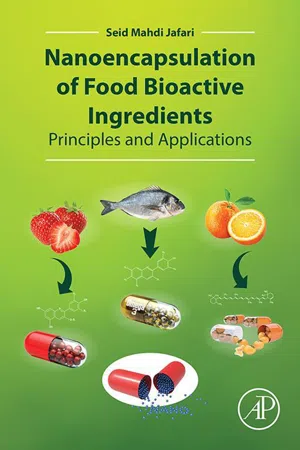
Nanoencapsulation of Food Bioactive Ingredients
Principles and Applications
- 500 pages
- English
- ePUB (mobile friendly)
- Available on iOS & Android
eBook - ePub
About this book
Nanoencapsulation of Food Bioactive Ingredients: Principles and Applications brings different nanoencapsulated food bioactive ingredients, their structure, applications, preparation, formulations and encapsulation methodologies, covering a wide range of compounds and giving detailed examples of the issues faced in their nano-encapsulation. The book addresses findings related to the study of natural food colorants, vitamins, antimicrobial agents, phenolic compounds, antioxidants, flavors, essential oils, fish oil and essential fatty acids, and other related ingredients. As a definitive manual for researchers and industry personnel working, or interested in, various branches of encapsulation for food ingredients and nutraceutical purposes, users will find this a great reference.
- Explains different categories of nanoencapsulated food ingredients, covering their applications, nanoencapsulation techniques, release mechanisms and characterization methods
- Addresses findings related to the study of natural food colorants, vitamins, antimicrobial agents, phenolic compounds, antioxidants, flavors and essential oils
- Provides a deep understanding and potential of nanoencapsulated food ingredients, as well as their novel applications in functional foods and nutraceutical systems
Trusted by 375,005 students
Access to over 1.5 million titles for a fair monthly price.
Study more efficiently using our study tools.
Information
Chapter 1
An Introduction to Nanoencapsulation Techniques for the Food Bioactive Ingredients
Seid Mahdi Jafari, Gorgan University of Agricultural Sciences and Natural Resources, Gorgan, Iran
Abstract
Various nanoencapsulation techniques for food bioactive components and nutraceuticals have been studied in the last couple of years including nanoemulsions; nanostructured lipid carriers; nanosuspensions; solid–lipid nanoparticles (NPs); nanosized liposomes and phytosomes; biopolymer NPs; and micelles made of proteins, polysaccharides, and their complexes or conjugates. These techniques yield nanoscale carriers (10–1000 nm). In this chapter, we have classified nanoencapsulation technologies into five groups based on the main mechanism/ingredient, which is being used to make nanocapsules. They include lipid-based techniques, nature-inspired techniques, specialized-equipment techniques, biopolymer-based techniques, and disparate techniques. Most of the bioactive compounds, such as hydrophobic vitamins, fatty acids, flavonoids, aromas, preservatives, etc., have hydrophobic natures which can be encapsulated by lipid-based nanocapsules. The idea of bioactives encapsulation using natural nanocarriers such as caseins, cyclodextrins, and amylose nanostructures results from taking into account the nature-made functionalities of these NPs. For the nanoencapsulation of food ingredients using different technologies, it is necessary to apply some general equipment including homogenizers, mills, mixing devices, etc., but there are some nanoencapsulation techniques which are feasible to implement only by specialized developed equipment such as electrospinning, electrospraying, nanospray dryer, and microfluidics devices. Utilization of individual biopolymer NPs and also complexes of biopolymer NPs along with nanogels and nanotubes made with biopolymers are another group of nanocarriers have been covered in this chapter. Finally, some miscellaneous techniques such as nanocrystals and dentrimeters have been described briefly.
Keywords
Nanocarriers; nanoencapsulation; techniques; food ingredients; classification
1.1 Introduction
Nanocapsules are defined in the literature as mostly an oily or hydrophilic cavity surrounded by a thin wall material (Jafari, Fathi, & Mandala, 2015). A broad variety of wall materials, such as biopolymers (proteins, carbohydrates), lipids, chemical polymers, surfactants, etc., can be used for the preparation of nanocapsules (Fathi, Martín, & McClements, 2014; Fathi, Mozafari, & Mohebbi, 2012). Nanocapsules are promising applications, since they are ideal for the encapsulation of many different bioactive ingredients such as antioxidants, antimicrobial agents, phenolic compounds, natural pigments, peptides, essential fatty acids, minerals, etc. (Borel & Sabliov, 2014; Ezhilarasi, Karthik, Chhanwal, & Anandharamakrishnan, 2013).
The implementation of nanotechnology that basically focuses on the medical science and diagnostic field is well known as nanomedicine. The term has been defined as “monitoring, repair, construction, and control of human biological systems at the molecular level using engineered nanodevices and nanostructures” (Kumari, Singla, Guliani, & Yadav, 2014; Nitta & Numata, 2013). Some applications of nanotechnology in medicine are promising and many advantages have been offered in various medical areas such as targeted drug-delivery system and gene-targeted therapy. As many other medical areas, drug-delivery system experiences substantial growth concomitant with the advancement of nanotechnology over the past few years. Similarly, nutraceutical delivery system is an interdisciplinary field of studies applying knowledge from vast array of disciplines including biology, chemistry, pharmaceutical, and food sciences in combined fields of engineering and technology (Livney, 2015; McClements, 2015). In fact, it is one of the current nanotechnology advances employing nanosized particles for various manipulations either for technological or therapeutic purposes based on the nanotechnology concept.
Supposedly, an ideal nutraceutical-delivery system should transport bioactive molecules at particular sites without releasing its cargo at the previous points. Lately, many extensive efforts have been devoted to search for an appropriate technique to overcome some of the problems via research and development programs globally. It is then a practical role of delivery carrier being introduced in the process and the exploration for remarkable delivery vehicles has been interesting yet challenging area of research over the past decades. In this regard, the demanding exploration of delivery agents remains ongoing covering many aspects of research including on types of materials, physical and chemical properties as well as surface characterization of delivery carriers. In fact, sorts of materials have been profoundly studied since the past few years to efficiently construct an effective carrier such as inorganic nanomaterials, carbon nanotubes, gold, silver, and polymer-based nanoparticles (NPs) (Neves, Hashemi, & Prentice, 2015; Paredes, Asencio, Manuel, Allemandi, & Palma, 2016). Therefore, there is a broad range of nanosized encapsulation systems, most of them are still in the academic labs, only a very few made it to the market. A nanosized delivery system is scientifically defined in the food and pharmaceutical area as particles with a size of a few nanometers to just below 1000 nm (=1 µm). It should not be mixed up with the legal definition of NPs/nanomaterial for labeling consumer products, e.g., labeling of cosmetic ingredients in the European Union with “nano” are necessary when more than 50% (by number distribution) of the particles have sizes below 100 nm (Quintanilla-Carvajal, Camacho-Díaz et al., 2010; Yada, Buck et al., 2014).
1.2 Nanoencapsulation Techniques
Various nanoencapsulation techniques for food bioactive components and nutraceuticals have been studied in the last couple of years including nanoemulsions; nanostructured lipid carriers (NLCs); nanosuspensions, solid–lipid nanoparticles (SLNs); nanosized liposomes; biopolymer NPs; and micelles made of proteins, polysaccharides, and their complexes or conjugates. These techniques yield nanoscale carriers (10–1000 nm).
From a classical viewpoint, nanoencapsulation technologies can be divided into two main approaches: “top-down” and “bottom-up.” Regarding the “top-down” method, particle size is decreased during the encapsulation process, e.g., by utilizing various mechanical forces; on the contrary, in the “bottom-up” process, particle size is increased by methods, such as self-assembly. Furthermore, in some cases, a combination of both approaches has been used. This classification is not applicable nowadays, and it is better to categorize nanoencapsulation techniques in more groups based on some other indices.
In this book, we have classified nanoencapsulation technologies into five groups based on the main mechanism/ingredient, which is being used to make nanocapsules. They include lipid-based techniques, nature-inspired techniques, specialized-equipment techniques, biopolymer-based techniques, and disparate techniques as shown in Table 1.1. Also, different morphologies and structures of final nanocarriers has been reviewed in Table 1.2.
Table 1.1
An Overview of Nanoencapsulation Techniques for the Food Industry
| No. | Main Groups | Techniques | Different Strategies |
| 1 | Lipid-based techniques | Nano/Microemulsions | Single emulsions: oil in water (O/W); water in oil (W/O) |
| 2 | Double emulsions: W/O/W; O/W/O | ||
| 3 | Structural emulsions: single interface layer; double interface layer | ||
| 4 | Nanostructured phospholipid carriers | Liposomes: monolayer; multilayer | |
| 5 | Phytosomes: monolayer; multilayer | ||
| 6 | Structural liposomes/phytosomes: with coatings | ||
| 7 | Nanolipid carriers | Solid lipid nanoparticles (SLNs) | |
| 8 | Nanostructured lipid carriers (NLCs) | ||
| 9 | Smart lipid carriers | ||
| 10 | Nature-inspired techniques | Caseins | Alpha, beta, gamma-caseins |
| 11 | Cyclodextrins | Alpha, beta, gamma-cyclodextrins | |
| 12 | Amylose | Single helix; double helix | |
| 13 | Special equipment-based techniques | Electrospinning | Single injection nozzle; double injection |
| 14 | Electrospraying | ||
| 15 | Nanospray dryer | ||
| 16 | Microfluidics/Nanofluidics | ||
| 17 | Biopolymer-based techniques | Single biopolymer nanocarriers | Protein nanoparticles made by desolvation |
| 18 | Polysaccharide nanoparticles made by precipitation | ||
| 19 | Complexd biopolymer nanocarriers | Protein + protein | |
| 20 | Polysaccharide + polysaccharide | ||
| 21 | Protein + polysaccharide | ||
| 22 | Nanogels | Hydrogels | |
| 23 | Organogels/Oleogels | ||
| 24 | Mixed gels | ||
| 25 | Nanotubes | Protein nanotubes made with alpha-lactalbumin | |
| 26 | Other techniques | Nanocrystals | Bioactives within crystals |
| 27 | Bioactive crystals within other nanocarriers | ||
| 28 | Nanostructured surfactants | Niosomes | |
| 29 | Dendrimeters |

Table 1.2
Different Morphologies and Structures for Nanocarriers of Food Ingredients and Nutraceuticals
| No. | Main Groups | Structures | Different Forms |
| 1 | Spherical nanocarriers | Nanocapsules | Liquid form: Nanocarriers made with nanoemulsions; nanostructured lipid carriers; nanoliposomes/phytosomes; cyclodextrins; electrospraying; microfluidics; biopolymer nanoparticles; niosomes; dendrimeters |
| 2 | Dried form (containing a void): nanocarriers made with nanospray dryer, nanocrystals | ||
| 3 | Nanospheres | Nanogels; casein nanocarriers | |
| 4 | Tubular nanocarriers | Filled fibers | Electrospun fibers |
| 5 | Hollow tubes | Protein nanotunes | |
| 6 | Helix forms | Amylose nanocarriers |

In the following sections, we will discuss briefly different techniques used for the nanoencapsulation of food bioactive ingredients. Much more details are provided in our previous book titled “Nanoencapsulation technologies for the food and nutraceutical industries,” in which each chapter has been devoted to one nanoencapsulation technique (Jafari, 2017). It should be mentioned that selection of a nanoencapsulation technology depends on several parameters, such as physicochemical features, required particle size, release type, delivery method, process cost, etc.
1.3 Lipid-Based Nanoencapsulation Techniques
Lipid-based nanoencapsulation systems are mostly used in the pharmaceutical and food industries and research programs. Despite the major advantages of biopolymer nanocapsules, they cannot be mass produced due to the demand for complicated chemical and thermal processes that should be monitored permanently. On the contrary, water-insoluble nanocarriers have the possibility to be scaled up plus the potential of more encapsulation efficiency and low toxicity (Fathi, Mozafari et al., 2012; Tamjidi, Shahedi, Varshosaz, & Nasirpour, 2013).
Most of the bioactive compounds, such as hydrophobic vitamins, fatty acids, flavonoids, arom...
Table of contents
- Cover image
- Title page
- Table of Contents
- Copyright
- In the Name of GOD
- Dedication
- I am deathless, I am the eternal Lord
- List of Contributors
- Preface
- Chapter 1. An Introduction to Nanoencapsulation Techniques for the Food Bioactive Ingredients
- Chapter 2. Nanoencapsulation of Phenolic Compounds and Antioxidants
- Chapter 3. Nanoencapsulation of Fish Oil and Essential Fatty Acids
- Chapter 4. Nanoencapsulation of Vitamins
- Chapter 5. Nanoencapsulation of Food Antimicrobial Agents and Essential Oils
- Chapter 6. Nanoencapsulation of Natural Food Colorants
- Chapter 7. Nanoencapsulation of Flavors
- Chapter 8. Nanoencapsulation of Enzymes, Bioactive Peptides, and Biological Molecules
- Chapter 9. Nanoencapsulation of Minerals
- Chapter 10. Release, Characterization, and Safety of Nanoencapsulated Food Ingredients
- Index
Frequently asked questions
Yes, you can cancel anytime from the Subscription tab in your account settings on the Perlego website. Your subscription will stay active until the end of your current billing period. Learn how to cancel your subscription
No, books cannot be downloaded as external files, such as PDFs, for use outside of Perlego. However, you can download books within the Perlego app for offline reading on mobile or tablet. Learn how to download books offline
Perlego offers two plans: Essential and Complete
- Essential is ideal for learners and professionals who enjoy exploring a wide range of subjects. Access the Essential Library with 800,000+ trusted titles and best-sellers across business, personal growth, and the humanities. Includes unlimited reading time and Standard Read Aloud voice.
- Complete: Perfect for advanced learners and researchers needing full, unrestricted access. Unlock 1.5M+ books across hundreds of subjects, including academic and specialized titles. The Complete Plan also includes advanced features like Premium Read Aloud and Research Assistant.
We are an online textbook subscription service, where you can get access to an entire online library for less than the price of a single book per month. With over 1.5 million books across 990+ topics, we’ve got you covered! Learn about our mission
Look out for the read-aloud symbol on your next book to see if you can listen to it. The read-aloud tool reads text aloud for you, highlighting the text as it is being read. You can pause it, speed it up and slow it down. Learn more about Read Aloud
Yes! You can use the Perlego app on both iOS and Android devices to read anytime, anywhere — even offline. Perfect for commutes or when you’re on the go.
Please note we cannot support devices running on iOS 13 and Android 7 or earlier. Learn more about using the app
Please note we cannot support devices running on iOS 13 and Android 7 or earlier. Learn more about using the app
Yes, you can access Nanoencapsulation of Food Bioactive Ingredients by Seid Mahdi Jafari in PDF and/or ePUB format, as well as other popular books in Technology & Engineering & Food Science. We have over 1.5 million books available in our catalogue for you to explore.