eBook - ePub
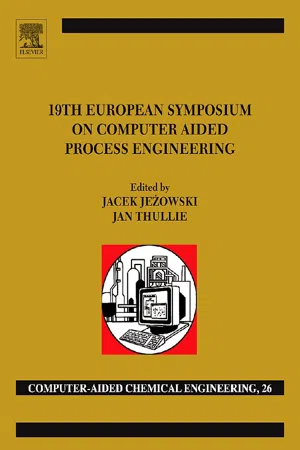
19th European Symposium on Computer Aided Process Engineering
ESCAPE-19: June 14-17, 2009, Cracow, Poland
- 1,200 pages
- English
- ePUB (mobile friendly)
- Available on iOS & Android
eBook - ePub
19th European Symposium on Computer Aided Process Engineering
ESCAPE-19: June 14-17, 2009, Cracow, Poland
About this book
The 19th European Symposium on Computer Aided Process Engineering contains papers presented at the 19th European Symposium of Computer Aided Process Engineering (ESCAPE 19) held in Cracow, Poland, June 14-17, 2009.The ESCAPE series serves as a forum for scientists and engineers from academia and industry to discuss progress achieved in the area of CAPE.
- CD-ROM that accompanies the book contains all research papers and contributions
- International in scope with guest speeches and keynote talks from leaders in science and industry
- Presents papers covering the latest research, key top areas and developments in computer aided process engineering (CAPE)
Information
Table of contents
- Cover Image
- Table of Contents
- Preface
- On the appropriate architecture of the water/wastewater allocation problem in process plants
- Perspectives of Application of Computer Aided Process Engineering Tools in Clinical Medicine
- The Development of an Advanced Systems Synthesis Environment: Integration of MI(NL)P Methods and Tools for Sustainable Applications
- Integration of chemical product development, process synthesis, and operation optimization
- Uncertainty, decomposition and feedback in batch production scheduling
- Hybrid Molecular QSAR Model for Toxicity Estimation: Application to Ionic Liquids
- Prediction of Phase Equilibrium Related Properties by Correlations Based on Similarity of Molecular Structures
- Systematic selection of extraction solvents in the aromatics production
- Towards Nanomaterial Design Automation: Hierarchical Computational Architecture Development
- Vibrational spectra of methane hydrate by Molecular Dynamics
- A Comparison of Deterministic and Stochastic Approaches to Solve the Facility Layout Problem with Toxic Releases
- Analysis of chemical routes and processes for production of glycerol ethers
- Model-based retrofit design and analysis of petrochemical processes
- Modelling and experimental validation of emulsification process in continuous rotor-stator units
- Modeling and simulation of a hybrid separation process for the carbon dioxide removal of the oxidative coupling of methane process
- Analysis of oxidative coupling of methane in membrane reactors
- Impact resistance of hetero-phase polymeric materials
- Information flow modeling and data mining in high-throughput discovery of functional nanomaterials
- Model Based Prediction of Crystal Shape Distributions
- Multi-objective dynamic optimization of fixed bed dryers: simulation and experiments
- Decomposition Techniques for Multiscale Structured Product Design: Molecular Synthesis
- Ontological informatics based decision support system for pharmaceutical product development: Milling as a case study
- Selection of process scheme and conditions for drying of pharmaceutical materials
- A first-principles model for the freezing step in ice cream manufacture
- A Framework for Solvent Selection Based on Optimal Separation Process Design and Controllability Properties
- Design and Optimization of Advanced Materials and Processes for Efficient Hydrogen storage
- Design and Optimization of Thermally Coupled Extractive Distillation Sequences
- Evaluation and Application of the Extended TBP Curves in Processing and Refining of Heavy Oil Fractions
- Integrated Design of Solvent-Based Extractive Separation Processes Including Experimental Validation
- Liquid solutions evaporation accompanied with mass transfer resistance in liquid phase
- Mineral Processing Flow Sheet Design Through A Group Contribution Method
- Modeling of separation process in a chromatographic column packed with porous adsorbents
- Process and Equipment Design Optimising Product properties and attributes
- Product Driven Process Synthesis Methodology
- Property based product design using combined property clustering and GC+ techniques
- Reaction networks – A rapid screening method
- The Virtual Product-Process Design Laboratory as a Tool for Product Development
- Anomaly detection in batch chemical processes
- Data-driven generation of multi-modal control programs for continuous-discrete processes
- DICA enhanced SVM classification approach to fault diagnosis for chemical processes
- Inferential estimation of kerosene dry point in refineries with varying crudes
- Model-Based Linear Control of Polymerization Reactors
- Optimal bifurcation tailoring based transition control of reactor separation recycle systems
- Quality by design approach in drying process organization
- Robust Multi-Parametric Model-Based Control
- Adaptation and testing of data reconciliation software for CAPE-OPEN compliance
- A LabVIEW-based intelligent system for monitoring of bioprocesses
- Approximate Method for Optimal Instrumentation Network Design
- A software tool for design of process monitoring and analysis systems
- Enhanced Predictive Modeling Using Multi Block Methods
- Development and Experimental Verification of Model-Based Process Control using Mixed-Reality Environments
- Fault detection of dynamic processes using a simplified monitoring-specific CVA state space approach
- Fault diagnosis and process monitoring through model-based and case based reasoning
- Online monitoring of nanoparticle suspensions using dynamic light scattering, ultrasound spectroscopy and process tomography
- Variance of Estimates in Dynamic Data Reconciliation
- A Hybrid Multiple Populations Evolutionary Algorithm for Two Stage Batch Planning Problems with Disjunctive Decisions
- A MILP Scheduling Model for Multi-stage Batch Plants
- Factory operations modelling methodology applied to a case study
- Integrated Operational Planning and Scheduling under Uncertainty
- Iterative learning control of a crystallisation process using batch wise updated linearised models identified using PLS
- Medium-term planning of multistage multiproduct continuous plants using mixed integer optimisation
- Optimal operation of a real multiproduct pipeline and storage system: Economical versus Operational Objectives
- Optimal Scheduling of Multistage, Multiproduct, Batch Plants with Parallel Units and Sequence Dependent Changeovers
- Optimisation of Design, Operation and Scheduling of Batch Reactive Distillation Process with Strict Product Specification and Fixed Product Demand using gPROMS
- Planning and Scheduling of Solar Salt Harvest
- Scheduling of a Multiproduct Batch Plant under Multiperiod Demand Uncertainties by Means of a Rolling Horizon Strategy
- Short-Term Operational Planning of Multiple-Source Refined Products Pipelines
- How a process simulator and a rule-based system contribute to virtual reality applications for process safety
- Data Driven Tuning of State Space Control loops with unknown state information and model uncertainty.
- Effect of Multiple Steady-States on Operation Strategy and Control Structure for a Heat Integrated Distillation Column (HIDiC)
- Modeling and Simulation of Gas Pipeline Network for Operational and Infrastructural Decisions
- Modeling of MSMPR crystallizer dynamics – time series prediction by neural network
- Sensitivity study of a heat integrated FCC plant
- A framework for optimal design of reactive distillation columns
- Event-Dynamic Assumptions in First-Principle Network Models and Model Reduction
- Model-based Optimisation and Closed-loop Control of Crystal Shape in Cooling Crystallisation
- Multi-scale evolution of optimal process designs for the production of acetic acid via ethane oxidation
- Multiscale Modelling Framework for Chemical Product-Process Design
- System approach to modeling of pharmaceutical integrated processes: drying, layering and coating
- Transport and reaction in reconstructed porous polyolefin particles
- A New Parallel Tempering Algorithm for Global Optimization: Applications to Bioprocess Optimization
- Anhydrous bioethanol production using bioglycerol – simulation of extractive distillation processes
- An Optimization Framework for Solving a Large Scale Scheduling Problem
- A Projection Approach for Optimization of Distributed Parameter Systems without Gradients
- An Evaluation of a Multi-method Tool for Real-Time Implementation of Two-layer Optimization
- Design and Control of New Intensified Distillation Systems for Quaternary Separations using Genetic Algorithms
- Design of Reactive Distillation with Thermal Coupling for the Synthesis of Biodiesel using Genetic Algorithms
- Dividing wall distillation columns for separation of azeotropic mixtures: feasibility procedure and rigorous optimization
- Environmental Design of IGCC through Pinch Analysis, Process Integration and Parameters Analysis
- Future potential for biomass use in blast furnace ironmaking
- Global optimal synthesis of integrated hybrid desalination plants
- Implementation of a Convexification Technique for Signomial Functions
- Improving efficiency when solving process synthesis problems through translation of variables
- Increasing Throughput of Batch Distillation
- Model and Parameter Identification in Phase Equilibria
- Multicriteria Design framework for CO2 capture by multi-step PSA cycles
- Optimal design of non-linear Temperature Programmed Reduction (TPR) experiments
- Optimization of combined DOC and NSRC diesel car exhaust catalysts
- Optimization of Molasses and Air Feeding Profiles in Fed-Batch Baker's Yeast Fermentation
- Optimization Studies of an Oil Well Drilling Process
- Particle Swarm Optimization for Phase Stability and Equilibrium Calculations in Reactive Systems
- Solution of separation network synthesis problems by the P-graph methodology
- Solving Nonlinear Problems with MILP Models
- Steady-state constrained optimisation for input/output large-scale systems
- The optimal design of heat exchanger networks considering heat exchanger types
- Towards Dynamic Conceptual Design
- CFD Modeling of a jet-pump mixer
- Computational fluid dynamics applied to study the hemodynamics in sangvin vessels. Case study - the portal system.
- Computational Fluid Dynamics Simulation of the Water – Sugar Cane Bagasse Suspension in Pipe with Internal Static Mixer
- Developing a mathematical model for the complete kinetic cycle of direct synthesis of DME from Syngas through the CFD technique
- Multiphase CFD modeling - scale-up of Fluidized-Bed Crystallizer
- Optimisation of a torus reactor geometry using CFD
- Robust and efficient numerical methods for the prediction of pollutants using detailed kinetics and fluid dynamics
- An Approach to the Representation of Gradual Uncertainty Resolution in Stochastic Multiperiod Planning
- Axial dispersion/population balance model of heat transfer in turbulent fluidization
- Dealing with Uncertainty in Polymer Manufacturing by Using Linear Regression Metrics and Sensitivity Analysis
- Detailed mathematical model for pollutants transport in a natural stream
- Developing a mathematical model for Ibuprofen's controlled release accounting for solubility and diffusion effects
- Development of a Computational Tool for Simulating Falling Film Molecular Design
- Dynamic analysis of oscillating flames
- Eliminating the Effect of Multivariate Outliers in PLS-Based Models for Inferring Process Quality
- Feasible Separation Regions for Ternary Mixtures with S-shaped Distillation Lines
- Graph theory and model simplification. Case study: distillation column
- Lactic Acid Recovery in Electro-Enhanced Dialysis: Modelling and Validation
- Maxwell-Stefan in mass fractions for numerical simulation of the pervaporation process
- Modeling of hydrodynamic, mass-exchange and chemical processes in open cell ceramic catalyst
- Modeling of thermal oxidation of silicon: stochastic approach
- Modelling biomass gasifiers
- Modelling of wall-flow filters for diesel particulate removal
- Numerical verification of the statistical moments method used to simplify the reactive adsorption models
- Rate Based Modelling and Simulation Studies of Hybrid Processes consisting of Distillation, Vapour Permeation and Adsorption for the dehydration of ethanol
- Simulating the change in shape factor for solid particles used in flue gas desulfurization and reacting in stirred batch systems. A mathematical model.
- Simulation and optimization of the continuous vacuum extractive fermentation for bioethanol production and evaluation of the influence on distillation process
- Strategy for Validating a Population Balance Model of a Batch Crystallization Process Using Particle Size Distribution from Image-based Sensor
- A New Model-Based Methodology for Simultaneous Design and Control of Reaction-Separation System with Recycle
- Biodiesel by Reactive Absorption – Towards Green Technologies
- Distributed wastewater treatment network design with detailed models of processes
- Dynamic simulation of Chemical Engineering systems using OpenModelica and CAPE-OPEN
- Integration of superstructure-based optimization and semantic models for the synthesis of reactor networks
- Modeling using higraphs: an integrating approach
- Interval Based MINLP Superstructure Synthesis of Multi-Period Mass Exchange Networks
- Towards an ontological infrastructure for chemical batch process management
- A co-operative model combining computer algebra and numerical calculation for simulation
- Adaptive moving pivot technique for growth dominated population balance equations
- An Efficient Discretization Approach for Partial Differential Equations describing Chemical Reaction Systems
- A new numerical solution scheme for tracking sharp moving fronts
- Criteria for Outliers Detection in Nonlinear Regression Problems
- Global Optimisation of mp-MILP Problems
- Improving the Morris method for sensitivity analysis by scaling the elementary effects
- Spectral reduction on empirically derived orthogonal basis of the dynamical model of a Circulating Fluidized Bed Combustor
- Tight, Efficient Bounds for Chemical Kinetics Models
- 3D Reversible Cellular Automata for Simulation of the Drug Release from Aerogel-Drug Formulations
- A new experimental relation for effective thermal conductivity of nanofluids
- Application of Klein's equation for description of viscosity of nanofluid
- Diffusion in semi-crystalline polymers
- Numerical simulation of heat transfer in nanofluids
- A Continuous-Time Approach to Supply Chain Planning: Managing Product Portfolios subject to Market Uncertainty under Different Partnership Structures
- Agent based model for performance analysis of a global chemical supply chain during normal and abnormal situations
- Agent Based Modelling and Simulation of Intelligent Distributed Scheduling Systems
- Optimal Design of Large-Scale Supply Chain with Multi-Echelon Inventory and Risk Pooling under Demand Uncertainty
- Optimal Planning of Supply Chains for Bioethanol and Sugar Production with Economic and Environmental Concerns
- Optimisation of Regional Energy Supply Chains Utilising Renewables: P-Graph Approach
- The supply-chain pick-up and delivery problem with transshipments
- How to Estimate True Effect of Changing Operating Condition on Product Quality: ICA-Based Approach
- Information system in the field of carbon nanomaterials
- Managing financial risk in the coordination of supply chain and product development decisions
- Normalization for cDNA microarray data of gene expression profiles from the human prostate cancer cell lines (PC3) by Pre-Processing Two-Color Data
- Reconstruction of flame kinematics and analysis of cycle variation in a Spark Ignition Engine by means of Proper Orthogonal Decomposition
- A global optimization strategy to identify quantitative design principles for gene expression in yeast adaptation to heat shock
- A Graph Theory Augmented Math Programming Approach to Identify Genetic Targets for Strain Improvement
- An MINLP Formulation for the Synthesis of Chromatographic Protein Purification Processes with Product Loss
- Combinatorial Optimisation Algorithms for Strategic Biopharmaceutical Portfolio & Capacity Management
- Dynamic Simulation Framework for Design of Lean Biopharmaceutical Manufacturing Operations
- Global Sensitivity Analysis in dynamic metabolic networks
- Method for determination of the reaction kinetics of an enzymatic conversion in a heterogeneous system
- An Integrated Ontology for Operational Processes
- Bulk Video Imaging for Nucleation Detection and Metastable Zone Determination of Pharmaceutical and Food Crystallization Processes
- Design of environmentally friendly absorption cooling systems via multi-objective optimization and life cycle assessment
- Environmental Sustainability Normalization of Industrial Processes
- Sustainable resource consumption assessment on LCA's basis
- Accident Prevention by Control System Reconfiguration
- Activity and Information Modeling of Comprehensive Assessment for Sustainable Process Design
- A Goal Based HAZOP Assistant
- A Systematic Approach to Determine Economic Potential and Environmental Impact of Biorefineries
- Computer Aided Chemical Exposure Estimation in Process Design
- Fast response model for dense gas dispersion accounting for complex geometries
- Middle term optimal control problem in eutrophic lakes through advanced mathematical programming approaches
- Numerical Comparison of Chemical Reactors Safety Criteria
- Sustainable reduction of dredging fleet emissions
- Systematic ontology development of accident databases
- Effect of life cycle impact assessment on the design and scheduling of a recovery network for industrial polluted waste
- Artificial Neural Networks Modelling of PID and Model Predictive Controlled Waste Water Treatment Plant Based on the Benchmark Simulation Model No.1
- Automated Targeting for Total Property-based Network
- Comparison of Control Strategies for Dissolved Oxygen Control in Activated Sludge Wastewater Treatment Process
- Metal ions sorption equilibrium on chitosan foamed structure
- Optimization of Wastewater Treatment Network
- Water Network Synthesis for Mixed Batch-Continuous Processes
- Wastewater Storage Minimisation through the Exploitation of Inherent Storage
- Water-efficiency as Indicator for Industrial Plant Sustainability Assessment
- A Simulation Program for Modelling Pollutant Dispersion for Educational Applications
- Heat and power integration for hydrogen-fuelled Combined Cycle Gas Turbine (CCGT)
- A heat exchanger model to increase energy efficiency in refinery pre heat trains
- CAPE Contribution to Availability and Reliability of Waste to Energy
- A disjunctive programming model for the optimal design of cooling water systems
- A MultiObjective Genetic Algorithm Framework for Electricity / Hydrogen Co-Production From Generation IV Nuclear Energy Systems
- Energy Efficiency Advancements in Wastewater Treatment – Study of Autothermal Thermophilic Aerobic Digestion
- Evaluation of energy vectors poly-generation schemes based on solid fuel gasification processes with Carbon Capture and Storage (CCS)
- Using Process Integration for Steam System Network Optimization with Sustained Boiler Efficiency
- Flexible Separative Reactors for Biodiesel Production
- Graph-theoretic approach to the catalytic-pathway identification of methanol decomposition
- Mathematical Modelling of Feed Pretreatment for Bioethanol Production
Trusted by 375,005 students
Access to over 1.5 million titles for a fair monthly price.
Study more efficiently using our study tools.
Frequently asked questions
Yes, you can cancel anytime from the Subscription tab in your account settings on the Perlego website. Your subscription will stay active until the end of your current billing period. Learn how to cancel your subscription
No, books cannot be downloaded as external files, such as PDFs, for use outside of Perlego. However, you can download books within the Perlego app for offline reading on mobile or tablet. Learn how to download books offline
Perlego offers two plans: Essential and Complete
- Essential is ideal for learners and professionals who enjoy exploring a wide range of subjects. Access the Essential Library with 800,000+ trusted titles and best-sellers across business, personal growth, and the humanities. Includes unlimited reading time and Standard Read Aloud voice.
- Complete: Perfect for advanced learners and researchers needing full, unrestricted access. Unlock 1.5M+ books across hundreds of subjects, including academic and specialized titles. The Complete Plan also includes advanced features like Premium Read Aloud and Research Assistant.
We are an online textbook subscription service, where you can get access to an entire online library for less than the price of a single book per month. With over 1.5 million books across 990+ topics, we’ve got you covered! Learn about our mission
Look out for the read-aloud symbol on your next book to see if you can listen to it. The read-aloud tool reads text aloud for you, highlighting the text as it is being read. You can pause it, speed it up and slow it down. Learn more about Read Aloud
Yes! You can use the Perlego app on both iOS and Android devices to read anytime, anywhere — even offline. Perfect for commutes or when you’re on the go.
Please note we cannot support devices running on iOS 13 and Android 7 or earlier. Learn more about using the app
Please note we cannot support devices running on iOS 13 and Android 7 or earlier. Learn more about using the app
Yes, you can access 19th European Symposium on Computer Aided Process Engineering by Jacek Jezowski,Jan Thullie in PDF and/or ePUB format, as well as other popular books in Technology & Engineering & Chemical & Biochemical Engineering. We have over 1.5 million books available in our catalogue for you to explore.