- 750 pages
- English
- ePUB (mobile friendly)
- Available on iOS & Android
eBook - ePub
Emotion Measurement
About this book
Emotion Measurement reviews academic and applied studies in order to highlight key elements of emotions which should be considered in the development and validation of newer commercial methods of emotion measurement. The goal of the book is practical, but the approach will be both academic and applied. It is aimed primarily at sensory scientists and the product developers they work alongside who require knowledge of measuring emotion to ensure high levels of consumer acceptability of their products.
The book begins with a review of basic studies of emotion, including the theory, physiology, and psychology of emotions – these are the standard studies of which food and sensory scientists as well as product developers need to be aware. The next section highlights methods for studying emotions on a relatively basic level. The book then moves to practical applications, with chapters on emotion research in food and beverage, as well as in a range of product and clinical settings. Finally, there is a treatment of cross-cultural research on emotions. This is critical because much of the newer commercial research is aimed at markets around the world, requiring methods which work in many cultures. The book ends with an integrative summary of the material presented.
- Serves as the first book on the market on emotion measurement aimed at sensory scientists and production development practitioners working in commercial R and D
- Also useful for psychologists with an interest in emotion
- Brings together applied and academic strands of emotion measurement research for the first time
- Focuses on cross-cultural studies of emotions, which is currently lacking from most of the literature in the field
Information
Subtopic
Personality in PsychologyIndex
PsychologyPart I
Basic Studies of Emotion
Outline
1
Theoretical Approaches to Emotion and Its Measurement
Géraldine Coppin1,2,3 and David Sander2,3, 1Max Planck Institute for Metabolism Research, Cologne, Germany, 2Swiss Center for Affective Sciences, Campus Biotech, Geneva, Switzerland, 3Laboratory for the Study of Emotion Elicitation and Expression, Department of Psychology, University of Geneva, Geneva, Switzerland
Abstract
We begin this introductory chapter by presenting some of the different definitions of emotion. We detail the consensual view of emotion, which is to consider emotion as a multicomponent phenomenon (ie, composed of an expression, action tendency, bodily reaction, feeling, and cognitive appraisal). We then describe each of these components, the different indicators typically used to measure them, and their relation to the major current theoretical approaches of emotion. The theories of emotion are grouped in three families, a taxonomy grounded in historical and conceptual reasons that is helpful to grasp theoretical developments in affective sciences, and to systematically present key concepts and theories in the field. Finally, we summarize the key points we have discussed and raise questions for future work. We hope this chapter provides an overview of current theoretical approaches to emotion and its measurement, without neglecting their historical roots. This chapter is also intended to bring the major conceptual foundations for the work described in the following chapters.
Keywords
Expression; Action tendency; bodily reaction; feeling; cognitive appraisal; basic emotion theories; dimensional theories; appraisal theories
1 Introduction
The topic of emotion rarely leaves individuals unemotional. Philosophers in the West have discussed it as early as Socrates’ times (470–399 BC), and many contemporary research traditions find their roots in philosophical approaches developed over the centuries (see Deonna & Teroni, 2012). During the 20th century, advances in experimental psychology and neuroscience allowed for the empirical testing of critical ideas, and the development of new models of emotion. Since the 1980s, there has been an explosion of the scientific study of emotion, and the topic has set off several vibrant debates. Experimental data are accumulating showing that emotion can impact most domains of animal and human cognition and behavior: emotion guides attention, memory, decision-making, and action. Research has led to models describing how emotion is elicited and how the emotional response is organized. Researchers have proposed conceptual clarifications regarding emotion and its regulation, and various methodological developments have allowed advances in the measurement of emotion. “Affective sciences” emerged as a new integrative and interdisciplinary domain investigating emotion and other affective phenomena (Sander & Scherer, 2009) as a result of many disciplines taking an “affective turn” during the last few decades. This domain includes disciplines such as psychology, neuroscience, philosophy, economics, literature, history, sociology, and computer sciences, which taken together aim at understanding, measuring, modeling, and predicting affective reactions.
In this chapter, we will start by discussing some of the different definitions of emotion and present what can be considered as a consensual view, namely that emotion is best defined as a multicomponent concept. We will then describe each of these components, the different indicators used to measure them, and their relation to the major current theoretical approaches of emotion. Finally, we will summarize the key points we have discussed and raise questions for future work. A discussion of affective neuroscience, and how knowledge about the emotional brain has impacted models of emotion is beyond the scope of this chapter, and has been presented and discussed elsewhere in detail (see Armony & Vuilleumier, 2013; Sander, 2013). For the purpose of this chapter, let us mention that research on the emotional brain went hand-in-hand with the development of the conceptual approaches of emotion. Thus, the three theories of emotion discussed in the current chapter have all been linked to the emotional brain (Hamann, 2012; Sander, 2013; Sander, Grafman, & Zalla, 2003; Skerry & Saxe, 2015), with particular focus on the amygdala, the insula, the orbitofrontal cortex, somatosensory cortices, basal ganglia, but also the dorsolateral prefrontal cortex, and the superior temporal sulcus. Although some attempts to link discrete emotions with dedicated brain structures (eg, fear with the amygdala, and disgust with the insula) have been made, current approaches tend to focus on how brain networks may underlie dimensions or components (Brosch & Sander, 2013; Namburi et al., 2015; Pessoa & Adolphs, 2010; Sander, 2009).
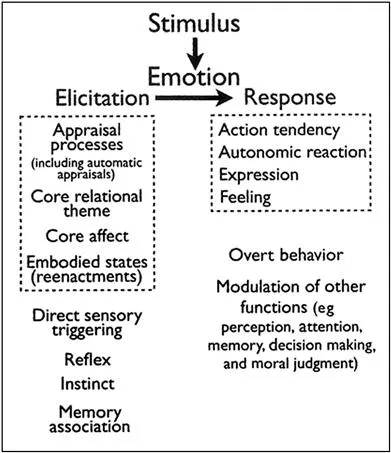
We hope this chapter will provide an overview on current theoretical approaches to emotion and its measurement, without neglecting their historical roots. Simultaneously, our goal is to bring the major conceptual foundations for the work described in the following chapters. We have grouped theories of emotion in three families, a taxonomy grounded in historical and conceptual reasons that is helpful to grasp theoretical developments in affective sciences, and to systematically present key concepts and theories in the field. Far from creating a barrier or being an “ineffective organizational approach” (see chapter: Navigating the Science of Emotion, p. 31), such a classification provides the readers with an organized description of theoretical roots and major conceptual distinctions in affective sciences. Boundaries between categories are always fuzzy, but it does not mean that categories do not exist (see Fig. 1.1; see chapter: Navigating the Science of Emotion).
2 What is an emotion?
2.1 Definitions
2.1.1 The complexity of defining emotion
Fehr and Russell (1984) appropriately stated that “everyone knows what an emotion is, until asked to give a definition. Then, it seems, no one knows” (p. 464). In one of the most famous articles on emotion, James (1884) raised the question of what an emotion is, highlighting that many definitions had been suggested before he proposed his theory. But the variety of approaches of emotion did not stop with James’ seminal paper: emotion has been defined in various ways in the 20th century as well. The numerous characterizations of emotion vary as a function of many factors, such as the historical and cultural contexts, as well as the different theoretical approaches they are embedded in.
To explicitly address the definitional question, Kleinginna and Kleinginna (1981) reviewed almost 100 definitions of emotion. They found that definitions have emphasized different aspects of it, aspects that can be classified into 11 categories. For instance, while some definitions of emotion have focused on the physiological aspects of emotion, others have insisted on expressive behaviors. Some have focused on emotion as a disturbing factor (eg, related to psychopathology) while others have rather focused on the functions of emotion (eg, related to evolutionary advantages). The difficulty of defining emotion, and delineating its boundaries to other affective phenomena (eg, mood, preference, attitude, passion, affect) is not the only challenge. It is also not straightforward to classify different emotions (as negative vs positive, as basic vs self-reflective, etc.; for a discussion on this aspect, see Sander, 2013). These conceptual problems are also evident in applied fields (eg, Meiselman, 2015). The issue of defining emotion is still a contemporary one (Russell, 2012), and strongly impacts current models of emotion (Sander, 2013).
A consensual definition that emerges from an analysis of the literature is the following: an emotion is an “event-focused, two-step, fast process consisting of (1) relevance-based emotion elicitation mechanisms that (2) shape a multiple emotional response (ie, action tendency, automatic reaction, expression, and feeling)” (Sander, 2013, p. 23). The mechanisms involved in emotion elicitation and their effects on emotional response are represented in Fig. 1.1. We will consequently restrict the term emotion to brief periods of time during which several subsystems of the organism (ie, emotions are multicomponent phenomena) are synchronized to an event considered relevant to an individual’s needs, goals, and/or values. Note that this definition emphasizes the fact that in addition to an emotional response, there are eliciting mechanisms, which are considered as being part of emotion and not just antecedent to it. Thus, although emotion can be perceived as “mysterious and deeply perplexing” (see chapter: Navigating the Science of Emotion, p. 31), there are ways to provide working definitions of this very complex phenomenon.
2.1.2 The multicomponent character of emotion
The three major theories of emotion—basic emotion, dimensional, and appraisal theories—all describe emotion as a phenomenon with multiple components (this is not a new idea; see, eg, Irons, 1897). This perspective typically characterizes emotion in terms of five components: (1) expression, (2) action tendency, (3) bodily reaction, (4) feeling, and (5) appraisal. This multiple components approach has proven useful not only to conceptualize (Sander, Grandjean, & Scherer, 2005) but also to measure (Mauss & Robinson, 2009) emotions. We will define and detail each of these components in the following sections of the chapter.
Before doing so, we would like to mention that besides this multicomponent character, there is now a consensus to define emotions with three additional criteria. First, emotions are two-step processes where emotion elicitation mechanisms generate emotional responses. Emotion elicitation mechanisms, such as appraisal processes, are more and more conceived as being part of emotion. Second, “relevant” or “significant” objects, which refer to both evolutionary and idiosyncratic concerns or situations, are required for emotions to occur. Third, emotion duration is brief and emotion has a quick onset (see chapter: Short-term Time Structure of Food-Related Emotions: Measuring Dynamics of Responses). More specifically, and although rarely studied (see Verduyn, Van Mechelen, & Tuerlinckx, 2011), emotion duration is thought to be shorter than other affective phenomena (eg, moods or preferences, which are typically conceptualized as more stable; see, eg, Beedie, Terry, Lane, & Davenport, 2011).
We will now describe each of the five emotional components and address their measurement. As different approaches of emotion have focused on different components, we will present these theories in the sections dealing with the components that they particularly emphasize.
2.2 Emotion components
2.2.1 Is emotion an expression?
Darwin’s early work
Emotions go hand-in-hand with emotional expressions, such as facial expressions (eg, frowns, clenched teeth), vocal expressions (eg, prosody), body actions and postures (eg, forward whole body movement in hot anger). Body cues play an important role in expressing and perceiving emotions and are increasingly st...
Table of contents
- Cover image
- Title page
- Table of Contents
- Copyright
- List of Contributors
- Preface
- Part I: Basic Studies of Emotion
- Part II: Methods for Studying Emotions
- Part III: Studying Emotions in Practice
- Part IV: Cross-Cultural Studies of Emotions
- Index
Trusted by 375,005 students
Access to over 1.5 million titles for a fair monthly price.
Study more efficiently using our study tools.
Frequently asked questions
Yes, you can cancel anytime from the Subscription tab in your account settings on the Perlego website. Your subscription will stay active until the end of your current billing period. Learn how to cancel your subscription
No, books cannot be downloaded as external files, such as PDFs, for use outside of Perlego. However, you can download books within the Perlego app for offline reading on mobile or tablet. Learn how to download books offline
Perlego offers two plans: Essential and Complete
- Essential is ideal for learners and professionals who enjoy exploring a wide range of subjects. Access the Essential Library with 800,000+ trusted titles and best-sellers across business, personal growth, and the humanities. Includes unlimited reading time and Standard Read Aloud voice.
- Complete: Perfect for advanced learners and researchers needing full, unrestricted access. Unlock 1.5M+ books across hundreds of subjects, including academic and specialized titles. The Complete Plan also includes advanced features like Premium Read Aloud and Research Assistant.
We are an online textbook subscription service, where you can get access to an entire online library for less than the price of a single book per month. With over 1.5 million books across 990+ topics, we’ve got you covered! Learn about our mission
Look out for the read-aloud symbol on your next book to see if you can listen to it. The read-aloud tool reads text aloud for you, highlighting the text as it is being read. You can pause it, speed it up and slow it down. Learn more about Read Aloud
Yes! You can use the Perlego app on both iOS and Android devices to read anytime, anywhere — even offline. Perfect for commutes or when you’re on the go.
Please note we cannot support devices running on iOS 13 and Android 7 or earlier. Learn more about using the app
Please note we cannot support devices running on iOS 13 and Android 7 or earlier. Learn more about using the app
Yes, you can access Emotion Measurement by Herbert L. Meiselman in PDF and/or ePUB format, as well as other popular books in Psychology & Personality in Psychology. We have over 1.5 million books available in our catalogue for you to explore.