eBook - ePub
Geological Sequestration of Carbon Dioxide
Thermodynamics, Kinetics, and Reaction Path Modeling
- 470 pages
- English
- ePUB (mobile friendly)
- Available on iOS & Android
eBook - ePub
Geological Sequestration of Carbon Dioxide
Thermodynamics, Kinetics, and Reaction Path Modeling
About this book
The contents of this monograph are two-scope. First, it intends to provide a synthetic but complete account of the thermodynamic and kinetic foundations on which the reaction path modeling of geological CO2 sequestration is based. In particular, a great effort is devoted to review the thermodynamic properties of CO2 and of the CO2-H2O system and the interactions in the aqueous solution, the thermodynamic stability of solid product phases (by means of several stability plots and activity plots), the volumes of carbonation reactions, and especially the kinetics of dissolution/precipitation reactions of silicates, oxides, hydroxides, and carbonates. Second, it intends to show the reader how reaction path modeling of geological CO2 sequestration is carried out. To this purpose the well-known high-quality EQ3/6 software package is used. Setting up of computer simulations and obtained results are described in detail and used EQ3/6 input files are given to guide the reader step-by-step from the beginning to the end of these exercises. Finally, some examples of reaction-path- and reaction-transport-modeling taken from the available literature are presented. The results of these simulations are of fundamental importance to evaluate the amounts of potentially sequestered CO2, and their evolution with time, as well as the time changes of all the other relevant geochemical parameters (e.g., amounts of solid reactants and products, composition of the aqueous phase, pH, redox potential, effects on aquifer porosity). In other words, in this way we are able to predict what occurs when CO2 is injected into a deep aquifer.* Provides applications for investigating and predicting geological carbon dioxide sequestration* Reviews the geochemical literature in the field* Discusses the importance of geochemists in the multidisciplinary study of geological carbon dioxide sequestration
Information
Topic
Physical SciencesSubtopic
Geology & Earth SciencesChapter 1
Why We Should Care: The Impact of Anthropogenic Carbon Dioxide on the Carbon Cycle
1.1 Carbon dioxide: from its discovery to the understanding of its role
Carbon dioxide was first identified around the middle of the 18th century by Joseph Black (1728–1799), a Scottish, in the framework of his studies to get the degree in medicine at the University of Edinburgh. Results of Black’s chemical investigations were published in 1756 under the title Experiments upon Magnesia Alba, Quick-lime, and Some Other Alcaline Substances (Leicester, 1956).
Black demonstrated that magnesia alba (an hydroxycarbonate of magnesium, possibly hydromagnesite, as considered in the following reactions) developed a gas upon heating and consequently transformed in magnesia calcinata (magnesium oxide):

Upon acid attack, driven for example by HCl, both magnesia calcinata and magnesia alba produced the same salts:


but effervescence was observed only in the reaction involving magnesia alba, due to CO2 development.
It was possible to obtain again magnesia alba by reacting magnesia calcinata with the so-called alkalies, i.e., sodium or potassium carbonate:

Black also observed that similar experiments carried out with limestone produced quicklime and the same gas. Again, the original limestone could be obtained through reaction of quicklime with alkalies. The gas was called fixed air by Black because it was fixed in solid form by magnesia and quicklime. Black was thus the first one who realized experiments of CO2 production and CO2 sequestration.
These results were really something new in that it was possible to combine chemically a gas with a solid to produce a new solid compound with different properties. The effect of this discovery is well evident in the words of John Robinson, Black’s colleague, who wrote the introduction of the conferences of chemistry held by Black and published posthumously in 1803.
He discovered that a cubic inch of marble was made up by pure quicklime for about half of its weight and by as much air to fill a six-gallons wine container … What could be more singular than to prove that a substance as thin as air can exist in the form of hard stone and that its presence determines such a change in the properties of stone?
Joseph Priestly (1733–1804) not only triggered soda water production in 1772, but also isolated and studied a series of gases, including NO, N2O5, CO, SO2, HCl, NH3 and O2, and observed that the latter gas was emitted by green plants exposed to light. This observation, confirmed and broadened by Jan Ingenhousz (1730–1799) and Jean Senebier (1742–1809), represented the base of all subsequent studies of photosynthesis, which demonstrated the important role of atmospheric carbon dioxide as a source of carbon for plants.
The first successful results in this direction were obtained by T. de Saussure, a Genevese, who carried out his studies in 1797–1804, but he did not fully realize the huge impact of his discovery. Such importance was partly recognized some 20 to 30 years later by the Russian physicist G. Parrot and the French botanist A. Brongniart, but their theories were wrong. Only the researches carried out by J. Boussingault in 1830–1840 led him to finally establish the role of atmospheric carbon dioxide in the formation of living matter. Afterwards, some further improvements concerned the existence of microbes, which can bypass CO2 and use the carbon of CH4 and CO, and the complex reactions of aquatic organisms, which are able to use bicarbonate ion and carbonic acid, as shown by Raspail in 1833.
Today we know that carbon gain by plants is strictly linked to the operation of Rubisco (ribulose–1,5 bisphosphate carboxylase–oxygenase), which catalyses the competitive processes of carboxylation (leading to photosynthesis) and oxygenation (leading to photorespiration). Both CO2 and O2 compete for the first acceptor molecule ribulose bisphosphate at their binding sites on Rubisco and are, consequently, mutually competitive inhibitors (Lawlor, 1993). A rise in O2 tends to inhibit the carboxylation reaction of Rubisco, suppressing photosynthesis, whereas a rise in CO2 inhibits the oxygenase reaction, suppressing photorespiration.
1.2 The short-term carbon cycle
The main reservoirs of the short-term carbon cycle are (Fig. 1.1) as follows: (a) the oceans that store ∼38,000 × 1015 g C, (b) the terrestrial biosphere, whose total C mass, ∼2,000 × 1015 g C, is distributed between the terrestrial plants (1/4) and soil (3/4), and (c) the atmosphere, which is the smallest reservoir with ∼730 × 1015 g C (Prentice et al., 2001).
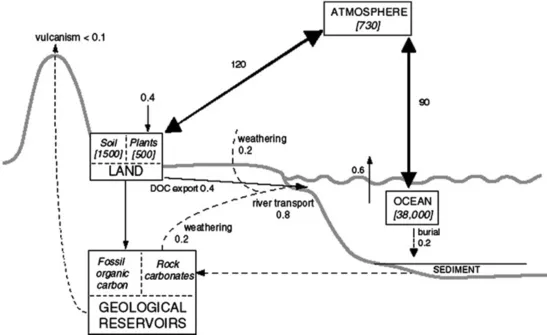
Figure 1.1 Schematic representation of the short-term carbon cycle. Reservoirs in Gt C = 1015 g C. Fluxes in Gt C × a−1. (Reproduced with permission fromI. C. Prentice et al., 2001. Copyright © 2001 by the Intergovernmental Panel on Climate Change 2001.)
1.2.1 The terrestrial biosphere
In higher plants, a total amount of ∼270 × 1015 g C a−1 of CO2 diffuses from the atmosphere into the leaves through the stomata, their small pores, and reaches the sites of photosynthesis. The mass of CO2 converted into carbohydrates, which is called gross primary production (GPP), is only ∼120 × 1015 g C a−1 (Ciais et al., 1997), as most CO2 diffuses back to the atmosphere without being involved in photosynthesis.
The difference between GPP and autotrophic respiration (i.e., the back conversion of carbohydrates to CO2) represents the annual plant growth or net primary production (NPP). This amounts globally to ∼60 × 1015 g C a−1 (Saugier and Roy, 2001).
The carbon fixed as NPP is returned to the atmosphere by both heterotrophic respiration (HR by bacteria, fungi and herbivores) and combustion processes during fires. The difference between NPP and HR is called net ecosystem production (NEP) and represents the mass of carbon either gained or lost by the ecosystem, without considering additional losses, such as fires, harvesting, erosion and transport processes by rivers. The NEP global amount is ∼10 × 1015 g C a−1 (Bolin et al., 2000). Subtraction of these additional losses from NEP gives the carbon accumulated by the terrestrial biosphere or net biome production (NBP), which represents the net land uptake from the atmosphere (Schulze and Heimann, 1998). Based on atmospheric O2 and CO2 concentrations,Prentice et al. (2001) have evaluated NBP of −0.2 × 10¹⁵ g C a−1 during the 1980s and of −1.4 × 10¹⁵ g C a−1 during the 1990s, with an uncertainty of ± 0.7 × 10¹⁵ g C a−1.
At steady state, NBP is zero. These...
Table of contents
- Cover image
- Title page
- Table of Contents
- Developments in Geochemistry
- Front Matter
- Copyright page
- Preface
- Chapter 1: Why We Should Care: The Impact of Anthropogenic Carbon Dioxide on the Carbon Cycle
- Chapter 2: The Thermodynamic Background
- Chapter 3: Carbon Dioxide and CO2–H2O Mixtures
- Chapter 4: The Aqueous Electrolyte Solution
- Chapter 5: The Product Solid Phases
- Chapter 6: The Kinetics of Mineral Carbonation
- Chapter 7: Reaction Path Modelling of Geological CO2 Sequestration
- References
- Subject Index
Trusted by 375,005 students
Access to over 1.5 million titles for a fair monthly price.
Study more efficiently using our study tools.
Frequently asked questions
Yes, you can cancel anytime from the Subscription tab in your account settings on the Perlego website. Your subscription will stay active until the end of your current billing period. Learn how to cancel your subscription
No, books cannot be downloaded as external files, such as PDFs, for use outside of Perlego. However, you can download books within the Perlego app for offline reading on mobile or tablet. Learn how to download books offline
We are an online textbook subscription service, where you can get access to an entire online library for less than the price of a single book per month. With over 1.5 million books across 990+ topics, we’ve got you covered! Learn about our mission
Look out for the read-aloud symbol on your next book to see if you can listen to it. The read-aloud tool reads text aloud for you, highlighting the text as it is being read. You can pause it, speed it up and slow it down. Learn more about Read Aloud
Yes! You can use the Perlego app on both iOS and Android devices to read anytime, anywhere — even offline. Perfect for commutes or when you’re on the go.
Please note we cannot support devices running on iOS 13 and Android 7 or earlier. Learn more about using the app
Please note we cannot support devices running on iOS 13 and Android 7 or earlier. Learn more about using the app
Yes, you can access Geological Sequestration of Carbon Dioxide by Luigi Marini in PDF and/or ePUB format, as well as other popular books in Physical Sciences & Geology & Earth Sciences. We have over 1.5 million books available in our catalogue for you to explore.