- 411 pages
- English
- ePUB (mobile friendly)
- Available on iOS & Android
eBook - ePub
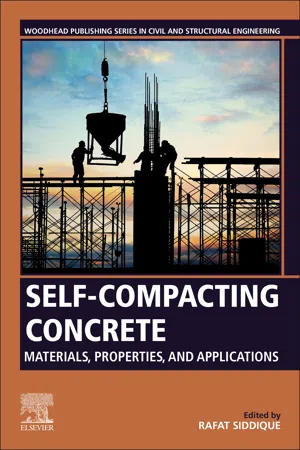
Self-Compacting Concrete: Materials, Properties and Applications
About this book
Self-Compacting Concrete: Materials, Properties and Applications presents the latest research on various aspects of self-compacting concrete, including test methods, rheology, strength and durability properties, SCC properties at elevated temperature, SC manufacturing with the use of SCMs, recycled aggregates and industrial by-products. Written by an international group of contributors who are closely associated with the development of self-compacting concrete, the book explores the main differences between SCC and normal concrete in terms of raw materials, fresh properties and hardened properties. Other topics discussed include the structure and practical applications of fiber reinforced SCC.
Researchers and experienced engineers will find this reference to be a systematic source to SCC with its accounting of the latest breakthroughs in the field and discussions of SCC constructability, structural integrity, improved flows into complex forms, and superior strength and durability.
- Offers a systematic and comprehensive source of information on the latest developments in SCC technology
- Includes mix design procedures, tests standards, rheology, strength and durability properties
- Explores the properties and practical applications of SCC
Information
1
Mix design procedure, tests, and standards
Mohammed Sonebia; Ammar Yahiab a Queens’ University Belfast, Belfast, United Kingdom
b University of Sherbrooke, Sherbrooke, QC, Canada
b University of Sherbrooke, Sherbrooke, QC, Canada
Abstract
Self-compacting concrete (SCC) is design to achieve three functional requirements, which are filling ability, passing ability, and resistance to segregation. These requirements are necessary to properly fill the formwork and adequately encapsulate reinforcing bars only through the action of gravity, while maintaining good homogeneity. These characteristics translate into a substantial reduction in labour cost and construction time, and a better working environment by eliminating the impact of vibration. These classes of concretes are obtained by using a low water-cementitious materials ratio (w/cm), incorporating high quantities of supplementary materials (cement and mineral admixtures, such as ground-granulated blast furnace slag, fly ash and limestone powder) and superplasticizer, increasing sand-aggregate ratio, and if needed, a viscosity-modifying admixture. The most important issues of how to design and test SCC are discussed in this chapter.
Keywords
Filling ability; J-Ring; Passing ability; Segregation; Slump flow; V-funnel; Rheology; Yield stress; Plastic viscosity; Thixotropy
1.1 Mix design procedure of SCC
1.1.1 Background
The mix design of SCC is chosen to achieve the required all performance criteria for the concrete in both the fresh and hardened states. As in the case of vibrated concrete, the water-to-supplementary cementitious materials (w/cm) is one of the fundamental mixture parameters governing the properties, including rheology, strength, and durability of SCC. As in the case of normal vibrated concrete, the w/cm is one of the fundamental key factor governing. However, in designing SCC, there are a number of factors that should be taken into consideration to a greater degree than conventional concrete. These include: (1) properties of locally available raw materials, including physical properties of supplementary cementitious materials (SCM) mineral additions and aggregates, (2) proper selection of chemical admixtures to ensure good compatibilities with the selected SCM, and (3) adapt the fresh properties given the casting method (pumping, etc.), geometry of cast element and reinforcing bars arrangements.
Mix design of SCC should consider both the fresh and hardened properties according to the application on hand. The consideration shall include specifications for the content of SCM and fillers, the water content or w/cm, the volume of coarse aggregate, the sand-to-aggregate ratio (S/A), as well as the air content for durability specifications. Proper selection of the type and combinations of chemical admixtures is part of the mix design process and depends on the flow characteristics requirement given the application on hand. In principle, three basic mixture-proportioning approaches for designing SCC mixtures have been used: powder type (i.e. increasing the powder content and fine fractions in the form of fly ash, blast-furnace slag or limestone filler); viscosity agent type (i.e. using suitable viscosity-modifying admixture to improve stability of the mixture); and combined type (i.e. combining the above-mentioned approaches).
1.1.2 Mix design approach
In principle, three different approaches have been used for the production of SCC. The first approach consists in increasing the content of ultra-fines particles by the addition of SCM. This approach was mainly based on increasing the supplementary cementitious materials, including fly ash, blast-furnace slag, or silica fume, and fillers content (powder type) (Sonebi a...
Table of contents
- Cover image
- Title page
- Table of Contents
- Copyright
- Contributors
- Preface
- 1: Mix design procedure, tests, and standards
- 2: Rheology and workability of SCC
- 3: Production and placement of self-compacting concrete
- 4: Strength properties of SCC
- 5: Permeation properties of self-compaction concrete
- 6: Creep and shrinkage of SCC
- 7: Carbonation and corrosion of SCC
- 8: Properties of SCC at elevated temperature
- 9: Properties of self-compacting concrete with recycled concrete aggregates
- 10: Properties of SCC with industrial by-products as aggregates
- 11: Properties of SCC with supplementary cementing materials
- 12: Properties of fibre reinforced SCC
- 13: Structural performance of self-compacting concrete
- Index
Trusted by 375,005 students
Access to over 1.5 million titles for a fair monthly price.
Study more efficiently using our study tools.
Frequently asked questions
Yes, you can cancel anytime from the Subscription tab in your account settings on the Perlego website. Your subscription will stay active until the end of your current billing period. Learn how to cancel your subscription
No, books cannot be downloaded as external files, such as PDFs, for use outside of Perlego. However, you can download books within the Perlego app for offline reading on mobile or tablet. Learn how to download books offline
Perlego offers two plans: Essential and Complete
- Essential is ideal for learners and professionals who enjoy exploring a wide range of subjects. Access the Essential Library with 800,000+ trusted titles and best-sellers across business, personal growth, and the humanities. Includes unlimited reading time and Standard Read Aloud voice.
- Complete: Perfect for advanced learners and researchers needing full, unrestricted access. Unlock 1.5M+ books across hundreds of subjects, including academic and specialized titles. The Complete Plan also includes advanced features like Premium Read Aloud and Research Assistant.
We are an online textbook subscription service, where you can get access to an entire online library for less than the price of a single book per month. With over 1.5 million books across 990+ topics, we’ve got you covered! Learn about our mission
Look out for the read-aloud symbol on your next book to see if you can listen to it. The read-aloud tool reads text aloud for you, highlighting the text as it is being read. You can pause it, speed it up and slow it down. Learn more about Read Aloud
Yes! You can use the Perlego app on both iOS and Android devices to read anytime, anywhere — even offline. Perfect for commutes or when you’re on the go.
Please note we cannot support devices running on iOS 13 and Android 7 or earlier. Learn more about using the app
Please note we cannot support devices running on iOS 13 and Android 7 or earlier. Learn more about using the app
Yes, you can access Self-Compacting Concrete: Materials, Properties and Applications by Rafat Siddique in PDF and/or ePUB format, as well as other popular books in Technology & Engineering & Materials Science. We have over 1.5 million books available in our catalogue for you to explore.