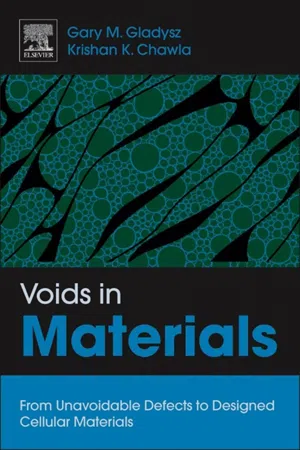
eBook - ePub
Voids in Materials
From Unavoidable Defects to Designed Cellular Materials
- 214 pages
- English
- ePUB (mobile friendly)
- Available on iOS & Android
eBook - ePub
Voids in Materials
From Unavoidable Defects to Designed Cellular Materials
About this book
Voids in Materials treats voids of different shapes and forms in various materials, and examines their effects on material properties. The book covers the origins of voids in materials, how they are sometimes introduced in the form of hollow spheres, and the resultant properties of materials containing voids.
There are many books that focus on foams (which intentionally incorporate voids into materials) and that cover voids incidental to or unwanted in the fabrication of non-porous materials. In fact, all materials have voids. This book starts from the premise that voids are pervasive in all material on some level. It goes beyond foams to provide a comprehensive overview of voids, a central reference for scientists and engineers to use for the effect of voids in materials.
- Includes 3D renderings of void geometries
- Explains how and why voids are introduced into materials across the length scales; from nanometer-scale voids up to macro-scale voids
- Provides a continuous picture of how material properties change as the volume fraction of voids increases, and the implications for product design
Information
Topic
Physical SciencesSubtopic
Physical & Theoretical ChemistryTable of contents
- Cover image
- Title page
- Table of Contents
- Copyright
- Preface
- Acknowledgments
- About the Authors
- Chapter 1. Introduction
- Chapter 2. Intrinsic Voids, Ideal Materials, and Real Materials
- Chapter 3. Intrinsic Voids in Polymers
- Chapter 4. Techniques for Introducing Intentional Voids into Materials
- Chapter 5. Techniques of Introducing Intentional Voids into Particles and Fibers
- Chapter 6. Cellular Materials
- Chapter 7. Applications
- Chapter 8. Void Characterization
- Glossary
- Author Index
- Subject Index
Trusted by 375,005 students
Access to over 1.5 million titles for a fair monthly price.
Study more efficiently using our study tools.
Frequently asked questions
Yes, you can cancel anytime from the Subscription tab in your account settings on the Perlego website. Your subscription will stay active until the end of your current billing period. Learn how to cancel your subscription
No, books cannot be downloaded as external files, such as PDFs, for use outside of Perlego. However, you can download books within the Perlego app for offline reading on mobile or tablet. Learn how to download books offline
We are an online textbook subscription service, where you can get access to an entire online library for less than the price of a single book per month. With over 1.5 million books across 990+ topics, we’ve got you covered! Learn about our mission
Look out for the read-aloud symbol on your next book to see if you can listen to it. The read-aloud tool reads text aloud for you, highlighting the text as it is being read. You can pause it, speed it up and slow it down. Learn more about Read Aloud
Yes! You can use the Perlego app on both iOS and Android devices to read anytime, anywhere — even offline. Perfect for commutes or when you’re on the go.
Please note we cannot support devices running on iOS 13 and Android 7 or earlier. Learn more about using the app
Please note we cannot support devices running on iOS 13 and Android 7 or earlier. Learn more about using the app
Yes, you can access Voids in Materials by Gary M. Gladysz,Krishan K. Chawla in PDF and/or ePUB format, as well as other popular books in Physical Sciences & Physical & Theoretical Chemistry. We have over 1.5 million books available in our catalogue for you to explore.