eBook - ePub
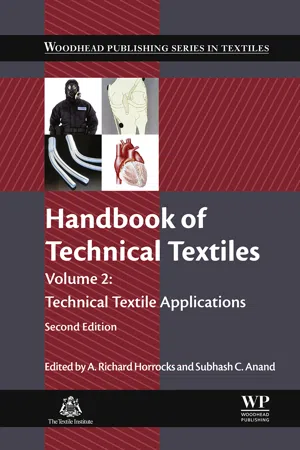
Handbook of Technical Textiles
Technical Textile Applications
- 452 pages
- English
- ePUB (mobile friendly)
- Available on iOS & Android
eBook - ePub
About this book
The first edition of Handbook of Technical Textiles has been an essential purchase for professionals and researchers in this area since its publication in 2000. With revised and updated coverage, including several new chapters, this revised two volume second edition reviews recent developments and new technologies across the field of technical textiles.
Volume 2 – Technical Textile Applications offers an indispensable guide to established and developing areas in the use of technical textiles. The areas covered include textiles for personal protection and welfare, such as those designed for ballistic protection, personal thermal and fire protection, and medical applications; textiles for industrial, transport and engineering applications, including composite reinforcement and filtration; and the growing area of smart textiles.
- Comprehensive handbook for all aspects of technical textiles
- Provides updated, detailed coverage of processes, fabric structure, and applications
- Ideal resource for those interested in high-performance textiles, textile processes, textile processing, and textile applications
- Many of the original, recognized experts from the first edition update their respective chapters
Information
1
Textile-reinforced composite materials
S.L. Ogin1; P. Potluri2 1 University of Surrey, Guildford, United Kingdom
2 University of Manchester, Manchester, United Kingdom
2 University of Manchester, Manchester, United Kingdom
Abstract
Fibre-reinforced polymer matrix composite materials for engineering structures are now commonplace. Their low densities, combined with high strength and high stiffness, provide many benefits in performance and durability; when combined with the expertise of the current generation of engineers and materials scientists prepared to accept the complexity of designing and fabricating structures using anisotropic materials, the range of applications (from human prosthetics to airplane fuselages) becomes less surprising. Whereas 30 years ago, the majority of high performance composite materials were manufactured from individual layers of unidirectionally reinforced material, textile-reinforced polymer matrix composites are increasingly used today. This chapter begins with a brief introduction to continuous fibre-reinforced composite materials before describing the various major types of textile-reinforced polymer matrix composite materials based on the following fabric types: two-dimensional woven, braided, knitted, stitched, three-dimensional woven. In each case, an introduction to the mechanical and damage accumulation behaviour, together with approaches to modelling the composite, is provided.
Keywords
Textile-reinforced; 2D woven; braided; knitted; stitched; 3D woven
1.1 Composite materials
Textile-reinforced composite materials (TRCMs) are part of the general class of engineering materials called composite materials. We can define composite materials as having two or more constituents at the macroscopic scale, such that the distribution and geometry of the constituents have been chosen to optimise one or more properties of the material. This is clearly an appropriate definition for textile-reinforced composites for which there is one phase, called the matrix, reinforced by a fibrous reinforcement in the form of a textile.
In principle, there are as many combinations of fibre and matrix available for textile-reinforced composites as there are available for the general class of composite materials. In addition to a wide choice of materials, there is the added factor of the manufacturing route to consider, since a valued feature of composite materials is the ability to manufacture the article at the same time as the material itself is being processed. This feature of composite materials contrasts with the other classes of engineering materials (metals, ceramics, polymers), where it is usual for the material to be produced first (e.g. steel sheet) followed by the forming of the desired shape.
The full range of possibilities for composite materials is very large. In terms of reinforcements, we must include S-glass, R-glass, a wide range of carbon fibres, boron fibres, ceramic fibres (e.g. alumina, silicon carbide), and aramid fibres and recognise that the reinforcement can come in the form of long (or continuous) fibres, short fibres, disks or plates, spheres, or ellipsoids. Matrices include a wide range of polymers (epoxides, polyesters, nylons, etc.), metals (aluminium alloys, magnesium alloys, titanium, etc.), and ceramics (SiC, glass ceramics, etc.). Processing methods include hand lay-up, autoclave, resin transfer moulding (RTM), injection moulding for polymer matrices, squeeze casting and powder metallurgy routes for metals, chemical vapour infiltration, and pre-pregging routes for ceramics. A reader interested in a general introduction to composite materials should consult one of a number of wide-ranging texts (e.g. Matthews and Rawlings,1 Hull and Clyne2).
The market for composite materials can be loosely divided into two categories: ‘reinforced plastics’ based on short fibre E-glass reinforced unsaturated polyester resins (which account for the bulk of composites usage) and ‘advanced composites’ which make use of the advanced fibres (carbon, boron, aramid, SiC, etc.), or advanced matrices (e.g. high temperature polymer matrices, metallic, or ceramic matrices), or advanced design or processing techniques. Even within these loosely defined categories, it is clear that textile composites are ‘advanced composites’ by virtue of the manufacturing techniques required to produce the textile reinforcement. This chapter will be mostly concerned with textile-reinforced polymeric matrices. The reader should be aware that ceramic fibres in a textile format which reinforce ceramic matrices are also possible (e.g. Kuo and Chou,3 Pryce and Smith4).
1.2 Textile reinforcement
1.2.1 Introduction
Textile-reinforced composites have been in service in engineering applications for many years in low profile, relatively low-cost applications (e.g. woven glass-reinforced polymer hulls for minesweepers). While there has been a continual interest in textile reinforcement during the last four decades, and increasingly since the 1980s, the recent desire to expand the envelope of composite usage has had a dramatic effect on global research into, and usage of, textile reinforcement. In addition to the possibility of a range of new applications for which textile reinforcement could replace metal technology, textile reinforcement is also in competition with relatively mature composite technologies which use the more traditional methods of pre-pregging and autoclave manufacture. This is because TRCMs show potential for reduced manufacturing costs and enhanced processability, with more than adequate, or in some cases improved, mechanical properties. In 2010, the major economic entities globally for the production of composite materials were split between Europe (with about 20% of global production), the USA (with about 22%), and China (with about 28%); the rest of the world accounted for about 29%.5 Within these markets, the interest in using textile-based composites of many different types has continued to grow. As a consequence, the first two decades of the 21st century have seen a rapid increase in the number of delegates at composite materials conferences, with large and well-attended sessions on textile reinforcement. In addition, there are composite material conferences dedicated to textile reinforcements (such as the TEXCOMP series).
Of the available textile reinforcements (woven, braided, knitted, stitched), many can now be considered to be mature applications. For example, non-crimp fabric (carbon fibre) is used to manufacture the A380 rear pressure bulkhead; at 240 kg, in mass, 6.2 m long, 5.5 m wide, and 1.6 m deep, this can be classed as a large structure; at a small...
Table of contents
- Cover image
- Title page
- Table of Contents
- Copyright
- Contributors
- Preface (2nd Edition, Volume 2)
- Woodhead Publishing Series in Textiles
- 1: Textile-reinforced composite materials
- 2: Waterproof breathable fabrics
- 3: Textiles in filtration
- 4: Geotextiles in civil engineering
- 5: Textiles for healthcare and medical applications
- 6: Technical textiles for ballistic protection
- 7: Technical textiles for knife and slash resistance
- 8: Technical fibres for heat and flame protection
- 9: Technical textiles for personal thermal protection
- 10: Technical textiles for survival
- 11: Technical textiles in transport (land, sea, and air)
- 12: Energy harvesting and storage textiles
- 13: Rope, cord, twine, and webbing
- Index
- Sync with Jellybooks
Trusted by 375,005 students
Access to over 1.5 million titles for a fair monthly price.
Study more efficiently using our study tools.
Frequently asked questions
Yes, you can cancel anytime from the Subscription tab in your account settings on the Perlego website. Your subscription will stay active until the end of your current billing period. Learn how to cancel your subscription
No, books cannot be downloaded as external files, such as PDFs, for use outside of Perlego. However, you can download books within the Perlego app for offline reading on mobile or tablet. Learn how to download books offline
Perlego offers two plans: Essential and Complete
- Essential is ideal for learners and professionals who enjoy exploring a wide range of subjects. Access the Essential Library with 800,000+ trusted titles and best-sellers across business, personal growth, and the humanities. Includes unlimited reading time and Standard Read Aloud voice.
- Complete: Perfect for advanced learners and researchers needing full, unrestricted access. Unlock 1.5M+ books across hundreds of subjects, including academic and specialized titles. The Complete Plan also includes advanced features like Premium Read Aloud and Research Assistant.
We are an online textbook subscription service, where you can get access to an entire online library for less than the price of a single book per month. With over 1.5 million books across 990+ topics, we’ve got you covered! Learn about our mission
Look out for the read-aloud symbol on your next book to see if you can listen to it. The read-aloud tool reads text aloud for you, highlighting the text as it is being read. You can pause it, speed it up and slow it down. Learn more about Read Aloud
Yes! You can use the Perlego app on both iOS and Android devices to read anytime, anywhere — even offline. Perfect for commutes or when you’re on the go.
Please note we cannot support devices running on iOS 13 and Android 7 or earlier. Learn more about using the app
Please note we cannot support devices running on iOS 13 and Android 7 or earlier. Learn more about using the app
Yes, you can access Handbook of Technical Textiles by A. Richard Horrocks,Subhash C. Anand in PDF and/or ePUB format, as well as other popular books in Technology & Engineering & Industrial Engineering. We have over 1.5 million books available in our catalogue for you to explore.