eBook - ePub
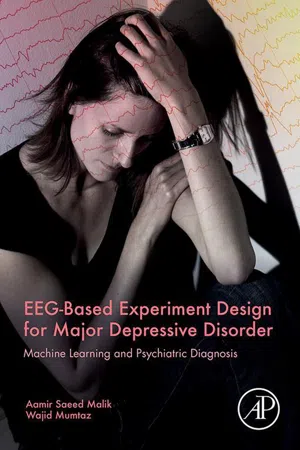
EEG-Based Experiment Design for Major Depressive Disorder
Machine Learning and Psychiatric Diagnosis
- 254 pages
- English
- ePUB (mobile friendly)
- Available on iOS & Android
eBook - ePub
EEG-Based Experiment Design for Major Depressive Disorder
Machine Learning and Psychiatric Diagnosis
About this book
EEG-Based Experiment Design for Major Depressive Disorder: Machine Learning and Psychiatric Diagnosis introduces EEG-based machine learning solutions for diagnosis and assessment of treatment efficacy for a variety of conditions. With a unique combination of background and practical perspectives for the use of automated EEG methods for mental illness, it details for readers how to design a successful experiment, providing experiment designs for both clinical and behavioral applications. This book details the EEG-based functional connectivity correlates for several conditions, including depression, anxiety, and epilepsy, along with pathophysiology of depression, underlying neural circuits and detailed options for diagnosis. It is a necessary read for those interested in developing EEG methods for addressing challenges for mental illness and researchers exploring automated methods for diagnosis and objective treatment assessment.
- Written to assist in neuroscience experiment design using EEG
- Provides a step-by-step approach for designing clinical experiments using EEG
- Includes example datasets for affected individuals and healthy controls
- Lists inclusion and exclusion criteria to help identify experiment subjects
- Features appendices detailing subjective tests for screening patients
- Examines applications for personalized treatment decisions
Information
Chapter 1
Introduction: Depression and Challenges
Abstract
This chapter introduces major depressive disorder (MDD), or simply put, depression, including its subtypes and associated challenges. Moreover, the chapter emphasizes the development of objective methods for diagnosis and treatment efficacy assessment involving depression. According to existing practice, diagnosis of depression involves clinical questionnaires, for example, the Beck Depression Inventory (BDI) and Hospital Anxiety and Depression (HDI) scale. However, these questionnaires have a subjective nature and could be inefficient in particular cases. Therefore alternative methods involving electroencephalography (EEG) and event-related potentials are presented and discussed. In particular, this chapter draws examples from EEG research studies that have addressed EEG-based methods for depression diagnosis and prognosis.
Keywords
Major depressive disorder; unipolar depression; electroencephalography; EEG-based diagnosis; EEG-based treatment selection
1.1 Introduction
Major depression, also termed as major depressive disorder (MDD), unipolar depression, clinical depression, or even simply depression, is a mental illness. According to the World Health Organization (WHO), depression has been identified as a leading cause of functional disability, worldwide. About 300 million people have been reported suffering from depression, globally.1 In addition to the functional disability caused by depression, it may lead to suicide ideations. Moreover, the treatment management for depression has been challenging due to multiple factors, such as the suitable selection of medication for a patient being based on the subjective experience of clinicians and which might not be appropriate for the patient and could result into unsuccessful treatment trials. Another implication is that the patient may stop the treatment.
In this chapter, the topics covered in this book are introduced by providing a basic explanation of the relevant concepts which will be elaborated on in later chapters. More specifically, this chapter explores the possibilities of utilizing electroencephalogram (EEG) as an objective method for the diagnosis and treatment efficacy assessment for depression. Also, depression will be discussed from different perspectives such as its subtypes, signs and symptoms, the challenges associated with treating depression, an overview of the literature involving EEG studies for depression, EEG as a modality, and the basics of an EEG-based machine learning (ML) approach.
EEG-based diagnosis of depression may be compared with the conventional practice of treating depression. Conventionally, depression has been diagnosed according to criteria in the Diagnostic and Statistical Manual (DSM)-V and its earlier versions. The DSM-V provides a questionnaire-based assessment that depends on the patient’s feedback. However, misreporting may occur when patients do not explain their condition well. Therefore an objective assessment provided by EEG may assist clinicians during clinical decision making. In addition, EEG-based methods may help standardize clinical decision making for depression.
1.2 Depression and Subtypes
Several different types of major depression have been identified, for example, unipolar depression, bipolar disorder (or manic depression), dysthymia, postpartum depression, atypical depression, psychotic depression, and seasonal effective disorder.2 Major or unipolar depression is the most generic form of depression. It has been characterized based on a depressed episode that persists for at least 2 weeks rendering the patient’s functionally disabled. Moreover, it has been discovered as a leading cause of disease burden for women in high-, middle-, and low-income countries.3 In the United States, it has been declared as the most common cause of functional disability.4 For example, the prevalence of unipolar depression has been found in 13%–16% of the total US population.
Bipolar depression normally manifests as two different episodes: a depressive episode and a manic episode. The occurrence of manic episodes differentiates bipolar from unipolar depression. However, bipolar depression is less common than unipolar depression. According to National Institute of Mental Health (NIMH), it has affected 2%–3% of the americal adult population. (https://www.nimh.nih.gov/health/statistics/bipolar-disorder.shtml). Other forms of depression such as postpartum depression is a form of depression that affects 5% of women in their second half of menstrual cycle, 10% of pregnant women, and 16% of women 3 months after giving birth.
Some other forms of depression which are normally considered to be less common include psychotic depression, atypical depression, seasonal effective disorder, and dysthymia. Psychotic depression has been characterized as a mental state with false beliefs (delusions) or false sights or sounds (hallucinations). It is a more severe form of depression, but is less common as about 20% of depressed patients may have psychotic symptoms. Similarly, atypical depression and seasonal effective disorder are forms of depression that occur only during specific seasons, particularly, winter. Dysthymia, which may entail less severe but longer lasting symptoms than of depression, has been found in only approximately 1.5% of adult Americans (https://www.nimh.nih.gov/health/statistics/persistent-depressive-disorder-dysthymic-disorder.shtml). As unipolar depression is the most common and affects the largest population, this book mainly focuses on the patients with unipolar depression; all other forms of depression are out of scope. In this book, unipolar depression is termed as MDD, or simply as depression.
1.3 Signs and Symptoms of Depression
The two core symptoms of depression are low mood and lack of pleasure from pleasurable activities. Depression involves sad episodes that prevail for more than 2 weeks and renders the patient functionally disabled. On the contrary, normal sadness that may result because of routine matters or a social problem may not be considered as depression, which is recurrent and comorbid in nature. Hence, depression should be treated properly by a specialist such as a psychiatrist or psychologist. Other symptoms of depression include:
- • significant changes in appetite or weight;
- • insomnia or hypersomnia nearly every day;
- • psychomotor agitation and retardation;
- • fatigue or loss of energy almost every day;
- • feeling of uselessness or inappropriate guilt;
- • decreased ability to think, concentrate, or to make decisions nearly every day; and
- • recurrent thoughts of death or suicidal ideas, plans, or attempts.
1.4 Unipolar Depression and Challenges
The treatment management for depression has been associated with two serious issues. First, a successful diagnosis of depression is required during a patient’s care. Since MDD is heterogeneous and comorbid in nature, there is a high chance that MDD patients may be misdiagnosed as having a bipolar disorder during their first visit to a psychiatric clinic.5 Because of such a misdiagnosis, the appropriate treatment process could be delayed. In addition, patients could be mistreated involving unsuitable medication (antidepressants) that may further complicate the patient’s condition, for example, development of a treatment resistant scenario. Hence, an accurate diagnosis increases the chances to achieve remission (absence of symptoms) early. Currently, the diagnosis of depression involves the use of well-structured questionnaires such as those provided in the DSM-V.6 Since the questionnaires are subjective in nature as the feedback from the depressed patients is required, there is a probability that the patients may not reveal their true conditions. Hence, the reliability of questionnaire-based diagnosis depends on the expertise of the specialist handling the patient. For example, in some cases a patient initially diagnosed with unipolar depression may revert from unipolar depression to psychotic depression after 2 weeks of treatment.
Second, prediction of the treatment outcome of antidepressant therapy for a depressed patient has been challenging, termed here as the antidepressant’s treatment efficacy assessment or treatment selection. A successful prediction could lead to a suitable selection of antidepressants for the MDD patient. Currently, the selection is subjective and mainly based on clinical expertise including an analysis of the patient’s symptoms and medical history. Unfortunately, a nonresponse to an antidepressant could be a waste of the adequate time frame of 2–4 weeks and may lead to a second-time selection. Eventually, the selection of antidepressants might become a sequential iterative treatment process.7 Hence, the inappropriate selection of...
Table of contents
- Cover image
- Title page
- Table of Contents
- Copyright
- Dedication
- About the Authors
- Preface
- Acknowledgments
- Chapter 1. Introduction: Depression and Challenges
- Chapter 2. Electroencephalography Fundamentals
- Chapter 3. Electroencephalography-Based Brain Functional Connectivity and Clinical Implications
- Chapter 4. Pathophysiology of Depression
- Chapter 5. Using Electroencephalography for Diagnosing and Treating Depression
- Chapter 6. Neural Circuits and Electroencephalography-Based Neurobiology for Depression
- Chapter 7. Design of an Electroencephalography Experiment for Assessing Major Depressive Disorder
- Chapter 8. Electroencephalography-Based Diagnosis of Depression
- Chapter 9. Electroencephalography-Based Treatment Efficacy Assessment Involving Depression
- Index
Trusted by 375,005 students
Access to over 1.5 million titles for a fair monthly price.
Study more efficiently using our study tools.
Frequently asked questions
Yes, you can cancel anytime from the Subscription tab in your account settings on the Perlego website. Your subscription will stay active until the end of your current billing period. Learn how to cancel your subscription
No, books cannot be downloaded as external files, such as PDFs, for use outside of Perlego. However, you can download books within the Perlego app for offline reading on mobile or tablet. Learn how to download books offline
Perlego offers two plans: Essential and Complete
- Essential is ideal for learners and professionals who enjoy exploring a wide range of subjects. Access the Essential Library with 800,000+ trusted titles and best-sellers across business, personal growth, and the humanities. Includes unlimited reading time and Standard Read Aloud voice.
- Complete: Perfect for advanced learners and researchers needing full, unrestricted access. Unlock 1.5M+ books across hundreds of subjects, including academic and specialized titles. The Complete Plan also includes advanced features like Premium Read Aloud and Research Assistant.
We are an online textbook subscription service, where you can get access to an entire online library for less than the price of a single book per month. With over 1.5 million books across 990+ topics, we’ve got you covered! Learn about our mission
Look out for the read-aloud symbol on your next book to see if you can listen to it. The read-aloud tool reads text aloud for you, highlighting the text as it is being read. You can pause it, speed it up and slow it down. Learn more about Read Aloud
Yes! You can use the Perlego app on both iOS and Android devices to read anytime, anywhere — even offline. Perfect for commutes or when you’re on the go.
Please note we cannot support devices running on iOS 13 and Android 7 or earlier. Learn more about using the app
Please note we cannot support devices running on iOS 13 and Android 7 or earlier. Learn more about using the app
Yes, you can access EEG-Based Experiment Design for Major Depressive Disorder by Aamir Saeed Malik,Wajid Mumtaz in PDF and/or ePUB format, as well as other popular books in Scienze biologiche & Ricerche e metodologie scientifiche. We have over 1.5 million books available in our catalogue for you to explore.