eBook - ePub
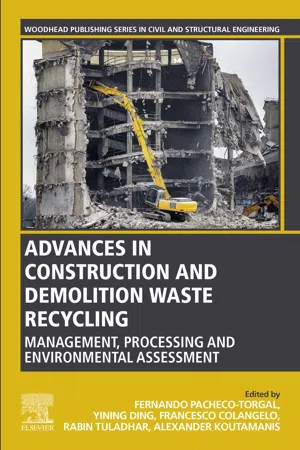
Advances in Construction and Demolition Waste Recycling
Management, Processing and Environmental Assessment
- 592 pages
- English
- ePUB (mobile friendly)
- Available on iOS & Android
eBook - ePub
Advances in Construction and Demolition Waste Recycling
Management, Processing and Environmental Assessment
About this book
Advances in Construction and Demolition Waste Recycling: Management, Processing and Environmental Assessment is divided over three parts. Part One focuses on the management of construction and demolition waste, including estimation of quantities and the use of BIM and GIS tools. Part Two reviews the processing of recycled aggregates, along with the performance of concrete mixtures using different types of recycled aggregates. Part Three looks at the environmental assessment of non-hazardous waste.
This book will be a standard reference for civil engineers, structural engineers, architects and academic researchers working in the field of construction and demolition waste.
- Summarizes key recent research in recycling and reusing concrete and demolition waste to reduce environmental impacts
- Considers techniques for managing construction and demolition waste, including waste management plans, ways of estimating levels of waste, and the types and optimal location of waste recycling plants
- Reviews key steps in handling construction and demolition waste
Information
Subtopic
Ingegneria civile1
Introduction to advances in construction and demolition waste
F. Pacheco-Torgal C-TAC Research Centre, University of Minho, Guimarães, Portugal
Abstract
Resource efficiency and the importance and limitations of the circular economy concept are highlighted. The case of construction and demolition waste (CDW) recycling is introduced. The 70% recycling rate for the European Union (EU) in 2020 is analyzed and a literature review on the Waste Framework Directive is carried out. Brief comments on CDW containing hazardous substances are made. A book outline is included.
Keywords
Resource efficiency; Circular economy; CDW; Recycling
1.1 Resource efficiency and the circular economy
World Business Council for Sustainable Development estimates that by 2050 a fourfold to 10-fold increase in resource efficiency will be needed (COM, 571). Allwood et al. (2011) recognizes that part of the problem is related to the fact that so far researchers have paid too little attention to the crucial issue of material efficiency. The truth is that there are still abundant resources to supply the construction industry (Pacheco-Torgal and Labrincha, 2013); still it is worth remembering the worrying environmental impacts caused by the extraction of nonrenewable raw materials, including extensive deforestation, top-soil loss, air pollution, and pollution of water reserves that will further aggravate the biodiversity loss boundary. On average for every ton of mined materials more than 85% became waste, for several it is more than 99% (Pacheco-Torgal and Jalali, 2011). Over the last century, the material consumption increased by a factor of around 10 and as a result human beings currently uses almost 60 billion tons (Gt) of materials per year (Krausmann et al., 2009). This dramatic increase has resulted in an accumulation of 792 Gt of materials within in-use stocks of buildings, buildings, infrastructure, and other manufactured goods (Krausmann et al., 2017). To make things worse some forecasts (Allwood et al., 2011) show that the demand for materials by 2050 will at least double the current levels. In this context, the European Union has long ago assumed a leading role into a sustainable future. The Europe 2020 Strategy and its flagship initiative on “A Resource Efficient Europe” (COM, 2011b) set the EU on the path to this transformation. The flagship called for a roadmap “to define medium and long-term objectives and means needed for achieving them.” The Roadmap to a Resource Efficient Europe (COM, 2011a) proposes a new pathway to action on resource efficiency involving all key stakeholders, sets several milestones to 2030 (recycling 65% of municipal waste; 75% of packaging waste; and reduce landfill to a maximum of 10% of municipal waste), and provides a framework explaining how policies interrelate and build on each other in which future actions can be designed and implemented coherently. The Roadmap to a Resource Efficient Europe shows the importance of resource efficiency on the building sector which is clearly expressed by the milestone: “By 2020 the renovation and construction of buildings and infrastructure will be made to high resource efficiency levels. The life-cycle approach will be widely applied; all new buildings will be nearly zero-energy and highly material efficient and policies for renovating the existing building stock will be in place so that it is cost-efficiently refurbished at a rate of 2% per year. 70% of nonhazardous construction and demolition waste (CDW) will be recycled” (COM, 2011a). An important concept inserted in the Europe 2020 Strategy for smart, sustainable and inclusive growth is the circular economy (CE) (COM, 2014; EC, 2015). Huysman et al. (2017) cites Preston on the definition of the CE concept as an: “open production systems—in which resources are extracted, used to make products and become waste after the product is consumed—should be replaced by systems that reuse and recycle resources and conserve energy”. Another definition states that the CE is “an industrial system that is restorative or regenerative by intention and design. It replaces the end-of-life concept with restoration, shifts toward the use of renewable energy, eliminates the use of toxic chemicals impairing reuse, and aims at eliminating waste through the superior design of materials, products, systems, and business models” (Ellen MacArthur Foundation, 2016). The Japanese government introduced the material-cycle society vision in 2000 involving several laws based on the three R’s (reduce, reuse, recycle) principle. More recently, Cramer (2017) describe the raw materials transition in the Amsterdam Metropolitan Area of and highlights the need to advance on the 10 R’s of the circularity ladder as a way to create more value. The evolution of CE scientific knowledge shows that an explosion took place in several countries since 2014. Results show that China produces the highest number of CE publications, yet EU-28 takes the lead if seen as a whole entity. These authors claim that is related to the policies introduced both in China and in EU concerning the promotion of the CE. The results also show that on this important field USA strangely shows a disappointing performance producing much less publications than UK, Germany, or even the Netherlands. Moreno and García-Álvarez (2018) developed a composite Resource-Efficiency Capacity Index based on the calculation of 29 indicators classified into three dimensions according to the Roadmap to a Resource Efficient Europe. Accordingly, they present an assessment of the 28 European members showing that the worst results are obtained for Cyprus, Slovakia, Malta, Poland, and Lithuania while the top performers are Denmark, Sweden, Finland, Germany, and Austria. Of course some authors warn about the problems associated to recycling high waste content. Lee et al. (2014) warned that full implementation of European waste legislation will increase unwanted micro-pollutants recycling. The studies of Knapp et al. (2017) confirm this problem because they showed that certain contaminants can be critical. These authors state that regulations for material recycling are required to assure adequate quality control measures. Also, although the concept of CE is already being enforced by several countries some authors showed that there are several limits and challenges in the concept in light of environmental sustainability. Several authors have described several barriers that could hinder successful implementation of the CE. Mittal and Sangwan (2014) mention “weak legislation and law enforcement, uncertain future legislation, low public pressure, high short-term costs, uncertain benefits, low customer demand, trade-offs, low top management commitment, lack of organizational resources, technological risk, lack of awareness/information.” For Mangla et al. (2017) the most important are appropriate methods, tools, techniques, and indicators to cleaner production practices. Ritzén and Sandström (2017) have listed the following ones: “measuring financial benefits of CE, financial profitability, missing exchange of information, unclear responsibility distribution, infrastructure/supply chain management, perception of sustainability, risk aversion, product design, and integration into production processes.” More recently Korhonen et al. (2018) identified six main challenges such as “concerning thermodynamics, definition of CE system boundaries and challenges in the governance and management of the CE-type inter organizational and inter-sectoral material and energy flows.”
1.2 Construction and demolition waste recycling
Following the general CE concepts mentioned in the section above it is worth mentioning the Leising et al. (2018) definition on the CE for the buildings sector as “A lifecycle approach that optimizes the buildings’ useful lifetime, integrating the end-of-life phase in the design and uses new ownership models where materials are only temporarily stored in the building that acts as a material bank.” Recent ...
Table of contents
- Cover image
- Title page
- Table of Contents
- Copyright
- Contributors
- 1: Introduction to advances in construction and demolition waste
- Part One: Managing construction and demolition waste
- Part Two: Processing, and applications of recycled aggregates from construction and demolition waste
- Part Three: Environmental issues affecting recycled aggregates from construction and demolition waste
- Index
Trusted by 375,005 students
Access to over 1.5 million titles for a fair monthly price.
Study more efficiently using our study tools.
Frequently asked questions
Yes, you can cancel anytime from the Subscription tab in your account settings on the Perlego website. Your subscription will stay active until the end of your current billing period. Learn how to cancel your subscription
No, books cannot be downloaded as external files, such as PDFs, for use outside of Perlego. However, you can download books within the Perlego app for offline reading on mobile or tablet. Learn how to download books offline
Perlego offers two plans: Essential and Complete
- Essential is ideal for learners and professionals who enjoy exploring a wide range of subjects. Access the Essential Library with 800,000+ trusted titles and best-sellers across business, personal growth, and the humanities. Includes unlimited reading time and Standard Read Aloud voice.
- Complete: Perfect for advanced learners and researchers needing full, unrestricted access. Unlock 1.5M+ books across hundreds of subjects, including academic and specialized titles. The Complete Plan also includes advanced features like Premium Read Aloud and Research Assistant.
We are an online textbook subscription service, where you can get access to an entire online library for less than the price of a single book per month. With over 1.5 million books across 990+ topics, we’ve got you covered! Learn about our mission
Look out for the read-aloud symbol on your next book to see if you can listen to it. The read-aloud tool reads text aloud for you, highlighting the text as it is being read. You can pause it, speed it up and slow it down. Learn more about Read Aloud
Yes! You can use the Perlego app on both iOS and Android devices to read anytime, anywhere — even offline. Perfect for commutes or when you’re on the go.
Please note we cannot support devices running on iOS 13 and Android 7 or earlier. Learn more about using the app
Please note we cannot support devices running on iOS 13 and Android 7 or earlier. Learn more about using the app
Yes, you can access Advances in Construction and Demolition Waste Recycling by F. Pacheco-Torgal,Francesco Colangelo,Rabin Tuladhar,Yining Ding,Fernando Pacheco-Torgal,Alexander Koutamanis in PDF and/or ePUB format, as well as other popular books in Tecnologia e ingegneria & Ingegneria civile. We have over 1.5 million books available in our catalogue for you to explore.