- 286 pages
- English
- ePUB (mobile friendly)
- Available on iOS & Android
eBook - ePub
About this book
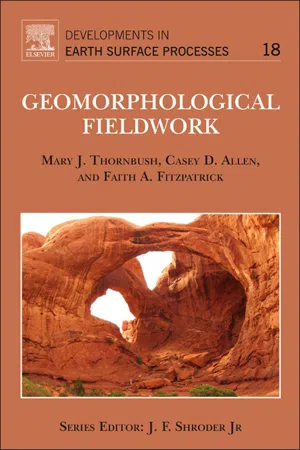
Geomorphological Fieldwork addresses a topic that always remains popular within the geosciences and environmental science. More specifically, the volume conveys a growing legacy of field-based learning for young geomorphologists that can be used as a student book for field-based university courses and postgraduate research requiring fieldwork or field schools. The editors have much experience of field-based learning within geomorphology and extend this to physical geography. The topics covered are relevant to basic geomorphology as well as applied approaches in environmental and cultural geomorphology. The book integrates a physical-human approach to geography, but focuses on physical geography and geomorphology from an integrated field-based geoscience perspective.
- Addresses fluvial and karst landscapes in depth
- Focuses on field-based learning as well as educational geomorphology
- Conveys experiential knowledge in international contexts
Information
Topic
Physical SciencesSubtopic
Geology & Earth SciencesChapter 1
Introduction
Mary J. Thornbush*, [email protected]
Casey D. Allen**
Faith A. Fitzpatrick†
* School of Geography, Earth and Environmental Sciences University of Birmingham, Edgbaston, Birmingham, United Kingdom
** Department of Geography and Environmental Sciences, University of Colorado Denver, Colorado, USA
† U.S. Geological Survey, Wisconsin Water Science Center, Middleton, Wisconsin, USA
* School of Geography, Earth and Environmental Sciences University of Birmingham, Edgbaston, Birmingham, United Kingdom
** Department of Geography and Environmental Sciences, University of Colorado Denver, Colorado, USA
† U.S. Geological Survey, Wisconsin Water Science Center, Middleton, Wisconsin, USA
As part of the Developments in Earth Surface Processes Series, Elsevier brings this edited volume on geomorphological fieldwork to the attention of practitioners and teachers of geomorphology, including physical geographers, geologists, and others who are conducting geomorphological fieldwork. The editors are representative of these disciplines within the geosciences, including two physical geographers (from Europe and North America) and a geologist working for the US Geological Survey. The purpose of this edited volume is to present a selection of contributions that address all aspects of conducting fieldwork, particularly how to maximize the benefits of learning geomorphological principles in the field.
This volume expands and complements the contents of a section on field techniques recently published in Elsevier’s Treatise on Geomorphology (Shroder 2013), a 14-volume set designed for students, instructors, and professionals. The final volume (volume 14 on Methods in Geomorphology) of the set that contains Section 14.2 on the Fundamental Classic and Modern Field Techniques in Geomorphology, including Techniques and Methods for the Field, comprises field surveying; coring and augering; trenching and exposed faces; gravel and boulders; rock sampling; describing soils; and ground-penetrating radar. Although Section 14.2 is geared toward methodological considerations, this volume on geomorphological fieldwork provides a complete view of the pedagogic aspects of fieldwork including why fieldwork is conducted, fieldwork’s learning benefits across a variety of levels, as well as how to integrate geomorphological field methods at different spatial and temporal scales. The emphasis on pedagogy in the current edited volume also leads to executing research in traditional geomorphological landscapes (such as karst and fluvial), employing typical media (such as soils), and landscape analysis and study.
Beginning with the rationale for conducting fieldwork (Why Fieldwork?), this volume represents a collection of chapters broken into three overarching sections: (1) Getting into the Field; (2) Teaching Geomorphology in the Field; and (3) Field Methodologies. Each section follows the student and practitioner into the field from the outset of their journey. The first section provides direction in preparation (Preparing for Fieldwork) and safety (Field Safety). Because fieldwork offers experiential learning opportunities for students, the second section incorporates the importance of fieldwork pedagogy, such as how students learn in the field traditionally (Students’ Learning Styles) and in the digital age (Fieldwork Going Digital), as well as a chapter centered specifically on undergraduates (Field-based Learning in Undergraduate Geomorphology Courses). The third section focuses on integrated field methodologies and addresses the traditional and commonly examined landscape (Methods in Fluvial Geomorphology), revisits an established topical area (Fieldwork Protocols for Soil Geomorphology), and conveys general strategies for landscape-scale studies (Reading the Landscape in Field-Based Geomorphology). This layout prepares the reader in advance of fieldwork, guiding them through the landscape of fieldwork, causing them to know the purpose of executing fieldwork before they even step into the field and ensuring that they comprehend the approach and preparation so they are ready to make educated decisions as field practitioners.
The importance of fieldwork’s pedagogical potentia...
Table of contents
- Cover
- Title page
- Table of Contents
- Copyright
- Foreword
- Preface
- List of contributors
- Chapter 1: Introduction
- Chapter 2: Why Fieldwork?
- Chapter 3: Getting into the Field
- Chapter 3.1: Preparing for Fieldwork
- Chapter 3.2: Field Safety: Principles, Practice, and Culture
- Chapter 4: Teaching Geomorphology in the Field
- Chapter 4.1: Student Learning Styles
- Chapter 4.2: Fieldwork Going Digital
- Chapter 4.3: Field-Based Learning in Undergraduate Geomorphology Courses
- Chapter 5: Field Methodologies
- Chapter 5.1: Use of Field Experiments in Soil Erosion Research
- Chapter 5.2: A Geologic Approach to Field Methods in Fluvial Geomorphology
- Chapter 5.3: Reading the Landscape in Field-Based Fluvial Geomorphology
- Chapter 6: Conclusion
- Index
Trusted by 375,005 students
Access to over 1.5 million titles for a fair monthly price.
Study more efficiently using our study tools.
Frequently asked questions
Yes, you can cancel anytime from the Subscription tab in your account settings on the Perlego website. Your subscription will stay active until the end of your current billing period. Learn how to cancel your subscription
No, books cannot be downloaded as external files, such as PDFs, for use outside of Perlego. However, you can download books within the Perlego app for offline reading on mobile or tablet. Learn how to download books offline
Perlego offers two plans: Essential and Complete
- Essential is ideal for learners and professionals who enjoy exploring a wide range of subjects. Access the Essential Library with 800,000+ trusted titles and best-sellers across business, personal growth, and the humanities. Includes unlimited reading time and Standard Read Aloud voice.
- Complete: Perfect for advanced learners and researchers needing full, unrestricted access. Unlock 1.5M+ books across hundreds of subjects, including academic and specialized titles. The Complete Plan also includes advanced features like Premium Read Aloud and Research Assistant.
We are an online textbook subscription service, where you can get access to an entire online library for less than the price of a single book per month. With over 1.5 million books across 990+ topics, we’ve got you covered! Learn about our mission
Look out for the read-aloud symbol on your next book to see if you can listen to it. The read-aloud tool reads text aloud for you, highlighting the text as it is being read. You can pause it, speed it up and slow it down. Learn more about Read Aloud
Yes! You can use the Perlego app on both iOS and Android devices to read anytime, anywhere — even offline. Perfect for commutes or when you’re on the go.
Please note we cannot support devices running on iOS 13 and Android 7 or earlier. Learn more about using the app
Please note we cannot support devices running on iOS 13 and Android 7 or earlier. Learn more about using the app
Yes, you can access Geomorphological Fieldwork by in PDF and/or ePUB format, as well as other popular books in Physical Sciences & Geology & Earth Sciences. We have over 1.5 million books available in our catalogue for you to explore.