eBook - ePub
Sediment Quality and Impact Assessment of Pollutants
- 348 pages
- English
- ePUB (mobile friendly)
- Available on iOS & Android
eBook - ePub
Sediment Quality and Impact Assessment of Pollutants
About this book
Volume 1 of the Sustainable Management of Sediment Resources mini-series is the first attempt to fill many of these gaps in knowledge and also in practice. The volume includes sections on:
- Sampling
- Characterization of contaminants in sediments being bioavailability the main issue
- Chemical analysis
- Biological analysis
- Effect directed analysis and toxicity
- Identification evaluation
- Benthos sediment quality assessment
- Modelling of pollutant fate and behaviour
- Sediment quality guidelines
This first volume is applicable to a wide audience, from students at the graduate level, to experienced researchers and laboratory personnel in academia, industry and government.This volume also available as part of a 4-volume set, ISBN 0444519599. Discount price for set purchase.
- A broad overview on sediment quality and impact assessment of pollutants
- Suitable for both newcomers to the field of sediment treatment and specialists alike
- Outlines practical examples of methods used in sediment quality analysis
Information
Topic
Physical SciencesSubtopic
Analytic ChemistryChemical Analysis of Contaminants in Sediments
M. Petrovica,b; E. Eljarrata; S. Dieza; G. Kowalewskac; D. Barceloa a Department of Environmental Chemistry, IIQAB-CSIC, c/ Jordi Girona 18-26, 08034 Barcelona, Spain
b ICREA – Catalan Institution for Research and Advance Studies, Passeig Lluis Companys 23, 08010, Barcelona, Spain
c Marine Pollution Laboratory, Institute of Oceanology, Polish Academy of Sciences, Sopot, Poland,
b ICREA – Catalan Institution for Research and Advance Studies, Passeig Lluis Companys 23, 08010, Barcelona, Spain
c Marine Pollution Laboratory, Institute of Oceanology, Polish Academy of Sciences, Sopot, Poland,
1 INTRODUCTION
Because of their high potential for accumulation of contaminants, sediments are particularly sensitive to anthropogenic impacts. Ignoring their special character as sink and source of contaminants can lead to wrong conclusions concerning the status already reached. The presence of contaminated sediments might be one of obstacles to achieving “good ecological status” for a waterbody. Therefore, sediment monitoring play an important part in the assessment of impacts on environmental quality and it is aimed to assess compliance with the no deterioration objective of the Water Framework Directive (WFD) and to assess the long term impacts of anthropogenic activity.
The selection of target compounds to be monitored in sediments is generally based on: (1) persistence; (2) bioaccumulation/adsorption; (3) relevance at the large scale (river basin); (4) high fluxes (tendency to increase concentrations/fluxes on the long term basis) and (5) ecotoxicity. The primary criterion for the selection of compounds to be monitored in sediments is their physico-chemical preference for the solid phase. The trigger for monitoring and deriving a sediment Environmental Quality Standards (EQS) is a sediment-water partition coefficient (log Kp) ≥ 3 for organic substances or metals. However, Kp values are rather difficult to generate empirically so log Kow (octanol-water coefficient), which is a good predictor of the partition coefficient of the contaminant in the organic fraction of the sediment (Koc) is likely to be a standard default for organic contaminants. As a rule of thumb, compounds with a log Kow > 5 should preferably be measured in sediments, while compounds with a log Kow < 3 should preferably be measured in water. For compounds with a log Kow of 3 to 5 the sediment matrix is optional and will depend on the degree of contamination. However, for metals there is no real analogue of Kow, so the simplest approach is to include the rather limited number of metals that will be of concern for toxicological reasons (e.g. cadmium, chromium, mercury, copper, nickel, lead, silver and zinc) [1].
Generally, environmental contaminants monitored in sediments and suspended matter fall broadly into two groups:
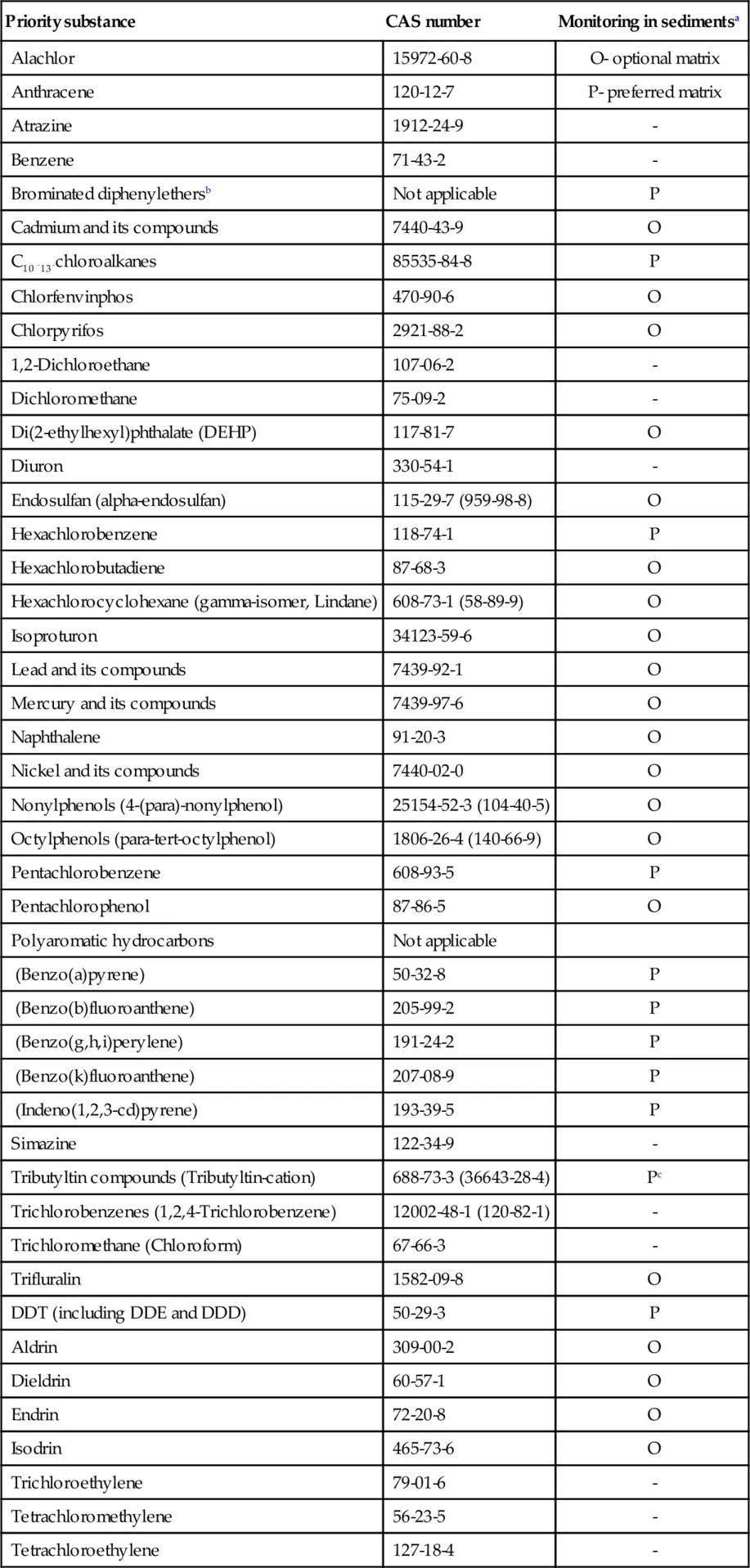
1. The first group includes contaminants listed in the list of priority compounds of the Water Framework Directive (WFD), which have long been recognized as posing risks to human health, due to their acute toxicity, carcinogenic, or mutagenic effects and their persistence in the environment (i.e. persistent organic pollutants, POPs). Some of the priority compounds are relatively new on regulatory lists and evidence regarding their unforeseen adverse health effects and occurrence in the environment are still emerging. There are currently 33 priority substances (2455/2001/EC) for which sediment EQS are required under the WFD. Additionally, 8 other hazardous substances are covered by the daughter directives of the Dangerous Substances Directive 86/280/EC and 76/464/EEC (i.e. DDT, aldrin, dieldrin, endrin, isodrin, trichlorethylene, perchlorethylene tetrachloroethylene and carbon tetrachloride) (Table 1).
Table 1
List of 33 priority pollutants of the EU Water Framework Directive (2455/2001/EC) + 8 substances covered by the daughter directives 86/280/EC and 76/464/EEC
| Priority substance | CAS number | Monitoring in sedimentsa |
| Alachlor | 15972-60-8 | O- optional matrix |
| Anthracene | 120-12-7 | P- preferred matrix |
| Atrazine | 1912-24-9 | - |
| Benzene | 71-43-2 | - |
| Brominated diphenylethersb | Not applicable | P |
| Cadmium and its compounds | 7440-43-9 | O |
| C10 −13−chloroalkanes | 85535-84-8 | P |
| Chlorfenvinphos | 470-90-6 | O |
| Chlorpyrifos | 2921-88-2 | O |
| 1,2-Dichloroethane | 107-06-2 | - |
| Dichloromethane | 75-09-2 | - |
| Di(2-ethylhexyl)phthalate (DEHP) | 117-81-7 | O |
| Diuron | 330-54-1 | - |
| Endosulfan (alpha-endosulfan) | 115-29-7 (959-98-8) | O |
| Hexachlorobenzene | 118-74-1 | P |
| Hexachlorobutadiene | 87-68-3 | O |
| Hexachlorocyclohexane (gamma-isomer, Lindane) | 608-73-1 (58-89-9) | O |
| Isoproturon | 34123-59-6 | O |
| Lead and its compounds | 7439-92-1 | O |
| Mercury and its compounds | 7439-97-6 | O |
| Naphthalene | 91-20-3 | O |
| Nickel and its compounds | 7440-02-0 | O |
| Nonylphenols (4-(para)-nonylphenol) | 25154-52-3 (104-40-5) | O |
| Octylphenols (para-tert-octylphenol) | 1806-26-4 (140-66-9) | O |
| Pentachlorobenzene | 608-93-5 | P |
| Pentachlorophenol | 87-86-5 | O |
| Polyaromatic hydrocarbons | Not applicable | |
| (Benzo(a)pyrene) | 50-32-8 | P |
| (Benzo(b)fluoroanthene) | 205-99-2 | P |
| (Benzo(g,h,i)perylene) | 191-24-2 | P |
| (Benzo(k)fluoroanthene) | 207-08-9 | P |
| (Indeno(1,2,3-cd)pyrene) | 193-39-5 | P |
| Simazine | 122-34-9 | - |
| Tributyltin compounds (Tributyltin-cation) | 688-73-3 (36643-28-4) | Pc |
| Trichlorobenzenes (1,2,4-Trichlorobenzene) | 12002-48-1 (120-82-1) | - |
| Trichloromethane (Chloroform) | 67-66-3 | - |
| Trifluralin | 1582-09-8 | O |
| DDT (including DDE and DDD) | 50-29-3 | P |
| Aldrin | 309-00-2 | O |
| Dieldrin | 60-57-1 | O |
| Endrin | 72-20-8 | O |
| Isodrin | 465-73-6 | O |
| Trichloroethylene | 79-01-6 | - |
| Tetrachloromethylene | 56-23-5 | - |
| Tetrachloroethylene | 127-18-4 | - |
a according to the Expert Advisory Group on Analysis and Monitoring of Priority Substances (AMPS) of the DG Environment [2]
b inclu...
Table of contents
- Cover image
- Title page
- Table of Contents
- Copyright page
- Preface
- Sampling of sediments and suspended matter
- Characterisation of contaminants in sediments – effects of bioavailability on impact
- Chemical Analysis of Contaminants in Sediments
- Biological analysis (Bioassays, Biomarkers, Biosensors)
- Effect Directed Analysis and Toxicity Identification Evaluation
- Benthos Sediment Quality Assessments
- Modelling of Pollutant Fate and Behaviour in Bed Sediments
- Sediment Quality Guidelines and Weight of Evidence Assessments
- Soil protection, sediment monitoring and key recommendations
- Glossary
- Index
Trusted by 375,005 students
Access to over 1.5 million titles for a fair monthly price.
Study more efficiently using our study tools.
Frequently asked questions
Yes, you can cancel anytime from the Subscription tab in your account settings on the Perlego website. Your subscription will stay active until the end of your current billing period. Learn how to cancel your subscription
No, books cannot be downloaded as external files, such as PDFs, for use outside of Perlego. However, you can download books within the Perlego app for offline reading on mobile or tablet. Learn how to download books offline
Perlego offers two plans: Essential and Complete
- Essential is ideal for learners and professionals who enjoy exploring a wide range of subjects. Access the Essential Library with 800,000+ trusted titles and best-sellers across business, personal growth, and the humanities. Includes unlimited reading time and Standard Read Aloud voice.
- Complete: Perfect for advanced learners and researchers needing full, unrestricted access. Unlock 1.5M+ books across hundreds of subjects, including academic and specialized titles. The Complete Plan also includes advanced features like Premium Read Aloud and Research Assistant.
We are an online textbook subscription service, where you can get access to an entire online library for less than the price of a single book per month. With over 1.5 million books across 990+ topics, we’ve got you covered! Learn about our mission
Look out for the read-aloud symbol on your next book to see if you can listen to it. The read-aloud tool reads text aloud for you, highlighting the text as it is being read. You can pause it, speed it up and slow it down. Learn more about Read Aloud
Yes! You can use the Perlego app on both iOS and Android devices to read anytime, anywhere — even offline. Perfect for commutes or when you’re on the go.
Please note we cannot support devices running on iOS 13 and Android 7 or earlier. Learn more about using the app
Please note we cannot support devices running on iOS 13 and Android 7 or earlier. Learn more about using the app
Yes, you can access Sediment Quality and Impact Assessment of Pollutants by Damia Barcelo,Mira Petrovic,Damià Barceló in PDF and/or ePUB format, as well as other popular books in Physical Sciences & Analytic Chemistry. We have over 1.5 million books available in our catalogue for you to explore.