- 440 pages
- English
- ePUB (mobile friendly)
- Available on iOS & Android
eBook - ePub
Machine Learning for Subsurface Characterization
About this book
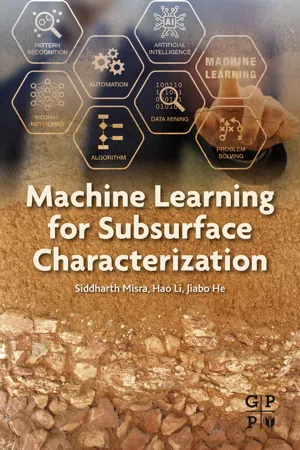
Machine Learning for Subsurface Characterization develops and applies neural networks, random forests, deep learning, unsupervised learning, Bayesian frameworks, and clustering methods for subsurface characterization. Machine learning (ML) focusses on developing computational methods/algorithms that learn to recognize patterns and quantify functional relationships by processing large data sets, also referred to as the "big data." Deep learning (DL) is a subset of machine learning that processes "big data" to construct numerous layers of abstraction to accomplish the learning task. DL methods do not require the manual step of extracting/engineering features; however, it requires us to provide large amounts of data along with high-performance computing to obtain reliable results in a timely manner. This reference helps the engineers, geophysicists, and geoscientists get familiar with data science and analytics terminology relevant to subsurface characterization and demonstrates the use of data-driven methods for outlier detection, geomechanical/electromagnetic characterization, image analysis, fluid saturation estimation, and pore-scale characterization in the subsurface.
- Learn from 13 practical case studies using field, laboratory, and simulation data
- Become knowledgeable with data science and analytics terminology relevant to subsurface characterization
- Learn frameworks, concepts, and methods important for the engineer's and geoscientist's toolbox needed to support
Information
Table of contents
- Cover image
- Title page
- Table of Contents
- Copyright
- Dedication
- Contributors
- Preface
- Acknowledgment
- Chapter 1: Unsupervised outlier detection techniques for well logs and geophysical data
- Chapter 2: Unsupervised clustering methods for noninvasive characterization of fracture-induced geomechanical alterations
- Chapter 3: Shallow neural networks and classification methods for approximating the subsurface in situ fluid-filled pore size distribution
- Chapter 4: Stacked neural network architecture to model the multifrequency conductivity/permittivity responses of subsurface shale formations
- Chapter 5: Robust geomechanical characterization by analyzing the performance of shallow-learning regression methods using unsupervised clustering methods
- Chapter 6: Index construction, dimensionality reduction, and clustering techniques for the identification of flow units in shale formations suitable for enhanced oil recovery using light-hydrocarbon injection
- Chapter 7: Deep neural network architectures to approximate the fluid-filled pore size distributions of subsurface geological formations
- Chapter 8: Comparative study of shallow and deep machine learning models for synthesizing in situ NMR T2 distributions
- Chapter 9: Noninvasive fracture characterization based on the classification of sonic wave travel times
- Chapter 10: Machine learning assisted segmentation of scanning electron microscopy images of organic-rich shales with feature extraction and feature ranking
- Chapter 11: Generalization of machine learning assisted segmentation of scanning electron microscopy images of organic-rich shales
- Chapter 12: Characterization of subsurface hydrocarbon/water saturation by processing subsurface electromagnetic logs using a modified Levenberg-Marquardt algorithm
- Chapter 13: Characterization of subsurface hydrocarbon/water saturation using Markov-chain Monte Carlo stochastic inversion of broadband electromagnetic logs
- Index
Trusted by 375,005 students
Access to over 1.5 million titles for a fair monthly price.
Study more efficiently using our study tools.
Frequently asked questions
Yes, you can cancel anytime from the Subscription tab in your account settings on the Perlego website. Your subscription will stay active until the end of your current billing period. Learn how to cancel your subscription
No, books cannot be downloaded as external files, such as PDFs, for use outside of Perlego. However, you can download books within the Perlego app for offline reading on mobile or tablet. Learn how to download books offline
We are an online textbook subscription service, where you can get access to an entire online library for less than the price of a single book per month. With over 1.5 million books across 990+ topics, we’ve got you covered! Learn about our mission
Look out for the read-aloud symbol on your next book to see if you can listen to it. The read-aloud tool reads text aloud for you, highlighting the text as it is being read. You can pause it, speed it up and slow it down. Learn more about Read Aloud
Yes! You can use the Perlego app on both iOS and Android devices to read anytime, anywhere — even offline. Perfect for commutes or when you’re on the go.
Please note we cannot support devices running on iOS 13 and Android 7 or earlier. Learn more about using the app
Please note we cannot support devices running on iOS 13 and Android 7 or earlier. Learn more about using the app
Yes, you can access Machine Learning for Subsurface Characterization by Siddharth Misra,Hao Li,Jiabo He in PDF and/or ePUB format, as well as other popular books in Technology & Engineering & Chemical & Biochemical Engineering. We have over 1.5 million books available in our catalogue for you to explore.