eBook - ePub
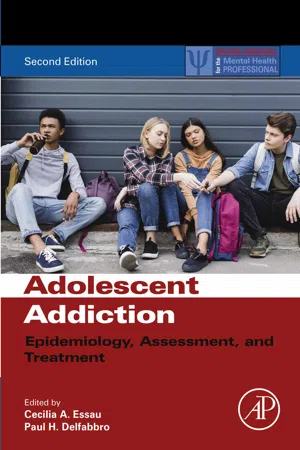
Adolescent Addiction
Epidemiology, Assessment, and Treatment
- 356 pages
- English
- ePUB (mobile friendly)
- Available on iOS & Android
eBook - ePub
About this book
Adolescent Addiction, Second Edition, offers researchers and clinicians a single-volume resource on the nature, extent and treatment of addictive problems in adolescents. The book is divided into three main parts. Part one addresses the foundations of addictive problems, including developmental, social, and neurobiologicl factors. Part two addresses common addictions among adolescents. New chapters include e-cigarette, smartphone, social networking, and exercise addiction. Part three discusses challenges and recommendations for future research in adolescent addiction. All chapters in part two follow a similar format to introduction and clinical characteristics, screening and clinical assessment methods, epidemiology, cormorbidity, course and outcome, protective and risk factors, evidence-based clinical strategies for prevention and treatment, and a concise summary of key clinical points.
- Introduces the foundations to understanding addiction.
- Examines the epidemiology, comorbidity, course, and outcome of addictions.
- Provides screening and clinical assessment methods.
- Summarizes evidence-based clinical strategies for treatment.
- Covers both substance addiction and behavioral addictions.
- New chapters on e-cigarette, smartphone, internet, and exercise addiction.
Information
Part I
General issues
Chapter 1
Foundations of addictive problems in adolescents: Developmental and social factors
Michèle Preydea; Jessica Furtadoa; Sarah Heada; Dennis Longb a Department of Family Relations and Applied Nutrition, University of Guelph, Guelph, ON, Canada
b Breakaway Addiction Services, Toronto, ON, Canada
b Breakaway Addiction Services, Toronto, ON, Canada
Abstract
Substance use and behavior addictions are a significant and evolving problem for today’s adolescents and young adults as they are at the apex of risk-taking behaviors and identity forming. For the prevention and treatment of addictions, problems associated with youth mean that solutions may need to be specifically tailored to meet the particular needs of young people. Comorbid mental health disorders are significantly involved with onset of addiction and its continuation into adulthood. Individual factors associated with substance and addictive problems include lack of behavioral control, temperament and genetic predispositions, and poor emotional regulation. Moreover, early initiation to substance use is a strong predictor of the development of substance use disorder. Since drug use initiation often begins in childhood and adolescence, it is suggested that primary care physicians receive specific training for prevention and intervention of substance use disorders.
Keywords
Youth; Addictive behavior; Social use; Substance; Adolescent; Development
1.1 Youth and addictions
Substance use and behavior addictions are a significant and evolving problem for today’s adolescents and young adults. It is important to consider this problem as a distinct phenomenon and not just a “junior version” of adult addictions. In this chapter, we will discuss these differences and the factors influencing youth as they struggle with the many challenges of development into adults. Addiction problems are likely to become an issue for youth as they are at the apex of risk-taking behaviors and identity forming. In many ways, a “perfect storm” of factors that can lead to addiction-related problems, if not adequately addressed, can lead to significant short- and potentially long-term harm for young people. The implications of this situation for the prevention and treatment of addictions problems associated with youth are that solutions may need to be specifically tailored to meet the particular needs of young people.
The conceptualization of additions and addictive behaviors continues to be revised or updated in the DSM and ICD based on the current scientific knowledge to guide classification and treatment (Grant & Chamberlain, 2016). In the DSM-5, substance-related and addictive disorders include gambling disorder, and under mental and behavioral disorders, substance dependence is featured in the draft ICD-11, although gaming disorders are included in both diagnostic systems (Saunders, 2017). Regardless of current state of conceptualizations, addiction to substances and addictive behaviors are a considerable public health concern for adolescents and young people (Degenhardt, Stocklings, Patton, Hall, & Lynskey, 2016). Accordingly, while acknowledging that the status of some classifications is still under development, this chapter is focused on young people and the developmental and social factors associated with substance use disorders and behavioral addictions such as gambling and video gaming within this population.
Addictive problems are costly and preventable. The use of addictive substances and indulgence in addictive behaviors can often be heightened during adolescence and emerging adulthood. Such problematic behavior can result in a range of harms including negative impacts on educational achievement and psychosocial transitions essential for successful adaptation to adulthood. How addictions have been conceptualized and the theories used to describe addictions have previously been reviewed (Preyde & Adams, 2008). In this chapter, the evolving prevalence of addictions will be introduced, followed by a review of the social and developmental factors underpinning the reliance on substances and behaviors in adolescence and the impacts of these behaviors on psychosocial development. The chapter is concluded with attention to emerging trends; vaping and the opioid epidemic are emerging as significant problems for youth. It is acknowledged that the development of adolescent addictions is multifaceted and is best approached from a multifaceted, bio-psycho-social, or ecological framework which can encompass diverse factors ranging from genetic and epigenetic contributions through to broader social influences. Much of our focus in this chapter will be upon the social and developmental contexts which influence higher risk behaviors and addiction in youth.
1.2 Prevalence of risky behaviors
Substance use and addictive behaviors have a peak onset during adolescence. The majority of adolescents has reported alcohol use; for example, estimates of 65%–85% of grade 12 youth (Boak, Hamilton, Adlaf, & Mann, 2017; Hibell et al., 2012) have reported alcohol use, and many youth report other substance use including cannabis (48% in grade 12 youth in Ontario; Boak et al., 2017). Moreover, the nature of adolescent addictions changes with the changing times (Kraus et al., 2018). Youth with substance use disorder are using substances in increasingly risky ways (Bridges, Gill, Omole, et al., 2013). However, trends suggest there is a decrease in alcohol consumption, but increases in other addictive behaviors. These changes could be due to changing social norms or possibly the effects of preventive efforts for alcohol. In terms of behavioral addictions, the prevalence of problem gambling in adolescents has typically been found to be higher than in adult populations with most figures often between 2% and 5% in major reviews (Calado, Alexandre, & Griffiths, 2016). In Britain, engagement in gambling is declining with a recent survey showing that only 12% of children aged 11–15 years reported gambling in the previous week (Wardle, 2018). An estimated 0.8% were classified as problem gamblers (Forrest & McHale, 2018). In the meantime, the popularity of Internet-based activities (gaming) is growing. Estimates of problematic Internet use range from 5% of European youth (Durkee, Carli, Floderus, et al., 2016) to almost 14% identified in a systematic review (Fumero, Marrero, Voltes, & Peñate, 2018). In a US-based report, estimates of Internet gaming ranged from 1% to 9% (Gentile et al., 2017), whereas addictive and problematic video gaming behaviors have been estimated to range from about 6% to about 10% of the adolescent and emerging adult population. Of greater concern is that those engaging in problematic behaviors are doing so at a younger age (Ferguson, Coulson, & Barnett, 2011; Wittek et al., 2015). In addition, the social aspects of gaming may be reinforcing increased use.
Comorbid mental health disorders are significantly involved with onset of addiction and its continuation into adulthood (Rush et al., 2008; Schlossarek, Kempkensteffan, Reimer, & Verthein, 2016). As many as two-thirds of adolescents who use addictive substances are reportedly polysubstance users in their lifetime (CASA, 2011); and there is concern for youth engaging in addictive behaviors such as gambling when they also have other addiction problems (Forrest & McHale, 2018). In fact, in one recent study, substance addictions and nonsubstance or behavioral addictions were strongly correlated (Estevez, Jauregui, Sanchez-Marcos, Lopez-Gonzalez, & Griffiths, 2017). The complexity of comorbidity can adversely influence efforts to address the addiction and increase cost of health care.
1.3 Adolescent psychosocial development
Adolescence is a vulnerable developmental period. There are many developmental changes including rapid biological, cognitive, psychological, and social development (Christie & Viner, 2005). During adolescence, autonomy from parents is often sought. Developmentally, greater autonomy from parents and increased peer contact contribute to risk-taking and exploration. Physical development, including growth and puberty, and sexual maturation and the development of intimate sexual relationships can influence young people’s sense of self-concept. Psychologically, the development of personal identity begins during childhood, but takes on greater significance in adolescence with increased time spent with peers and extra-familial influences. Feelings of invincibility are prominent. Biologically, the adolescent brain undergoes remarkable development which can permit abstract thinking and increas...
Table of contents
- Cover image
- Title page
- Table of Contents
- Copyright
- Contributors
- Preface
- Part I: General issues
- Part II: Specific addictive problems
- Part III: Implications for the future
- Index
Trusted by 375,005 students
Access to over 1.5 million titles for a fair monthly price.
Study more efficiently using our study tools.
Frequently asked questions
Yes, you can cancel anytime from the Subscription tab in your account settings on the Perlego website. Your subscription will stay active until the end of your current billing period. Learn how to cancel your subscription
No, books cannot be downloaded as external files, such as PDFs, for use outside of Perlego. However, you can download books within the Perlego app for offline reading on mobile or tablet. Learn how to download books offline
Perlego offers two plans: Essential and Complete
- Essential is ideal for learners and professionals who enjoy exploring a wide range of subjects. Access the Essential Library with 800,000+ trusted titles and best-sellers across business, personal growth, and the humanities. Includes unlimited reading time and Standard Read Aloud voice.
- Complete: Perfect for advanced learners and researchers needing full, unrestricted access. Unlock 1.5M+ books across hundreds of subjects, including academic and specialized titles. The Complete Plan also includes advanced features like Premium Read Aloud and Research Assistant.
We are an online textbook subscription service, where you can get access to an entire online library for less than the price of a single book per month. With over 1.5 million books across 990+ topics, we’ve got you covered! Learn about our mission
Look out for the read-aloud symbol on your next book to see if you can listen to it. The read-aloud tool reads text aloud for you, highlighting the text as it is being read. You can pause it, speed it up and slow it down. Learn more about Read Aloud
Yes! You can use the Perlego app on both iOS and Android devices to read anytime, anywhere — even offline. Perfect for commutes or when you’re on the go.
Please note we cannot support devices running on iOS 13 and Android 7 or earlier. Learn more about using the app
Please note we cannot support devices running on iOS 13 and Android 7 or earlier. Learn more about using the app
Yes, you can access Adolescent Addiction by Cecilia A. Essau,Paul Delfabbro in PDF and/or ePUB format, as well as other popular books in Psychology & Addiction in Psychology. We have over 1.5 million books available in our catalogue for you to explore.