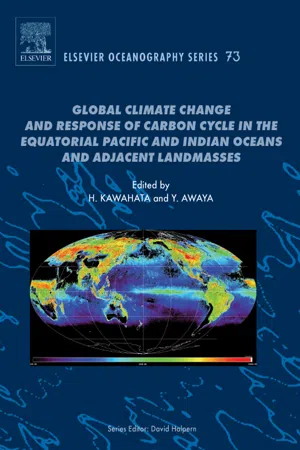
To understand the global warming mechanism, global mapping of primary production was carried out under the GCMAPS program. The program was concerned with marine and terrestrial environmental changes, which affect carbon cycle on the regional and global scales. On the regional scale, warm phase of ENSO (El Niño / Southern Oscillation) has been shown to affect economic activities in many countries. The keyword for understanding mechanism of global warming is 'primary productivity'. The earth observation satellites (EOS) like the ADEOS of Japan, and the SeaWiFS, Sea Star and Terra of the U.S.A. provided much required data for modeling and verification of primary production estimates on both land and ocean.The knowledge gained during the GCMAPS program has been documented in this book. Interpretation of the data suggests that global warming, which causes temperature and sea level rise, and changes in climate and ecosystems, is likely to have the largest influence on mankind. The first half of this book discuss changes in marine environments. Physical and chemical oceanographic properties of the equatorial Pacific and Indian Oceans are presented. Changes in partial pressure of carbon dioxide, flux and composition of settling particles and biological communities in the surface ocean have also been discussed. In addition to this, over hundred years of environmental records based upon coral skeletons are presented. Estimations of primary production and its utilization in validating satellite imagery data were conducted in the western North Pacific. Primary productivity estimates based upon the validated satellite imagery are presented on the global scale. Climate change modeling of primary production in global oceans is also presented.The latter half of this book deals with changes in terrestrial environments. Primary productivity estimates for different types of ecosystems (e.g., forest, grassland) are presented together with soil carbon dynamics. Also, biomass and productivity estimation and environmental monitoring based upon remote sensing techniques are presented with a model analysis of the relationship between climate perturbations and carbon budget anomalies in global terrestrial ecosystems. This book elucidates integrated aspects of the global carbon cycle involving marine and terrestrial environments.
- Discusses a current understanding of the biogeochemical processes on land and ocean
- Provides global mapping of primary production based on satellite imagery data and modelling
- Presents the latest interpretations of relationships between carbon cycle and climatic change
Chapter 1 Long-Term Trend of the Partial Pressure of CO2 in Surface Waters and Sea−Air CO2 Flux in the Equatorial Pacific
Hisayuki Y. Inoue1,5,*, Richard A. Feely2, Masao Ishii1, Takeshi Kawano3, Akihiko Murata3, Rik Wanninkhof4
1 Geochemical Research Department, Meteorological Research Institute, Tsukuba, Ibaraki 305-0052, Japan
2 Pacific Marine Environmental Laboratory, National Oceanic and Atmospheric Administration, Seattle, WA 98115-0070, USA
3 Ocean Research Department, Japan Marine Science and Technology Center, Yokosuka, Kanagawa 237-0061, Japan
4 Atlantic Oceanographic and Meteorological Laboratory, National Oceanic and Atmospheric Administration, Miami, FL 33149, USA
5 Laboratory of Marine and Atmospheric Geochemistry, Graduate School of Environmental Earth Sciences, Hokkaido University, Kita-ku, Sapporo 060-0810, Japan
Measurements of partial pressure of CO2 in surface waters (pCO2sw) and overlying air (pCO2air) were made intermittently in the central and western equatorial Pacific from January 1987 to January 2003. We estimated the long-term trend of the pCO2sw in the high nutrient low chlorophyll (HNLC) region and the western Pacific warm pool. The spatial distribution of pCO2sw in the HNLC region could be expressed as a linear function of sea surface temperature (SST) and concentration of macronutrients ([NO2−]+[NO3−]), and in the western Pacific warm pool as a function of SST and sea surface salinity (SSS). By using an average SST (27.4 °C) and concentration of nitrate and nitrite (3.9 μmol/kg) in the HNLC region and the average SST (29.6 °C) and SSS (34.29) in the western Pacific warm pool between 1987 and 2003, we obtained pCO2sw values for respective cruises. The growth rate of pCO2sw due to increases in atmospheric CO2 was calculated to be 1.4±0.5 μatm/yr in the HNLC region and 1.3±0.3 μatm/yr in the western Pacific warm pool. The sea−air CO2 flux in the equatorial Pacific since 1998 was evaluated by using underway pCO2sw data measured by Japan Meteorological Agency, Meteorological Research Institute (JMA/MRI), National Oceanic and Atmospheric Administration, Pacific Marine Environmental Laboratory (NOAA/PMEL), and NOAA, Atlantic Oceanographic and Meteorological Laboratory (NOAA/AOML). From 1998 to 2003 the sea−air CO2 flux in the equatorial Pacific (5°N–10°S, 140°E–90°W) showed lowest flux in January/February 1998 (0.1±0.1 Pg C/yr, 1997/98 El Niño), and highest (0.9±0.4 Pg C/yr) in January/February 2001, suggesting significant interannual variations in sea−air CO2 flux in the equatorial Pacific. In October 2002−January 2003, which was within a weak El Niño period, the CO2 flux in the equatorial Pacific was 0.5±0.3 Pg C/yr, almost same as that of the non-El Niño period. In this period, sea−air CO2 flux in the central and western equatorial Pacific decreased considerably to the same level of January/February 1998, but that in the eastern equatorial Pacific remained fairly constant.
Keywords
partial pressure of CO2 • sea−air CO2 flux • Oceanic carbon cycle • Equatorial Pacific • Long-term trend
1 Introduction
By exchanging CO2 with the atmosphere, ocean plays an important role in determining the atmospheric CO2 level that has been increasing due to human activities (IPCC, 2001). The CO2 flux between the sea and the overlying air (F) can be estimated by the product of the gas transfer velocity expressed as a function of wind speed (k; Wanninkhof, 1992; Wanninkhof and McGillis, 1999), the solubility of CO2 (s; Weiss, 1974), and the difference in partial pressure (or fugacity) of CO2 between the sea surface water and the air (
pCO2=pCO2sw–pCO2air):
(1)
The pCO2sw actually determines whether the ocean acts as a source for atmospheric CO2 or a sink, because it varies significantly as compared with that of air (see e.g., Takahashi et al., 2002).
The equatorial Pacific is a well-documented source for atmospheric CO2 in which the sea−air CO2 flux has been estimated to vary between 0.02 and 0.96 Pg–C/yr, depending on changes in physical and biological processes driven by the El Niño−southern oscillation (ENSO) phenomena (Feely et al., 2002). As described by Le Borgne et al. (2002), the equatorial Pacific consists of two regions that have distinct carbon system dynamics: the high nutrient low chlorophyll (HNLC) region and the western Pacific warm pool. The HNLC region extends from the eastern edge of the western Pacific warm pool to the coast of south America. Since the 1980s temporal and spatial variations in pCO2sw in the equatorial Pacific have been examined (see e.g., Feely et al., 2002; Takahashi et al., 2003). According to Feely et al. (2002), the prominent feature of pCO2sw in the eastern equatorial Pacific can be described as follows. Shoaling thermocline to the east and local upwelling and the Peruvian upwelling bring waters containing high CO2 concentration to the surface. The northward-flowing Peru Current entrains water with high pCO2sw into the south equatorial current (SEC). These lead to the highest pCO2sw in the eastern equatorial Pacific HNLC region. A steep gradient of pCO2sw occurs between the SEC and the north equatorial counte...
Table of contents
Cover image
Title page
Table of Contents
List of Contributors
Chapter 1 Long-Term Trend of the Partial Pressure of CO2 in Surface Waters and Sea−Air CO2 Flux in the Equatorial Pacific
Chapter 2 Global Change and Oceanic Primary Productivity: Effects of Ocean–Atmosphere–Biological Feedbacks
Chapter 3 Simulated In Situ Measurements of Primary Production in Japanese Waters
Chapter 4 Depth and Time Resolved Primary Productivity Model Examined for Optical Properties of Water
Chapter 5 Settling Particles in the Central North Pacific
Chapter 6 Understanding Biogeochemical Processes in the Pacific Ocean on the Basis of Labile Components of Settling Particles
Chapter 7 Monsoonal Impacts on the Biological Pump in the Northern Indian Ocean as Discerned from Sediment Trap Experiments
Chapter 8 Variability of the Indonesian Throughflow: A Review and Model-to-Data Comparison
Chapter 9 Coral Records of the 1990s in the Tropical Northwest Pacific: ENSO, Mass Coral Bleaching, and Global Warming
Chapter 10 Recent Advances in Coral Biomineralization with Implications for Paleo-Climatology: A Brief Overview
Chapter 11 Potential Feedback Mechanism Between Phytoplankton and Upper Ocean Circulation with Oceanic Radiative Transfer Processes Influenced by Phytoplankton – Numerical Ocean General Circulation Models and an Analytical Solution
Chapter 12 Precession and ENSO-Like Variability in the Equatorial Indo-Pacific Ocean
Chapter 13 Methods of Estimating Plant Productivity and CO2 Flux in Agro-Ecosystems – Liking Measurements, Process Models, and Remotely Sensed Information
Chapter 14 Absorption of Photosynthetically Active Radiation, Dry-matter Production, and Light-use Efficiency of Terrestrial Vegetation: A Global Model Simulation
Chapter 15 Terrestrial Net Primary Production (NPP) Estimation Using NOAA Satellite Imagery: Inter-annual Changes between 1982 and 1999
Chapter 16 Global Mapping of Net Primary Production
Chapter 17 Slash-and-Burn Agriculture in a Japanese Cedar (Cryptomeria japonica D. Don.) Plantation: Effects of Fire on Nutrients and Soil Emissions of Carbon Dioxide
Chapter 18 Leaf and Shoot Ecophysiological Properties and Their Role in Photosynthetic Carbon gain of Cool-Temperate Deciduous Forest Trees
Chapter 19 Seasonal Variations in CH4 Uptake and CO2 Emission by a Japanese Temperate Deciduous Forest Soil
Index
Trusted by 375,005 students
Access to over 1.5 million titles for a fair monthly price.
Study more efficiently using our study tools.
Frequently asked questions
Yes, you can cancel anytime from the Subscription tab in your account settings on the Perlego website. Your subscription will stay active until the end of your current billing period. Learn how to cancel your subscription
No, books cannot be downloaded as external files, such as PDFs, for use outside of Perlego. However, you can download books within the Perlego app for offline reading on mobile or tablet. Learn how to download books offline
Perlego offers two plans: Essential and Complete
Essential is ideal for learners and professionals who enjoy exploring a wide range of subjects. Access the Essential Library with 800,000+ trusted titles and best-sellers across business, personal growth, and the humanities. Includes unlimited reading time and Standard Read Aloud voice.
Complete: Perfect for advanced learners and researchers needing full, unrestricted access. Unlock 1.5M+ books across hundreds of subjects, including academic and specialized titles. The Complete Plan also includes advanced features like Premium Read Aloud and Research Assistant.
Both plans are available with monthly, semester, or annual billing cycles.
We are an online textbook subscription service, where you can get access to an entire online library for less than the price of a single book per month. With over 1.5 million books across 990+ topics, we’ve got you covered! Learn about our mission
Look out for the read-aloud symbol on your next book to see if you can listen to it. The read-aloud tool reads text aloud for you, highlighting the text as it is being read. You can pause it, speed it up and slow it down. Learn more about Read Aloud
Yes! You can use the Perlego app on both iOS and Android devices to read anytime, anywhere — even offline. Perfect for commutes or when you’re on the go. Please note we cannot support devices running on iOS 13 and Android 7 or earlier. Learn more about using the app
Yes, you can access Global Climate Change and Response of Carbon Cycle in the Equatorial Pacific and Indian Oceans and Adjacent Landmasses by Hodaka Kawahata,Yoshio A. Awaya in PDF and/or ePUB format, as well as other popular books in Biological Sciences & Global Warming & Climate Change. We have over 1.5 million books available in our catalogue for you to explore.