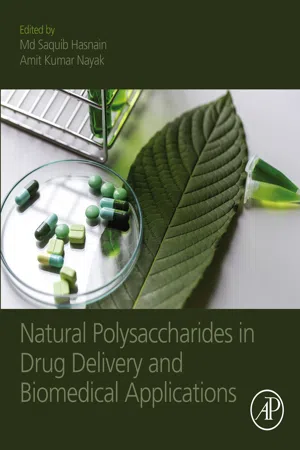
eBook - ePub
Natural Polysaccharides in Drug Delivery and Biomedical Applications
- 654 pages
- English
- ePUB (mobile friendly)
- Available on iOS & Android
eBook - ePub
Natural Polysaccharides in Drug Delivery and Biomedical Applications
About this book
Natural Polysaccharides in Drug Delivery and Biomedical Applications provides a fundamental overview of natural polysaccharides, their sources, extraction methodologies, and characterizations. It covers specific natural polysaccharides and their effective application in drug delivery and biomedical use. Additionally, chapters in the book discuss key topics including the sources and extraction methodologies of natural polysaccharides, their role in tissue engineering applications, polysaccharide-based nanoparticles in biomedical applications, and their role in the delivery of anticancer drugs. Written by industry leaders and edited by experts, this book emphasizes recent advances made in the field.Natural Polysaccharides in Drug Delivery and Biomedical Applications provides academics, researchers, and pharmaceutical health care professionals with a comprehensive book on polysaccharides in pharmaceutical delivery process.
- Provides fundamental concepts of natural polysaccharides as it applies to the pharmaceutical, biomedical, and biotechnology industries
- Includes contributions from global leaders and experts from academia, industry, and regulatory agencies in the application of natural polysaccharides in pharmaceutical products and biomedical utilization
- Offers practical examples, illustrations, chemical structures, and research case studies to help explain natural polysaccharides concepts in drug delivery and biomedical applications
Information
Chapter 1
Natural polysaccharides
sources and extraction methodologies
S M Mozammil Hasnain 1 , Md Saquib Hasnain 2 , and Amit Kumar Nayak 3 1 Department of Mechanical Engineering, Birla Institute of Technology, Mesra, Ranchi, India 2 Department of Pharmacy, Shri Venkateshwara University, Gajraula, India 3 Department of Pharmaceutics, Seemanta Institute of Pharmaceutical Sciences, Mayurbhanj, Odisha, India
Abstract
Polysaccharides extracted from various natural resources such as plants, animals, fungus, seaweeds, etc., are gaining increasing attention. These offer some unique advantages like biocompatibility, biodegradability, nontoxicity, solubility in water, stability, higher degrees of swelling capability, etc., for use in various biomedical applications including drug delivery, tissue engineering, wound healing, etc. Natural polysaccharides have also been reported to comprise outstanding rheological and biomucoadhesive properties, which can be applied in the designing and development of various useful and cost-effective drug delivery systems. The literature studies have enumerated various extraction methodologies to extract different natural polysaccharides, which are somewhat different with respect to small molecules. The present chapter describes various sources and extraction methodologies of natural polysaccharides.
Keywords
Drug delivery; Extraction; Natural polysaccharides
1. Introduction
In the past few decades, materials from the natural origin have gained wide acceptability in almost all fields of human lives more or less [1–8]. Currently, due to the exceptional biodegradability, sustainability, and higher abundances, as well as cost-effectiveness, natural materials are being widely used as the replacement for synthetic materials [9–13]. Natural polysaccharides, among a variety of natural origin materials, are the major industrial raw materials and have been the focus of thorough research due to above mentioned qualities [1,14–16]. Owing to a broad array of pharmacological activities like antitumor, immune-modulation, antioxidation, and antiinflammatory effects, natural polysaccharides extracted from various natural resources such as plants, animals, fungus, seaweeds, etc., are gaining increasing attention during the past few decades [17]. Natural polysaccharides comprise of numerous monosaccharide residues, which are interconnected with each other by means of the O – glycosidic linkages [17–19]. These polysaccharides yield simple sugar units like glucose, galactose, mannose, arabinose, xylose, uronic acids, etc., when hydrolyzed [1,20]. Natural polysaccharides, at the cellular level, are either present as the reserve materials in the cytoplasm (e.g., starch), or structural substances of the cell membranes or cell walls (e.g., cellulose) [9]. In general, extraction, purification, and uses of natural polysaccharides depend on their structural characteristics. The core structures of natural polysaccharides are extremely multifaceted, complex, and diverse. Nevertheless, the basic structures of the backbone chain of these natural polysaccharides are mannan, galactan, glucan, xylan, fructan, etc., or a combination of two or more monosaccharidic units (e.g., galactomannan, pectin) [1,17]. The structures of the polysaccharidic branched chains represent the great diversity of the biomacromolecular structural features.
The natural polysaccharides possess different physicochemical characteristics as well as functional groups [14,21–24]. These also have some useful advantageous properties such as biocompatibility, biodegradability, nontoxicity, solubility in water, stability, higher degrees of swelling, capability by means of simple chemical modifications, etc [25–27]. These biomaterials also possess an extroverted array of chemical structures, which may be the potential sites for the chemical modifications/functionalizations [23,24,28–34]. The proneness of the natural polysaccharides to the microbial degradations and/or enzymatic actions can be employed as the useful advantages in some cases (e.g., colon targeted drug delivery systems) [26,29]. These polysaccharides are capable of forming a variety of three-dimensional (3D) interconnecte...
Table of contents
- Cover image
- Title page
- Table of Contents
- Copyright
- List of contributors
- Preface
- Chapter 1. Natural polysaccharides: sources and extraction methodologies
- Chapter 2. Pharmaceutical applications of natural polysaccharides
- Chapter 3. Sodium alginate in drug delivery and biomedical areas
- Chapter 4. Chitosan in drug delivery applications
- Chapter 5. Xanthan gum in drug delivery applications
- Chapter 6. Gellan gum in drug delivery applications
- Chapter 7. Guar gum in drug delivery applications
- Chapter 8. Locust bean gum in drug delivery application
- Chapter 9. Sterculia gum in drug delivery applications
- Chapter 10. Pectin in drug delivery applications
- Chapter 11. Cashew gum in drug delivery applications
- Chapter 12. Tamarind gum in drug delivery applications
- Chapter 13. Hyaluronic acid in drug delivery applications
- Chapter 14. Gum odina as pharmaceutical excipient
- Chapter 15. Alginate-chitosan combinations in controlled drug delivery
- Chapter 16. Synthesis of micro- and nanoparticles of alginate and chitosan for controlled release of drugs
- Chapter 17. Polysaccharides nanoparticles as oral drug delivery systems
- Chapter 18. Natural polysaccharide-based composites for drug delivery and biomedical applications
- Chapter 19. Natural polysaccharides for the delivery of anticancer therapeutics
- Chapter 20. Organic nanocomposites for the delivery of bioactive molecules
- Chapter 21. Natural polysaccharides for growth factors delivery
- Chapter 22. Marine polysaccharides for drug delivery in tissue engineering
- Chapter 23. Natural polysaccharides in tissue engineering applications
- Chapter 24. Natural polysaccharides in wound dressing applications
- Chapter 25. Polysaccharides from leafy vegetables: chemical, nutritional and medicinal properties
- Chapter 26. Electrospun natural polysaccharide for biomedical application
- Index
Trusted by 375,005 students
Access to over 1.5 million titles for a fair monthly price.
Study more efficiently using our study tools.
Frequently asked questions
Yes, you can cancel anytime from the Subscription tab in your account settings on the Perlego website. Your subscription will stay active until the end of your current billing period. Learn how to cancel your subscription
No, books cannot be downloaded as external files, such as PDFs, for use outside of Perlego. However, you can download books within the Perlego app for offline reading on mobile or tablet. Learn how to download books offline
Perlego offers two plans: Essential and Complete
- Essential is ideal for learners and professionals who enjoy exploring a wide range of subjects. Access the Essential Library with 800,000+ trusted titles and best-sellers across business, personal growth, and the humanities. Includes unlimited reading time and Standard Read Aloud voice.
- Complete: Perfect for advanced learners and researchers needing full, unrestricted access. Unlock 1.5M+ books across hundreds of subjects, including academic and specialized titles. The Complete Plan also includes advanced features like Premium Read Aloud and Research Assistant.
We are an online textbook subscription service, where you can get access to an entire online library for less than the price of a single book per month. With over 1.5 million books across 990+ topics, we’ve got you covered! Learn about our mission
Look out for the read-aloud symbol on your next book to see if you can listen to it. The read-aloud tool reads text aloud for you, highlighting the text as it is being read. You can pause it, speed it up and slow it down. Learn more about Read Aloud
Yes! You can use the Perlego app on both iOS and Android devices to read anytime, anywhere — even offline. Perfect for commutes or when you’re on the go.
Please note we cannot support devices running on iOS 13 and Android 7 or earlier. Learn more about using the app
Please note we cannot support devices running on iOS 13 and Android 7 or earlier. Learn more about using the app
Yes, you can access Natural Polysaccharides in Drug Delivery and Biomedical Applications by Md Saquib Hasnain,Amit Kumar Nayak in PDF and/or ePUB format, as well as other popular books in Medicina & Industria farmacéutica, biotecnológica y sanitaria. We have over 1.5 million books available in our catalogue for you to explore.