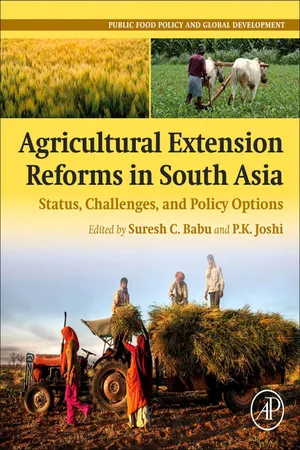
eBook - ePub
Agricultural Extension Reforms in South Asia
Status, Challenges, and Policy Options
- 410 pages
- English
- ePUB (mobile friendly)
- Available on iOS & Android
eBook - ePub
Agricultural Extension Reforms in South Asia
Status, Challenges, and Policy Options
About this book
Agricultural Extension Reforms in South Asia: Status, Challenges, and Policy Options is based on agricultural extension reforms across five South Asian countries, reflecting past experiences, case studies and experiments. Beginning with an overview of historical trends and recent developments, the book then delves into country-wise reform trajectories and presents several cases testing the effectiveness of different types (public and private) and forms (nutrition extension, livestock extension) of extension systems. Further, the book provides a comprehensive overview of challenges and constraints faced in formulating and implementing reforms, tying the results into a concrete set of lessons and highlighting areas that require further research.
In addition, the book discusses how a major aspect of agricultural development is the productivity increase from the knowledge base of farmers, and how translating research results into a knowledge base for farmers requires designing and implementing well-functioning extension programs.
- Presents the current challenges and solutions by region, and provides insights for application in global settings
- Provides key foundational information for the effective and efficient design of future intervention programs
- Includes workshops and presentations based on real-world research of specific aspects of extension systems and provision of advisory and consultation services to various governments
Information
Subtopic
AgribusinessPart I
Introduction
Outline
Chapter 1
Extension reforms in South Asia – an overview
Pramod K. Joshi1 and Suresh Chandra Babu1,2, 1International Food Policy Research Institute, Washington, DC, United States, 2Agricultural Economics, the University of Pretoria, South Africa
Abstract
Over the last 30 years, due funding constraints and poor organizational design and implementation, the quality of extension and rural services have declined in developing countries. As a result, public extension system has become ineffective in reaching the smallholder farmers who are crucial for the transformation of the agriculture sector. South Asia is no exception. Public extension system needs reformation to meet the changing needs of the farmers. Setting priorities in line with farmers’ problems and national policies and strategies are key for continuous innovation in the extension system. Agricultural transformation requires not just technological adoption of innovations. Behavioral change of the farmers through demonstration and through the right type of customized information is key for not just technology adoption but also for food system transformation. The extension messages must be simplified, and pluralistic extension needs coordination at the decentralized levels in terms of thematic areas, crops, livestock, fisheries, marketing prices, nutrition, and national resource management. Use of information, communication, and technology (ICT), internet of things (IoT), and drones are increasingly effective in generating and in sharing knowledge. Yet the role of quality information and the authenticity of information needs to be regulated. Social networks and farmers organizations could be effective in making information and agricultural services move easily accessible to the farmers. The monitoring, evaluation, and learning should go beyond the number of farmers reached and to become a system of learning, innovation, and capacity development. Information on innovations must be communicated through regular face-to-face interaction and through multiple channels of reinforcements with farm communities including on-site demonstration according to the context of the problem and capacity of the farming community to receive the information. Extension workers and the organizations involved in rural service delivery should be rewarded based on their performance and the feedback from the farming community. Extension workers need to be trained differently at various levels. There is a need to go beyond technology transfer skills to make them rural social entrepreneurs for providing a wide range of services depending on the needs of the farmers and the farming communities. Private sector approaches should be complemented by the public extension system. Public–private partnerships with private, NGOs, and farmer organizations are key for advancing agricultural transformation through extension and rural service provision.
Keywords
Agriculture; agriculture extension and advisory services; research and development; South Asia
Public extension and rural advisory services have, historically, played a significant role in accelerating agricultural productivity in many South Asian countries. However, reforms in agricultural extension systems have had varied levels of success. Several steps have been taken to increase the efficacy of the extension systems, but the challenge of applying the lessons learnt to policy-making and extension reforms still remains.
Due to the continued interest in research on extension systems and their reforms, several publications have focused on the challenges and constraints faced by the current extension systems from public and private sectors, their sustainability, and identifying lessons for the future. Research conducted so far in the South Asia region largely focuses on topics such as the provision of extension services by the public, private, or NGO sectors; how to make extension services more responsive to farmer needs; and how to improve farmers’ access to information. This has led to the development of a body of knowledge that will be useful in the formulation of future policy reform. However, several challenges remain for continued innovation and reform of the extension system in South Asia.
This book provides a comprehensive overview of agricultural extension reforms across four South Asian countries reflecting on past experiences, case studies, and experiments. The book then delves into country-wise reform trajectories and presents several cases testing the effectiveness of several types (public and private) and forms of extension systems. Further, it provides a comprehensive overview of the different challenges and constraints faced in formulating and implementing reforms, tying the results into a concrete set of lessons, and highlighting the areas that require further research.
The first set of chapters systematically compares the reforms in agriculture extension and advisory services in Bangladesh, India, Nepal, and Sri Lanka. Rest of the chapters focus on examining the effectiveness of the reforms and programs implemented from several perspectives.
Despite consistent efforts to improve agriculture extension and advisory services, there is a decline in agricultural growth in all four countries and there is an urgent need to identify approaches for promoting innovations in the agriculture extension system. Since the current techniques implemented and technology used are outdated, South Asian countries as discussed in this book need to move away from traditional single crop production techniques and adoption of modern technology perceptive to the extension to increase productivity and efficiency of the agriculture sector and food system as a whole. Farmer-first approaches need to better understand the critical needs of farmers and identify appropriate solutions.
Since public extension system has limited outreach and is unable to provide extension services to all farmers, building and promoting private extension services to fill the gap left by public extension system becomes essential for the South Asian countries analyzed in this book. For example, in India, agriclinics are privately run service, which provides information on soil testing and inputs to farmers. These agriclinics are opened in areas where access to public extension services is low. Several developing countries, like the ones in South Asia, face both institutional and structural challenges in their current extension system. Other factors limiting efficiency and productivity of the agriculture sector in these countries include low literary of farmers, limited outreach of extension and advisory services, and limited access to technology. Access to reliable and timely information not just forms public extension, but a wide variety of information sources, both public and private, can help farmers to make appropriate decisions regarding their crop production.
Another common challenge observed in the country case studies was that extension services provided were largely supply-driven. In general, farmers’ demands are changing to a variety of technologies and services to remain competitive and profitable. They try to diversify production, produce for niche markets, and move to high-value products. To provide these farmers with the relevant information, the extension system needs to be transformed to provide a demand-driven extension.
In the chapters of this book, a wide range of issues and challenges and potential solutions are described and analyzed. These chapters look at existing a potential program that has opportunities for scaling up and provides opportunities for policy reforms in extension systems. Part II of the book contains chapters focusing on the innovations in public extension system. These four chapters provide examples of extension reforms in South Asia. Chapter 2, Reforms in Agricultural Extension Services System in Bangladesh, focuses on reforms in agriculture extension service system in Bangladesh. This chapter critically analyzes policy innovations in the market extension system in Bangladesh. It reviews major extension reforms occurred in Bangladesh, assesses the performance of the existing approach, and identifies the various actors and key players engaged in the extension policy process and program implemented along with their impact through conducting case studies with farmers, field-level grassroot extension workers, and senior officers.
Chapter 3, Agricultural Extension Reforms: Lessons from India, provides a critical overview of the current state of agriculture extension in India. Agriculture extension in India has undergone several changes since independence. However, public extension system is unable to reach a large number of smallholder farmers and other vulnerable groups. Several organizational performance issues such as inadequate staff numbers, low partnerships, and continued top-down linear focus to extension hinder the effectiveness and efficiency of public extension system. Based on the field case studies in four states (Bihar, Himachal Pradesh, Maharashtra, and Tamil Nadu), it identifies policy priorities and strategic solutions to further refine the ongoing reform process.
Chapter 4, Extension Policies and Reforms in Nepal: An Analysis of Challenges, Constraints, and Policy Options, provides an overview of agricultural extension system reforms and how demand-driven extension should be implemented in Nepal. Since farmers’ priorities are rapidly changing, extension services need to change as well. It became difficult to address diversified farmers’ needs by public extension services alone. This chapter explains the urgency of providing up-to-date and commodity-specific extension services to farmers. Further, it explores why it is important to carefully reshape location-specific and need-based extension methodologies.
Chapter 5, Extension Reforms in Sri Lanka: Lessons and Policy Options, examines the developments over the past two decades in the provision of agricultural extension services in Sri Lanka. Agricultural extension services worldwide have been under increasing pressure to become more effective and more responsive to clients, and less costly to the governments. Sri Lanka has been no exception as seen by the various past attempts to reform the extension system for effective dissemination of agricultural technology to farmers. In many ways, the process of agricultural extension reforms has remained one that is incomplete and uncertain about the path to follow. This chapter demonstrates that the agricultural extension system has moved increasingly toward defining a greater role for the private sector. It identifies the elements of an environment conducive for the participation of the private sector in agricultural extension system and delineates conditions under which the private sector could be a strong complement to the public sector in delivery of agricultural extension services in Sri Lanka.
Part III of this book focuses on public innovations in the extension system. Chapter 6, Information Needs of Farmers: A Systemic Study Based on Farmer Surveys, focuses on the information needs of the farmers. Using a case study of two districts in South India, authors examine farmers’ information needs and information search behavior, factors affecting their search behavior, and their willingness to pay for information. Using cluster analysis on access, frequency, and use of information sources, study identifies four farmer information search behaviors—high, medium, semimedium, and low based on factors such as education level, economic status, cultivated land area, agricultural income, and membership in a farmer-based organization and a primary agricultural cooperative bank. Reliability and timeliness were major constraints across all groups. The preferred medium for obtaining information was interpersonal contacts, which followed mobile phones (helpline, voice message, and SMS). High and medium searchers used a greater number of sources, which also included print media and television.
Chapter 7, Can Institutional Convergence Force Agricultural Development in Pluralistic Extension Systems: A Case of Krishi Vigyan Kendra (The Farm Science Center) in India, provides empirical evidence toward institutional convergence for agricultural development within a pluralistic extension system. Specifically, the study is about the attempts taken by a public extension service provider Krishi Vigyan Kendra (KVK), the farm science center in Eastern India working with restricted funding and manpower to accelerate agricultural extension with partners working with almost parallel mandates at the district level. Largely, experiences of convergence in partnership envisaged have been narrated by the authors who were solely responsible to implement this approach. Results indicate that convergence helps to the foremost shift in agricultural extension of KVK through partnerships that are in terms of increased technology assessed, increased role as a knowledge broker, and improved research-extension linkage, high visibility, larger outreach, and quantitative jump in targets, devising and implementing alternative extension approaches and expanding expertise.
Chapter 8, Helping Farmers to Use Optimal Inputs: Lessons From Soil Health Cards in Bhoochetana Experiment, draws lessons from soil health cards in India. Poor understanding of soil quality and distortionary subsidies for urea are two big reasons for imbalanced use of chemical fertilizers in India. In 2009, Government of Karnataka launched a program, called Bhoochetana, to address both these problems. This chapter analyzes data from crop-cutting samples collected from a random sample of more than 3600 farmers and uses regress difference in yield against crop dummies and year dummies. The results of this chapter show that the application of micronutrients led to a 35%–40% increase in crop yields.
Chapter 9, Bihar Governments’ Efforts on Agricultural Extension Adopting Agricultural Technology Management (ATMA) Approach, evaluates efforts of Indian government on agriculture extension system in Bihar. The agricultural extension system is largely responsible for dissemination of technological knowledge to farmers in India. It is being operated by the Department of Agriculture, Government of India (GoI), through state-, district-, and block-level machinery. The research institutes and agricultural universities in the country also play a limited role in delivery of extension services. The extension system being an increasingly important engine for transfer of knowledge, innovations, and developments in agriculture needs reforms over time (Rivera and Sulaiman 2009). During mid-1990s, the GoI and the World Bank explored a new approach to address the prevalent problems and constraints of the agricultural extension system. The new decentralized extension approach, Agricultural Technology Management Agency (ATMA), emphasized more on agricultural diversification, and increasing farm income and rural employment came into existence. As a follow-up action, the GoI, on the success of ATMA model, initiated a new scheme on Support to State Extension Programs for extension reforms and provided funds for setting up of ATMA in all the 588 rural districts of the country. The ATMA model envisages a paradigm shift from top-down to bottom-up planning and in implementation of agricultural development programs. However, to make future program more effective, scientific study of the technology transfer system is essential.
Part IV of the book contains chapters that discuss innovations in private extension services. Chapter 10, Extension Through Rural Business Hubs: Lessons From Case Studies in Andhra Pradesh, Tamil Nadu, and Uttar Pradesh, uses stochastic frontier analysis to cross-section data from three large states of India (Andhra Pradesh, Tamil Nadu, and Uttar Pradesh) and assesses the actual use of extension services from institutional sources (private or public), and soil testing makes paddy farmers more efficient. Controlling for farmer characteristics like age, education, religion, social category, and total landownership and village fixed effects, results show that farmers who had received extension inputs from a formal source at least once in 12 months before our survey are more efficient growers of paddy in all three states. Similarly, farmers who had their soil tested were also more efficient in Andhra Pradesh and Tamil Nadu. Results on soil testing and use of exte...
Table of contents
- Cover image
- Title page
- Table of Contents
- Copyright
- List of Contributors
- About the Editors
- Preface
- Part I: Introduction
- Part II: Extension Reforms in South Asia
- Part III: Public Innovations in Extension Systems
- Part IV: Private Innovations in Extension Systems
- Part V: Information and Communication Technology and Education in Extension Systems
- Part VI: Specialized Extension Programs
- Part VII: Synthesis and Conclusion
- Index
Trusted by 375,005 students
Access to over 1.5 million titles for a fair monthly price.
Study more efficiently using our study tools.
Frequently asked questions
Yes, you can cancel anytime from the Subscription tab in your account settings on the Perlego website. Your subscription will stay active until the end of your current billing period. Learn how to cancel your subscription
No, books cannot be downloaded as external files, such as PDFs, for use outside of Perlego. However, you can download books within the Perlego app for offline reading on mobile or tablet. Learn how to download books offline
Perlego offers two plans: Essential and Complete
- Essential is ideal for learners and professionals who enjoy exploring a wide range of subjects. Access the Essential Library with 800,000+ trusted titles and best-sellers across business, personal growth, and the humanities. Includes unlimited reading time and Standard Read Aloud voice.
- Complete: Perfect for advanced learners and researchers needing full, unrestricted access. Unlock 1.5M+ books across hundreds of subjects, including academic and specialized titles. The Complete Plan also includes advanced features like Premium Read Aloud and Research Assistant.
We are an online textbook subscription service, where you can get access to an entire online library for less than the price of a single book per month. With over 1.5 million books across 990+ topics, we’ve got you covered! Learn about our mission
Look out for the read-aloud symbol on your next book to see if you can listen to it. The read-aloud tool reads text aloud for you, highlighting the text as it is being read. You can pause it, speed it up and slow it down. Learn more about Read Aloud
Yes! You can use the Perlego app on both iOS and Android devices to read anytime, anywhere — even offline. Perfect for commutes or when you’re on the go.
Please note we cannot support devices running on iOS 13 and Android 7 or earlier. Learn more about using the app
Please note we cannot support devices running on iOS 13 and Android 7 or earlier. Learn more about using the app
Yes, you can access Agricultural Extension Reforms in South Asia by Suresh Chandra Babu,P.K. Joshi in PDF and/or ePUB format, as well as other popular books in Technik & Maschinenbau & Agribusiness. We have over 1.5 million books available in our catalogue for you to explore.