- 100 pages
- English
- ePUB (mobile friendly)
- Available on iOS & Android
eBook - ePub
About this book
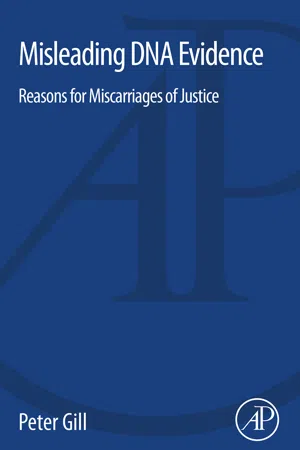
Misleading DNA Evidence: A Guide for Scientists, Judges, and Lawyers presents the reasons miscarriages of justice can occur when dealing with DNA, what the role of the forensic scientist is throughout the process, and how judges and lawyers can educate themselves about all of the possibilities to consider when dealing with cases that involve DNA evidence.
DNA has become the gold standard by which a person can be placed at the scene of a crime, and the past decade has seen great advances in this powerful crime solving tool. But the statistics that analysts can attach to DNA evidence often vary, and in some cases the statistical weight assigned to that match, can vary enormously. The numbers provided to juries often overstate the evidence, and can result in a wrongful conviction. In addition to statistics, the way the evidence is collected, stored and analyzed can also result in a wrongful conviction due to contamination.
This book reviews high-profile and somewhat contentious cases to illustrate these points, including the death of Meredith Kercher. It examines crucial topics such as characterization of errors and determination of error rates, reporting DNA profiles and the source and sub-source levels, and the essentials of statement writing. It is a concise, readable resource that will help not only scientists, but legal professionals with limited scientific backgrounds, to understand the intricacies of DNA use in the justice system.
- Ideal reference for scientists and for those without extensive scientific backgrounds
- Written by one of the pioneers in forensic DNA typing and interpretation of DNA profiling results
- Ideal format for travel, court environments, or wherever easy access to reference material is vital
Information
Chapter 1
Definitions
Contamination and Interpretation
Abstract
The purpose of this chapter is to introduce the subject of interpretation of “trace-DNA” evidence. The definition of “trace-DNA” is associated with the uncertainty of the relevance of the DNA evidence relative to the crime event itself. There is an extended discussion on the causes and implications of contamination at the crime scene and in the laboratory. Background contamination exists at the crime scene before the crime event has occurred. The challenge is to distinguish between the crime-event DNA vs. the naturally occurring background DNA–it may not be possible to distinguish between them. The concept of the “statement of limitations” is introduced as the baseline. A number of common fallacies/errors that are primary causes of miscarriages of justice are highlighted: “the association fallacy,” “the hidden perpetrator effect,” “the naïve investigator effect,” “the serial error effect,” “the compounded error effect,” and confirmation bias.
Keywords
Definitions
Contamination
Interpretation
Fallacies
Trace-DNA
Limitations
Cognitive errors
1.1 Historical
The original DNA profiling technique developed in 1985 had relatively low sensitivity. It was limited to the analysis of large visible crime stains that were at least 1 cm in diameter. Improvements facilitated by the widespread adoption of the polymerase chain reaction (PCR) method gradually increased the sensitivity to the point that only a few cells were required in an assay (Gill et al., 2000). At first this development was regarded as controversial, but now, the analysis of “trace-DNA”1 has become routine. This book is about the interpretation of DNA profiles derived from “trace-DNA” evidence.
1.2 Definition of “Trace-DNA”
The term “trace-DNA” was used in a recent review by van Oorschot et al., (2010):
Trace-DNA samples may be defined as any sample which falls below recommended thresholds at any stage of the analysis.
I have modified this definition simply because this type of analysis is now universal. It has been motivated by the introduction of new biochemistry and instrumentation over recent years. Manufacturers compete with each other to develop the most sensitive methods and forensic scientists readily adopt the new systems, along with protocols that now standardize tests.
Therefore, I have altered Oorschots definition of “trace-DNA” to take account of this change in practice. The key to the definition is whether a DNA profile is meaningful within the context of the “Locard’s exchange principle”: “every contact leaves a trace” and its implied extension to: “every perpetrator leaves a trace.”
Accordingly, I have redefined as follows:
Trace-DNA is defined as any sample where there is uncertainty that it may be associated with the crime event itself—so that it is possible that the transfer may have occurred before the crime event (innocent transfer) or after the crime event (investigator mediated).
The definition is deliberately vague: it hinges upon an assessment of the relevance of a “trace-DNA” profile to the crime event which is considered in the context of a “statement of limitations” originally published in 2001 and reproduced below.
1.2.1 “Trace-DNA” Evidence: Statement of Limitations (Gill, 2001)
This is the “starting” position:
1. Although a DNA profile has been obtained, it is possible neither to identify the type of cells from which the DNA originated, nor to state when the cells were deposited.
2. It is not possible to make any conclusion about transfer and persistence of DNA in this case. It is not possible to estimate when the suspect last wore the [watch],2 if it is his DNA.
3. Because the DNA test is very sensitive, it is not unexpected to find mixtures. If the potential origins of DNA profiles cannot be identified, it does not necessarily follow that they are relevant to this case, since transfer of cells can occur as a result of casual contact.
The definition of “trace-DNA” will encompass a large proportion of crime samples that are currently processed within DNA laboratories. It will include all low-level DNA profiles, for which there is no concurrent body fluid that has been identified with certainty (Section 1.5).
1.2.2 Assessment of “Trace-DNA” Evidence in the Context of the Case: “The List of Possibilities”
With some cases (examples described later in the book) it will not be possible for a scientist to go beyond the “statement of limitations.” The prosecution will nevertheless “push” the scientist to associate the “trace-DNA” evidence with the crime event “activity”; the challenge is to refrain from overstepping boundaries of knowledge—i.e., to imply that the evidence has more meaning than it really does—this is how miscarriages of justice occur.
The second step is to explain all of the different possibilities describing how a “trace-DNA” may be transferred, without expressing any preference. The list should be fully inclusive—just because the scientist believes that a particular mode of transfer is remote, it is not a reason to omit it from the list of possibilities:
1. The “trace-DNA” profile was transferred during the crime event itself.
2. The “trace-DNA” profile was part of the background contamination of the crime scene (innocent transfer).
3. The “trace-DNA” profile was a post crime scene contamination event (investigator-mediated contamination).
The list can be subdivided or expanded further to take account of the specific case circumstances. The next question evaluates whether the various possibilities can be ranked in order of “likelihood.” This is the most difficult part of the exercise and much caution is required to take the interpretation toward an opinion on the “activity” that led to the transfer of the “trace-DNA” profile. Whether this is possible is very case specific, but provided that there are sufficient experimental data that are relevant, underpinned by peer-reviewed literature, and provided that there is a good understanding about the background and investigator-mediated contamination, then it may be possible to provide some further meaning to the “trace-DNA” evidence.
Chapter 3 provides a detailed exemplar framework to assess “trace-DNA” evidence from underneath fingernails. This is probably the best-researched evidence type; probabilistic assessments can be made to describe the likelihood of a transfer event via each of the possibilities. The research to date shows the inherent unpredictability of DNA transfer at the crime scene that is influenced by numerous variables which are difficult to evaluate and to quantify.
Sometimes forensic scientists may try to find meaning in the absence of a DNA profile, to prove a negative: e.g., “Mr X was not in the room because I could not find his DNA.” This is a specious argument. Absence of evidence is not evidence of absence.
1.3 A Discussion on Contamination
DNA is everywhere in the environment. A DNA profile cannot be interpreted under the strict confines of “Locard’s exchange principle” as there are several alternative transfer methods other than direct “contact.” DNA can be transferred from one place to another—either by other people or in aerosol suspension, as house dust, composed of dead-skin-cells, for example, first demonstrated by Toothman et al., (2008) who concluded:
even though anti-contamination measures may be in place at a crime scene and in the laboratory, trace DNA derived from dust in t...
Table of contents
- Cover image
- Title page
- Table of Contents
- Copyright
- Dedication
- Acknowledgments
- About the Author
- Foreword
- Preface
- Chapter 1: Definitions: Contamination and Interpretation
- Chapter 2: A Deep Analysis of the Basic Causes of Interpretation Errors
- Chapter 3: A Framework to Interpret “Trace-DNA” Evidence Transfer
- Chapter 4: National DNA Databases, Strength of Evidence and Error Rates
- Chapter 5: Concluding Remarks: Illustrated by the Case of the Death of Meridith Kercher
- Glossary
- Bibliography
- Index
Trusted by 375,005 students
Access to over 1.5 million titles for a fair monthly price.
Study more efficiently using our study tools.
Frequently asked questions
Yes, you can cancel anytime from the Subscription tab in your account settings on the Perlego website. Your subscription will stay active until the end of your current billing period. Learn how to cancel your subscription
No, books cannot be downloaded as external files, such as PDFs, for use outside of Perlego. However, you can download books within the Perlego app for offline reading on mobile or tablet. Learn how to download books offline
Perlego offers two plans: Essential and Complete
- Essential is ideal for learners and professionals who enjoy exploring a wide range of subjects. Access the Essential Library with 800,000+ trusted titles and best-sellers across business, personal growth, and the humanities. Includes unlimited reading time and Standard Read Aloud voice.
- Complete: Perfect for advanced learners and researchers needing full, unrestricted access. Unlock 1.5M+ books across hundreds of subjects, including academic and specialized titles. The Complete Plan also includes advanced features like Premium Read Aloud and Research Assistant.
We are an online textbook subscription service, where you can get access to an entire online library for less than the price of a single book per month. With over 1.5 million books across 990+ topics, we’ve got you covered! Learn about our mission
Look out for the read-aloud symbol on your next book to see if you can listen to it. The read-aloud tool reads text aloud for you, highlighting the text as it is being read. You can pause it, speed it up and slow it down. Learn more about Read Aloud
Yes! You can use the Perlego app on both iOS and Android devices to read anytime, anywhere — even offline. Perfect for commutes or when you’re on the go.
Please note we cannot support devices running on iOS 13 and Android 7 or earlier. Learn more about using the app
Please note we cannot support devices running on iOS 13 and Android 7 or earlier. Learn more about using the app
Yes, you can access Misleading DNA Evidence by Peter Gill in PDF and/or ePUB format, as well as other popular books in Social Sciences & Forensic Science. We have over 1.5 million books available in our catalogue for you to explore.