eBook - ePub
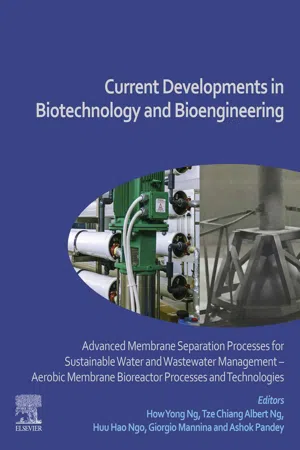
Current Developments in Biotechnology and Bioengineering
Advanced Membrane Separation Processes for Sustainable Water and Wastewater Management – Aerobic Membrane Bioreactor Processes and Technologies
- 320 pages
- English
- ePUB (mobile friendly)
- Available on iOS & Android
eBook - ePub
Current Developments in Biotechnology and Bioengineering
Advanced Membrane Separation Processes for Sustainable Water and Wastewater Management – Aerobic Membrane Bioreactor Processes and Technologies
About this book
Current Developments in Biotechnology and Bioengineering: Advanced Membrane Separation Processes for Sustainable Water and Wastewater Management – Aerobic Membrane Bioreactor Processes and Technologies consolidates up-to-date research developments in AeMBR systems for wastewater treatments in terms of membrane materials and decorations, reactor designs and fouling mechanisms. It includes discussions on developments in AeMBR research on energy efficiency and fouling control strategies, gaps, future research and application perspectives. This book is a potential resource for membrane separation and AeMBR practitioners, engineers, scientists, educators and students, and public to understand the latest developments and future prospects in membrane technology.
- Provides the latest comprehensive review in various important aspects of AeMBR
- Consolidates scattered AeMBR information into a single easily assessible resource
- Provides state-of-the-art technology development of membrane separation, AeMBR reactor designs, membrane development, advantages and challenges in operational implementation and their appropriate control strategies
- Presents a comprehensive review on Quorum Quenching (QQ) fouling control strategy, QQ benefits and drawbacks
- Provides an excellent resource on the latest techniques in characterizing and understanding fouling mechanisms
Information
1
Introduction to aerobic membrane bioreactors: Current status and recent developments
Meijia Zhanga,*; Eunyoung Leeb,*; Enrico Vonghiac; Youngseck Hongc; Baoqiang Liaoa a Department of Chemical Engineering, Lakehead University, Thunder Bay, ON, Canada
b KMEC, Seoul, Korea
c SUEZ Water Technologies & Solutions, Oakville, ON, Canada
* Equal contribution.
b KMEC, Seoul, Korea
c SUEZ Water Technologies & Solutions, Oakville, ON, Canada
* Equal contribution.
Abstract
The aerobic membrane bioreactor (MBR) process is a wastewater treatment technology that combines suspended growth bioreactor with membrane filtration, which is one of the most successful commercial applications of membrane technology. The membrane acts as a barrier, rejecting solid particles while passing permeate through the membrane. The result is a high-quality permeate with very low suspended solids. This book chapter provides a minireview on the current status and recent developments in aerobic MBRs. Aerobic MBR is a mature technology and has been widely used for both municipal and industrial wastewater treatment for very large-scale plants. The major issue of membrane fouling in aerobic MBRs has been well understood, and effective strategies have been developed and implemented for membrane fouling control in full-scale MBR plants. The capital, operating, and energy costs have continuously decreased with the development of new membrane manufacturing technologies, materials, and processes. New applications of aerobic MBRs include removal of emerging pollutants, sludge thickening, dewatering, and reduction. Future development in aerobic MBRs includes the development of new membrane materials, further reduction of energy consumption, and the development of hybrid aerobic MBR processes for high COD/BOD removal and nutrient recovery.
Keywords
Membrane bioreactor; Aerobic treatment; MBR market; MBR development; Membrane fouling; Hybrid MBR; Costs
Abbreviations
AGMBR aerobic granular membrane bioreactor
AnMBR anaerobic membrane bioreactor
AsMBR air sparging membrane bioreactor
BEMR bioelectrochemical membrane bioreactor
BOD biological oxygen demand
BOW Beijing Origin Water
CAGR compound annual growth rate
CAPEX capital expenditures
CAS conventional activated sludge
COD chemical oxygen demand
DECs disrupting compounds
DO dissolved oxygen
ECs emerging contaminants
EMBR electrochemical membrane bioreactor
EPS extracellular polymeric substances
FO forward osmosis
GHG greenhouse gas
GO graphene oxide
GVR Grand View Research
HFMBR hybrid biofilm membrane bioreactor
HRT hydraulic retention time
JLMBR jet loop membrane bioreactor
LCA life cycle assessment
MBR membrane bioreactor
MD membrane distillation
MDMBR membrane distillation bioreactor
MF microfiltration
MFC microbial fuel cells
MLSS mixed liquor suspended solids
NFMBR nanofiltration membrane bioreactor
NF nanofiltration
NPV net present value
OM osmotic membranes
OMBR osmotic membrane bioreactor
OPEX operating expenses
PAN polyacrylonitrile
PES polyethersulfone
PPCPs personal care products
PVDF polyvinylidene fluoride
RO reverse osmosis
SMP soluble microbial products
SRMBR submerged rotating membrane bioreactor
SRT solids retention time
THM trihalomethanes
TMP transmembrane pressure
UF ultrafiltration
VSMBR vertical submerged membrane bioreactor
WWTP wastewater treatment plant
Acknowledgment
The authors thank NSERC (Natural Sciences and Engineering Research Council of Canada) for financial support of this work.
1 Introduction
Global population growth and industrialization has generated a tremendous amount of municipal and industrial wastewater (approximately 450 km3 in 2010) requiring proper treatment and disposal to protect the environment [1]. Every day, over 2 million tons of human waste enter oceans, lakes, and other water bodies without treatment and over 70% of industrial wastewater is untreated in developing counties [2]. This wastewater causes significant health issues, with over 3900 children dying every day of issues related to water quality [2]. Consequently, effective wastewater treatment technologies are extremely important to purify wastewater prior to discharge to the environment [2].
Activated sludge processes have been successfully and widely used for both municipal and industrial wastewater treatment for over a century [3]. The activated sludge process usually consists of a bioreactor for aerobic biodegradation and a secondary clarifier for biomass (sludge) separation from treated effluent. The settled sludge is largely recycled back to the bioreactor to maintain enough biomass for biodegradation, with a small portion of settled sludge wasted. Although activated sludge processes are characterized as being highly efficient for biodegradation, high COD/BOD removal, and relatively low operating and capital costs, one major challenge associated with activated sludge processes is effective biomass flocculation and settling in the secondary clarifier [4]. Sludge bu...
Table of contents
- Cover image
- Title page
- Table of Contents
- Copyright
- Contributors
- Editors Biography
- Preface
- 1: Introduction to aerobic membrane bioreactors: Current status and recent developments
- 2: Fundamentals of aerobic membrane bioreactors
- 3: Roles of soluble microbial products and extracellular polymeric substances in membrane fouling
- 4: Techniques for understanding mechanisms underlying membrane fouling
- 5: Aerobic membrane bioreactors for municipal wastewater treatment
- 6: Aerobic membrane bioreactors for industrial wastewater treatment
- 7: Aerobic membrane bioreactors and micropollutant removal
- 8: Nutrients removal in membrane bioreactors for wastewater treatment
- 9: Osmotic membrane bioreactor technology—Concept, potential and challenges
- 10: Advanced membrane bioreactor fouling control and prevention strategies
- 11: Air sparging for fouling control
- 12: Quorum sensing and quorum quenching in membrane bioreactors
- 13: Advanced membrane bioreactors and hybrid membrane bioreactors configurations
- Index
Trusted by 375,005 students
Access to over 1.5 million titles for a fair monthly price.
Study more efficiently using our study tools.
Frequently asked questions
Yes, you can cancel anytime from the Subscription tab in your account settings on the Perlego website. Your subscription will stay active until the end of your current billing period. Learn how to cancel your subscription
No, books cannot be downloaded as external files, such as PDFs, for use outside of Perlego. However, you can download books within the Perlego app for offline reading on mobile or tablet. Learn how to download books offline
Perlego offers two plans: Essential and Complete
- Essential is ideal for learners and professionals who enjoy exploring a wide range of subjects. Access the Essential Library with 800,000+ trusted titles and best-sellers across business, personal growth, and the humanities. Includes unlimited reading time and Standard Read Aloud voice.
- Complete: Perfect for advanced learners and researchers needing full, unrestricted access. Unlock 1.5M+ books across hundreds of subjects, including academic and specialized titles. The Complete Plan also includes advanced features like Premium Read Aloud and Research Assistant.
We are an online textbook subscription service, where you can get access to an entire online library for less than the price of a single book per month. With over 1.5 million books across 990+ topics, we’ve got you covered! Learn about our mission
Look out for the read-aloud symbol on your next book to see if you can listen to it. The read-aloud tool reads text aloud for you, highlighting the text as it is being read. You can pause it, speed it up and slow it down. Learn more about Read Aloud
Yes! You can use the Perlego app on both iOS and Android devices to read anytime, anywhere — even offline. Perfect for commutes or when you’re on the go.
Please note we cannot support devices running on iOS 13 and Android 7 or earlier. Learn more about using the app
Please note we cannot support devices running on iOS 13 and Android 7 or earlier. Learn more about using the app
Yes, you can access Current Developments in Biotechnology and Bioengineering by How Yong Ng,Tze Chiang Ng,Huu Hao Ngo,Giorgio Mannina,Ashok Pandey in PDF and/or ePUB format, as well as other popular books in Tecnologia e ingegneria & Ingegneria chimica e biochimica. We have over 1.5 million books available in our catalogue for you to explore.