eBook - ePub
Solid Oxide Fuel Cell Lifetime and Reliability
Critical Challenges in Fuel Cells
- 234 pages
- English
- ePUB (mobile friendly)
- Available on iOS & Android
eBook - ePub
About this book
Solid Oxide Fuel Cell Lifetime and Reliability: Critical Challenges in Fuel Cells presents in one volume the most recent research that aims at solving key issues for the deployment of SOFC at a commercial scale and for a wider range of applications. To achieve that, authors from different regions and backgrounds address topics such as electrolytes, contaminants, redox cycling, gas-tight seals, and electrode microstructure. Lifetime issues for particular elements of the fuel cells, like cathodes, interconnects, and fuel processors, are covered as well as new materials. They also examine the balance of SOFC plants, correlations between structure and electrochemical performance, methods for analysis of performance and degradation assessment, and computational and statistical approaches to quantify degradation.
For its holistic approach, this book can be used both as an introduction to these issues and a reference resource for all involved in research and application of solid oxide fuel cells, especially those developing understanding in industrial applications of the lifetime issues. This includes researchers in academia and industrial R&D, graduate students and professionals in energy engineering, electrochemistry, and materials sciences for energy applications. It might also be of particular interest to analysts who are looking into integrating SOFCs into energy systems.
- Brings together in a single volume leading research and expert thinking around the broad topic of SOFC lifetime and durability
- Explores issues that affect solid oxide fuel cells elements, materials, and systems with a holistic approach
- Provides a practical reference for overcoming some of the common failure mechanisms of SOFCs
- Features coverage of integrating SOFCs into energy systems
Information
Subtopic
Gestione ambientaleChapter 1
An Introduction to Solid Oxide Fuel Cell Materials, Technology and Applications
Samuel J. Cooper and Nigel P. Brandon, Imperial College London, London, United Kingdom
Abstract
This chapter begins with a brief history of fuel cell development and introduces solid oxide fuel cells (SOFCs) as high efficiency energy conversion devices. Following this the fundamentals of SOFC performance and cell design are explored, with special focus given to the significance of operating temperature and microstructure. Next the current commercial status of SOFCs is outlined in brief. Finally, SOFC degradation, the major theme of this book, is introduced; the various mechanisms are split into the two broad categories of physical and chemical degradation.
Keywords
Solid oxide fuel cell (SOFC); degradation; introduction; fundamentals; history; commercial; microstructure; operating temperature; design
This chapter aims to give the reader an overview of solid oxide fuel cell (SOFC) technology in terms of both the fundamental theory and real world applications. It concludes with an introduction to the various degradation mechanisms common to many fuel cell systems today, which are discussed in detail in the following chapters of this book.
A Brief History of Solid Oxide Fuel Cells
Fuel cells are a family of electrochemical devices, which generate electricity by promoting a redox reaction across an ionically conductive membrane. Although fuel cells were first reported in 1839 by Sir William Grove, it was not until 1961, when NASA began Project Gemini, that they found their first practical application [1]. Fuel cells are typically named in terms of two key characteristics: the mobile ion and the electrolyte material, with the operating temperature also being used to subclassify in some cases.
SOFCs are named after their ion conducting, ceramic oxide electrolyte and their history is tied to some of the great names in science and engineering. Faraday’s early investigations of conduction in ceramics in the 1830s [2], led him to classify conductors into two categories, although the exact mechanism for these two modes of conduction was unknown. It was not until much later, in the 1890s, when Walther Nernst observed the significantly increased conductivity of mixed oxides over their pure constituents that the first technological implication of ion conduction in solids was conceived. Although ultimately not a commercial success, due in part to its high cost, the “Nernst Glower” was nearly twice as efficient as the carbon filament lamps of the day [3]. The device consisted of a ceramic oxide rod made of yttria-doped zirconia (often referred to as the “Nernst Mass”) which, after preheating to around 1000°C, would begin to conduct under load; this in turn led to the temperature increasing further, causing the rod to glow. The 1930s saw the conceptual development of ion conduction through lattice defects by Schottky [4] and Frenkel [5], which led to the submission of the first SOFC patent through Siemens and Halske [6].
The first cell beginning to resemble a modern configuration was proposed by Baur and Preis [7], who used the “Nernst Mass” for the electrolyte in combination with metal oxide electrodes. Although the system was a failure due to high Ohmic losses, it spurred a new wave of investigation into conducting mixed oxides. Over the following 30 years, Kiukkola and Wagner [8] and many others [9,10] undertook a systematic investigation into ion-conducting electrode materials in order to find structures that had both the mechanical and electrochemical properties required for a durable fuel cell.
By 1970 the adoption of electroceramics for a broad range of other industrially relevant applications, such as sensors (e.g., lambda sensors that are widely used today to measure the air/fuel ratio in engine exhaust gases) and oxygen separation membranes, led to key advances in materials processing and the materials supply chain. Other related advances, for example in the semiconductor industry, resulted in processes emerging such as electrochemical vapor deposition [11]. This allowed for much thinner layers of high-purity material to be deposited, which not only had the potential to reduce Ohmic losses, but also opened the possibility of using materials previously deemed too costly.
Following the first and second oil crises of the 1970s, which cumulatively led to a 10-fold increase in the price of oil [12], governments from fuel importing nations began to invest more heavily in the research and development of alternative energy technologies [13]. Since the early 1990s, a sequence of SOFC companies predominantly from the United States, Western Europe, and Japan have emerged aiming at bringing a range of SOFC configurations to market.
These companies are developing technologies largely focussed on the distributed generation market.
• Residential combined heat and power (c. 1 kWe)
- e.g., Solid Power, Ceres Power
- e.g., Solid Power, Ceres Power
• Commercial grid-independent generators (c. 100 kWe)
- e.g., Bloom Energy
- e.g., Bloom Energy
• Industrial SOFC gas turbine hybrids (c. 1 MWe)
- e.g., LG Fuel Cell Systems
- e.g., LG Fuel Cell Systems
Common to all of these applications is the necessity for the devices to operate for extended periods (5–10 years) without requiring significant maintenance or replacement. It is also critical for the cells, stacks, and systems to be able to withstand the inevitable shut down events, which poses a particular problem for SOFCs due to their high operating temperature and brittle ceramic components.
State of the art SOFC devices can already achieve electrical efficiencies of above 50% and combined heat and power systems exist with total efficiencies in excess of 90%. These two metrics are very impressive on their own, but in combination with the lack of NOx/SOx or particulates in the exhaust stream and the low noise/vibration of these systems, the appeal of SOFC devices is clear. However, SOFCs will not be able to fully deliver on their potential until the degradation issues key to lifetime are resolved, which is the subject of this book.
Solid Oxide Fuel Cell Fundamentals
The Nernst potential, ENernst, of an SOFC is a function only of the physical properties and chemical composition of its two incoming gas streams (fuel and oxidant). It can be determined using the Nernst equation, which is the sum of the standard cell potential E0 and a term that describes the activity at the specific conditions in question,
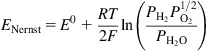
where R is the universal gas constant, T is the temperature, F is the Faraday constant, and Px is the normalized partial pressure of species x. The standard cell potential term, E0, is calculated as the difference between the equilibrium potentials of the two reduction/oxidation (redox) reactions under standard conditions:


For the hydrogen–oxygen redox couple under standard conditions, the cell potential is 1.23 V. As a current is drawn, the system moves away from equilibrium and the potential between the two electrodes decreases. The Nernst potential describes an idealized reaction, which is a useful reference when quantifying the four main categories of losses (overpotentials) in SOFCs: activation losses, Ohmic losses, concentration losses, and crossover losses.
Activation Losses
Activation losses can be considered as ...
Table of contents
- Cover image
- Title page
- Table of Contents
- Copyright
- List of Contributors
- Chapter 1. An Introduction to Solid Oxide Fuel Cell Materials, Technology and Applications
- Chapter 2. Solid Oxide Fuel Cell Electrolytes—Factors Influencing Lifetime
- Chapter 3. The Impact of Fuels on Solid Oxide Fuel Cell Anode Lifetime: The Relationship Between Fuel Composition, Fuel Impurities, and Anode Lifetime and Reliability
- Chapter 4. The Impact of Redox Cycling on Solid Oxide Fuel Cell Lifetime
- Chapter 5. Microstructural Degradation: Mechanisms, Quantification, Modeling and Design Strategies to Enhance the Durability of Solid Oxide Fuel Cell Electrodes
- Chapter 6. Cathode Degradation From Airborne Contaminants in Solid Oxide Fuel Cells: A Review
- Chapter 7. Lifetime Issues for Solid Oxide Fuel Cell Interconnects
- Chapter 8. Fuel Processor Lifetime and Reliability in Solid Oxide Fuel Cells
- Chapter 9. Life and Reliability of Solid Oxide Fuel Cell-Based Products: A Review
- Chapter 10. New Materials for Improved Durability and Robustness in Solid Oxide Fuel Cell
- Index
Trusted by 375,005 students
Access to over 1.5 million titles for a fair monthly price.
Study more efficiently using our study tools.
Frequently asked questions
Yes, you can cancel anytime from the Subscription tab in your account settings on the Perlego website. Your subscription will stay active until the end of your current billing period. Learn how to cancel your subscription
No, books cannot be downloaded as external files, such as PDFs, for use outside of Perlego. However, you can download books within the Perlego app for offline reading on mobile or tablet. Learn how to download books offline
Perlego offers two plans: Essential and Complete
- Essential is ideal for learners and professionals who enjoy exploring a wide range of subjects. Access the Essential Library with 800,000+ trusted titles and best-sellers across business, personal growth, and the humanities. Includes unlimited reading time and Standard Read Aloud voice.
- Complete: Perfect for advanced learners and researchers needing full, unrestricted access. Unlock 1.5M+ books across hundreds of subjects, including academic and specialized titles. The Complete Plan also includes advanced features like Premium Read Aloud and Research Assistant.
We are an online textbook subscription service, where you can get access to an entire online library for less than the price of a single book per month. With over 1.5 million books across 990+ topics, we’ve got you covered! Learn about our mission
Look out for the read-aloud symbol on your next book to see if you can listen to it. The read-aloud tool reads text aloud for you, highlighting the text as it is being read. You can pause it, speed it up and slow it down. Learn more about Read Aloud
Yes! You can use the Perlego app on both iOS and Android devices to read anytime, anywhere — even offline. Perfect for commutes or when you’re on the go.
Please note we cannot support devices running on iOS 13 and Android 7 or earlier. Learn more about using the app
Please note we cannot support devices running on iOS 13 and Android 7 or earlier. Learn more about using the app
Yes, you can access Solid Oxide Fuel Cell Lifetime and Reliability by Nigel Brandon in PDF and/or ePUB format, as well as other popular books in Tecnologia e ingegneria & Gestione ambientale. We have over 1.5 million books available in our catalogue for you to explore.