eBook - ePub
Chain Mobility and Progress in Medicine, Pharmaceuticals, and Polymer Science and Technology
- 242 pages
- English
- ePUB (mobile friendly)
- Available on iOS & Android
eBook - ePub
Chain Mobility and Progress in Medicine, Pharmaceuticals, and Polymer Science and Technology
About this book
Chain Mobility and Progress in Medicine, Pharmaceuticals, and Polymer Science and Technology covers the core fundamentals and applications of chain movement, chain mobility, segmental mobility, segmental dynamics, and chain orientation in polymer science, medicine, pharmaceuticals, and other disciplines. The book starts by defining principal terms, then looks at the work of Pierre-Gilles de Gennes and his 1991 Nobel Prize in Physics for his work on polymer-chain motion. From there the book discusses the different mechanisms of chain motion of macromolecular substances, the conditions under which chains move, and the effects of these movements on properties of materials, such as chain alignment, chain orientation, creation of free volume, dimensional stability, and more. The final chapters provide insight on analytical methods of chain movement, chain movement phenomena in different polymers, and various fields of application. All concepts, findings, and applications are discussed in easy-to-understand language stripped of disciplinary slang, making the book accessible to researchers and practitioners across a variety of scientific fields.
- Discusses various chain motion mechanisms such as bond fluctuation, Brill transition, chain diffusion, and more and how these can be applied in the development of cutting-edge products
- Looks at conditions under which chains move and the effects these movements have on the properties of materials
- Provides examples of research and technological aspects of chain movements as they relate to analytical methods used for studies, different polymers, and various fields of application
Information
1
INTRODUCTION. NOBEL PRIZE JUSTIFICATION FOR PIERRE-GILLES DE GENNES
The Royal Swedish Academy of Sciences awarded the 1991 Nobel Prize in Physics to Professor Pierre-Gilles de Gennes, College de France, Paris, France for discovering that methods developed for studying order phenomena in simple systems can be generalized to more complex forms of matter, in particular to liquid crystals and polymers.1
A bulk of de Gennes work was aimed at the description of how polymer chains and their individual segments can move, known as polymer dynamics.1 Using neutron-scattering techniques, it is possible to distinguish how individual parts of a polymer chain move.1 The results of measurements have helped to confirm de Gennes’ models for polymer chain motion.1 The “reptation” model, which describes the serpentine motion of a polymer chain within a “tangle” of surrounding polymer chains was proposed by de Gennes.1
Prof. de Gennes published 422 papers between 1956 to 1995.2 His work was recognized by numerous organizations including Hollweck Prize from the Joint French-British Physical Society in 1968: Prix Cognac-Jay in 1970; Prix Ampere from the French Academy of Science in 1977; Gold Medal from Centre National de Recherche Scientifique (CNRS), France in 1981; Matteucci Medal from the Italian Science Academy in 1987; Harvey Prize from Technion Israel in 1988; Polymer Award from American Physical Society as well as American Chemical Society in 1988; Wolf Prize for Physics from Israel in 1990; Lorentz Medal from the Dutch Academy of Arts and Sciences in 1991.2 The analysis of his scientific contribution can be found elsewhere.2
The justification of Wolf Prize included the following achievements: “Among his important contributions to many different parts of condensed matter physics, including magnetism, superconductivity and scattering studies, Professor Pierre-Gilles de Gennes has provided fundamental concepts for the development of macromolecular science. These have provided a firm foundation for analyzing complicated but important processes. He analyzed the dynamics of correlated motions of polymers in their complex environment and predicted their critical phenomena by extending the use of path-integral methods, developing applications of scaling ideas and introducing the concept of reptation. This work has stimulated many experiments which have confirmed his concepts and their relevance. It has energized the whole field of the physics of long chained macromolecules, much of the new work being done by former students and young colleagues. These achievements also hold promise for future applications to biological systems.”3
Chain movement affects many physical properties of materials such as orientation, creation of free volume, crystallization, dimensional stability, steric hindrance, ionic transport, reaction to external forces, self-healing, thermal expansion, vibration damping, etc., and factors affecting mechanical performance such as storage modulus, mechanical properties, wear, etc. Prediction and simulation of chain mobility require well designed models and principles.
After receiving the Nobel Prize in 1991, de Gennes gave talks on science, innovation, and common sense, to high school students.1 He visited around 200 high schools during 1992-1994.1 This story is summarized in a book (Les objets fragiles, Plon, Paris 1994, also available in English translation under the title Fragile Objects: Soft Matter, Hard Science, and the Thrill of Discovery).1
This book revisits the theoretical work of Pierre-Gilles de Gennes in the area of chain movement and compares findings with the status of currently applied methods of study.
References
1. Royal Swedish Academy of Science. Press release. 16 October 1991.
2. Kalyane, VL, Sen, BK. Malaysian J. Libr. Inf. Sci.. 1996; 1(2):13–26.
3. Pierre-Gilles de Gennes Winner of Wolf Prize in Physics - 1990. The 1990 Wolf Foundation Prize in Physics.
2
ANALYSIS OF EXISTING PUBLICATIONS
The French word reptation translated to English means the crawling, creep, creeping motion, or the act of crawling. The reptiles (class Reptilia) includes tetrapod animals such as crocodiles, lizards, snakes, etc. It is, therefore, an excellent combination of meaning and profoundly ingrained image of a certain kind of movement commonly recognized. The application of this word in science is not new. In 1939, Griggs used this term to describe movement of rocks, in 1968, Breed applied it in discussion of the movement of microorganism, and finally in 1971, Yelon used the word of reptation in field of interaction of multilayer magnetic fields, as well as, de Gennes adapted reptation to describe movement of polymer chains.1
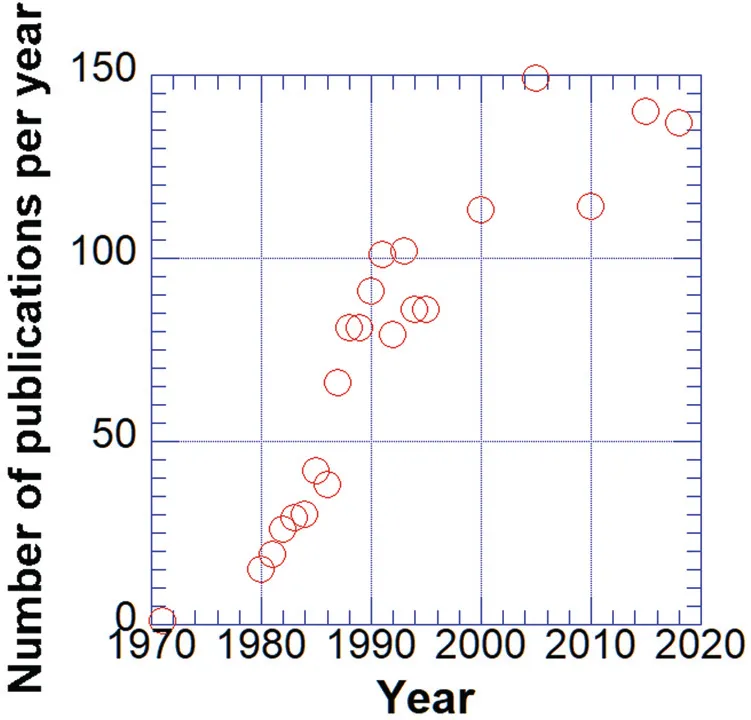
Figure 2.1 shows a yearly number of publications in the area of polymer chemistry which contained the word of reptation. The current number of papers published recently oscillates around 140 which is small when compared with graphene which has also been awarded Nobel Prize (about 5000 publications per year).2 Analyzing Figure 2.1, one may notice that there was no characteristic spike of interest (very prominent in the case of graphene) after Nobel Prize was awarded. Several years later, the present frequency of publication was achieved and stabilized.
There is a small number of patents which have used word of reptation to discuss the process of formation of coatings, compression moldings, composite self-healing systems, solute migration, etc. The total number of such patents up-to-date is less than 200 (compared with several thousand patents obtained for graphene applications per year). This means that reptation has a stronger influence on evaluation and discussion of scientific findings (e.g., random thermal motion, entanglements, friction, maximum relaxation time, etc.) than on the practical, technological developments. The growing interest in the self-healing materials may contribute to the modification of these trends.
The primary goal of this chapter is to establish the effect of the Nobel Prize on the development of knowledge. It can be stated that awarding the Nobel Prize did not accelerate research in the area since a number of publications on the subject did not change significantly after the Nobel Prize was awarded and it still maintains low-frequency today.
References
1. De Gennes, PG. J. Chem. Phys. 1971; 55:572–579.
2. Wypych, G. Graphene - Important Results and Applications. Toronto: ChemTec Publishing; 2019.
3
MECHANISMS OF CHAIN MOTION OF MACROMOLECULAR SUBSTANCES
3.1
BEAD-CHAIN
The bead-chain model was devel...
Table of contents
- Cover image
- Title page
- Table of Contents
- Copyright
- Chapter 1: INTRODUCTION. NOBEL PRIZE JUSTIFICATION FOR PIERRE-GILLES DE GENNES
- Chapter 2: ANALYSIS OF EXISTING PUBLICATIONS
- Chapter 3: MECHANISMS OF CHAIN MOTION OF MACROMOLECULAR SUBSTANCES
- Chapter 4: PARAMETERS (CONDITIONS) OF CHAIN MOVEMENT
- Chapter 5: THE EFFECT OF CHAIN MOVEMENT ON THE PROPERTIES OF MATERIALS
- Chapter 6: SIGNIFICANT ANALYTICAL METHODS OF STUDY
- Chapter 7: CHAIN MOBILITY IN DIFFERENT POLYMERS
- Chapter 8: COMPARISON OF JUSTIFICATION OF NOBEL PRIZE BY THE SELECTION COMMITTEE WITH ACTUAL RESULTS OF RESEARCH REPORTED
- INDEX
Trusted by 375,005 students
Access to over 1.5 million titles for a fair monthly price.
Study more efficiently using our study tools.
Frequently asked questions
Yes, you can cancel anytime from the Subscription tab in your account settings on the Perlego website. Your subscription will stay active until the end of your current billing period. Learn how to cancel your subscription
No, books cannot be downloaded as external files, such as PDFs, for use outside of Perlego. However, you can download books within the Perlego app for offline reading on mobile or tablet. Learn how to download books offline
Perlego offers two plans: Essential and Complete
- Essential is ideal for learners and professionals who enjoy exploring a wide range of subjects. Access the Essential Library with 800,000+ trusted titles and best-sellers across business, personal growth, and the humanities. Includes unlimited reading time and Standard Read Aloud voice.
- Complete: Perfect for advanced learners and researchers needing full, unrestricted access. Unlock 1.5M+ books across hundreds of subjects, including academic and specialized titles. The Complete Plan also includes advanced features like Premium Read Aloud and Research Assistant.
We are an online textbook subscription service, where you can get access to an entire online library for less than the price of a single book per month. With over 1.5 million books across 990+ topics, we’ve got you covered! Learn about our mission
Look out for the read-aloud symbol on your next book to see if you can listen to it. The read-aloud tool reads text aloud for you, highlighting the text as it is being read. You can pause it, speed it up and slow it down. Learn more about Read Aloud
Yes! You can use the Perlego app on both iOS and Android devices to read anytime, anywhere — even offline. Perfect for commutes or when you’re on the go.
Please note we cannot support devices running on iOS 13 and Android 7 or earlier. Learn more about using the app
Please note we cannot support devices running on iOS 13 and Android 7 or earlier. Learn more about using the app
Yes, you can access Chain Mobility and Progress in Medicine, Pharmaceuticals, and Polymer Science and Technology by George Wypych in PDF and/or ePUB format, as well as other popular books in Technology & Engineering & Industrial & Technical Chemistry. We have over 1.5 million books available in our catalogue for you to explore.