- 356 pages
- English
- ePUB (mobile friendly)
- Available on iOS & Android
eBook - ePub
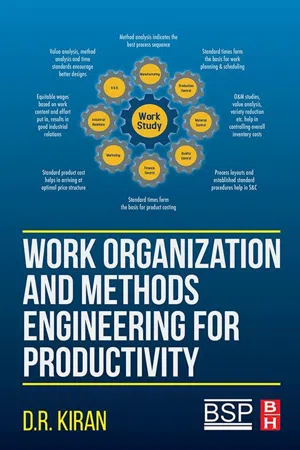
Work Organization and Methods Engineering for Productivity
About this book
Work Organization and Methods Engineering for Productivity provides an introduction to, and practical advice on, assessing methods of working to achieve maximum output and efficiency. The main focus of the book is on the 'work study', which helps to increase the productivity of men, machines and materials. We are currently seeing a lot of disruptive advancement in industrial operations caused by technologies, including artificial intelligence and IoT. Against this technological backdrop, and with ever increasing focus on value, the fundamental understanding of how to analyze and organize the workplace for productivity is more important than ever.
Case studies and illustrations throughout make this book a much have for managers with responsibility for production and planning in industry.
- Helps the reader understand the fundamental factors affecting productivity, along with their relevance to work organization
- Includes valuable industry case studies from sectors including manufacturing, textile production and sea port operations
- Includes several formats and charts that are important in the recording of data for practical work studies
Information
Chapter 1
Introduction
Abstract
Increase in the productivity in all occupations is the topic of the day. This is achieved by Work Study which concentrates on organizing the work performed and developing or engineering the methods of operations. Work Study hence has a direct relationship with productivity and is referred to as the basic tool to increase productivity.
Keywords
Work organization; Methods engineering IS 6363; BS 3138; Method study; Work measurement; Productivity; Production objectives; Work study specialists; Penetrating tool of investigation; International labor organization; Human abilities and psychological aspects
1.1 Work organization and methods engineering
Work Organization and Methods Engineering is a subspecialty of industrial engineering. While Work Organization is concerned with human integration in industrial production processes by skills distribution and coordination of work tasks, Methods Engineering is the analysis and development of the method being employed in performing these tasks to achieve the objective of lowering the production costs and increasing reliability and productivity. Work study is that branch of industrial engineering, that aims at achieving both these objectives. For this reason, we use the term work study in this chapter as well as the other chapters of this book, to represent both Work Organization and Methods Engineering.
1.2 What is work study
Before we attempt to answer this question, let us review some of the explanatory definitions available on work study, which may possibly outline what it incorporates. It basically is a system of assessing methods of working so as to achieve the maximum output and efficiency. Work study helps to increase productivity of men, machines and materials.
IS 6363:1972 (Glossary of terms used in work study) of the Bureau of Indian Standards, defines work study as
Work study is a modern discipline, which analyzes and evaluates all aspects of the work system in order to enhance the effectiveness and functional efficiency.
BS 3138:1979 (Glossary of terms used in work study) of the British Standards Institution gives a more typical and comprehensive definition, which is more an explanatory definition as
Work-study is a generic term for those techniques, particularly of method study and work measurement, which are used in the examination of human effort in all its contexts and which leads systematically to the investigation of all factors that affect the efficiency and economy of the situation being reviewed in order to affect the improvement.
R.H. Hammond in his chapter History and Development of Industrial Engineering in the Production Hand Book edited by Gordon Carson, refers to the Report on the Training for Work Study Practices of the Joint Industrial Training Board, which states as follows
Work study attains its benefits through, firstly by investigation of the current situation, examining especially any apparent weaknesses, for example, the performance of an operating team or a machine group. This diagnosis is followed by the determination and the introduction of appropriate improvements in operating methods. Then investigating and review will cover operating methods, selection and usage of equipment, plant layout supply and usage of materials, availability of ancillary services like material handling, work organization, effectiveness of total operating procedures, progress control and the potential effect of the investigations on overall costs and efficiency.
The Free dictionary defines work study as the analysis of industrial or work procedures to determine the most efficient methods of operation.
We may cite a hoard of such explanatory definitions, which have one thing common with them - no single sentence definition can fairly and adequately explain the subject as much as the above definitions, or rather explanatory definitions do. They reveal how boundless work study can be in the day to day works in all walks of life, whatever it is a manufacturing industry or an automobile workshop, or a chemical industry or even an educational institution.
1.3 Work study is a tool for increasing productivity
From the above definitions, we can see that work study has a direct relationship to productivity and is the most frequently used technique for increasing the amount produced (output) from a given resource (input), with little or no increase in the capital investment. Productivity, of course can be increased in the long run by innovations and development of new processes, modernizing of plant and equipment or by acquisition of advanced technology. But these need heavy capital outlay and cause a drain of our meager foreign exchange and other resources. No one would like to increase the capital outlay just like that. This aspect is discussed more in detail in Chapter 11 on kaizen.
We shall hence look at the productivity problem from a different angle. Let us determine the causes of low productivity by systematic analysis of the existing processes, designs and work methods, thereby devising means and methods to increase output by eliminating or modifying wasteful elements of operations, designs etc., with no or minimal increase in the capital. But after all, history has time and again shown that, what is supposedly impossible in the yesteryears has become a possibility today, whether it is a steam engine or man landing on the moon or the desk-top and lap-top computers, or more so, in smart machines or IoT.
It may be true that some improvements like the discovery of steam power by James Watt had come by pure chance. Nevertheless, many of the successes achieved in the recent past have been results of systematic applications of the work study principles. In these days of scientific and technical advancement, it would indeed be an unforgivable crime to rely on pure chance and here lies the need to have some reliable predetermined knowledge of the implications and consequences of a change.
After all, investigations and improvements of operations or increase in productivity are not new in the history of industrial development. Many geniuses starting from Frederick Taylor have made notable advances towards an increase in productivity. Unfortunately, we are yet to come across a factory that would produce such geniuses in a mass production line to cater for the highly complex industrial situations of today. Thus, it is of prime importance that the process of improvements be made so systematic, foolproof and at the same time, simple that any normal manager, by carrying out this systematic procedure can achieve results as good as, or better than what a less systematic genius was able to achieve in the past.
1.4 Work study is a tool to achieve production objective
The basic objective of production management is to produce the right quantity of goods in right quality at a predetermined time at a predetermined cost. Work study is the tool with which the management strives to achieve this objective by providing standard methods of operation to the manufacturing activities.
The prime value of work-study lies in the fact that if a systematic procedure is applied both in the investigation into the problem and the development of solutions, one is sure that no criteria or limitation or alternative is left unconsidered and can confidently say that he had left no stone unturned. This is a prerequisite for effective results and this aspect undoubtedly distinguishes a systematic application of work study from chance improvements.
1.5 Work study is a penetrating tool of investigation
As we have defined earlier, work study is concerned with the analyzes for the optimization of complex processes, systems or organizations, leading to the elimination of waste of time, money, materials, man-hours, machine time, energy and other resources that do not generate value. This is why it is also referred to as CREW (Cost reduction by elimination of waste). It hence involves investigations by direct observations of all the factors affecting the efficiency of an operation and is bound to show up any shortcomings in all the activities of an organization. A common example is the low productivity due to the forced idleness caused factors, frequent machine breakdown or non-availability of the raw material at the right time in the right place in the right quantities. In ILO’s expression, work study acts like a surgeon’s knife laying bare the activities and functioning of all the different departments of an origination, good or bad, for all those to see. These point inaction by respective officials in activities like maintenance and material control. That means it shows up people, and obviously no one likes to be shown up.
In other words, what we may start as a simple methods improvement may reflect on the effectiveness of one or more senior executives, and may well cause considerable resentment and in some cases, active opposition by the aggrieved, which might boomerang in situations where the work study engineer lacks adequate managerial support. Basically, such an opposition or resistance is caused due to the fact that many executives view such an exposition as an isolated ...
Table of contents
- Cover image
- Title page
- Table of Contents
- Copyright
- About the author
- Preface
- Acknowledgments
- Useful computer software
- Abbreviations
- Chapter 1. Introduction
- Chapter 2. History and development of work study
- Chapter 3. The concepts of productivity
- Chapter 4. Factors affecting productivity
- Chapter 5. System approach to productivity
- Chapter 6. Method study – select
- Chapter 7. Method study – record
- Chapter 8. Examine and develop
- Chapter 9. Method study - define, install and maintain
- Chapter 10. Methods study as a necessary tool for productivity improvement - a case study
- Chapter 11. Kaizen and continuous improvement
- Chapter 12. Terminology used in Japanese management practices
- Chapter 13. Principles of motion economy
- Chapter 14. Work measurement
- Chapter 15. Micro motion study
- Chapter 16. Ergonomics and work study
- Chapter 17. Work sampling
- Chapter 18. Value analysis
- Chapter 19. Material layout planning
- Chapter 20. Work study on clerical operations
- Chapter 21. Resistance to change
- Chapter 22. Industrial engineer’s role as a consultant
- Work study syllabi from the Indian universities and professional bodies
- Summarized syllabi – foreign universities
- Index
Trusted by 375,005 students
Access to over 1.5 million titles for a fair monthly price.
Study more efficiently using our study tools.
Frequently asked questions
Yes, you can cancel anytime from the Subscription tab in your account settings on the Perlego website. Your subscription will stay active until the end of your current billing period. Learn how to cancel your subscription
No, books cannot be downloaded as external files, such as PDFs, for use outside of Perlego. However, you can download books within the Perlego app for offline reading on mobile or tablet. Learn how to download books offline
Perlego offers two plans: Essential and Complete
- Essential is ideal for learners and professionals who enjoy exploring a wide range of subjects. Access the Essential Library with 800,000+ trusted titles and best-sellers across business, personal growth, and the humanities. Includes unlimited reading time and Standard Read Aloud voice.
- Complete: Perfect for advanced learners and researchers needing full, unrestricted access. Unlock 1.5M+ books across hundreds of subjects, including academic and specialized titles. The Complete Plan also includes advanced features like Premium Read Aloud and Research Assistant.
We are an online textbook subscription service, where you can get access to an entire online library for less than the price of a single book per month. With over 1.5 million books across 990+ topics, we’ve got you covered! Learn about our mission
Look out for the read-aloud symbol on your next book to see if you can listen to it. The read-aloud tool reads text aloud for you, highlighting the text as it is being read. You can pause it, speed it up and slow it down. Learn more about Read Aloud
Yes! You can use the Perlego app on both iOS and Android devices to read anytime, anywhere — even offline. Perfect for commutes or when you’re on the go.
Please note we cannot support devices running on iOS 13 and Android 7 or earlier. Learn more about using the app
Please note we cannot support devices running on iOS 13 and Android 7 or earlier. Learn more about using the app
Yes, you can access Work Organization and Methods Engineering for Productivity by D.R. Kiran in PDF and/or ePUB format, as well as other popular books in Business & Operations. We have over 1.5 million books available in our catalogue for you to explore.