eBook - ePub
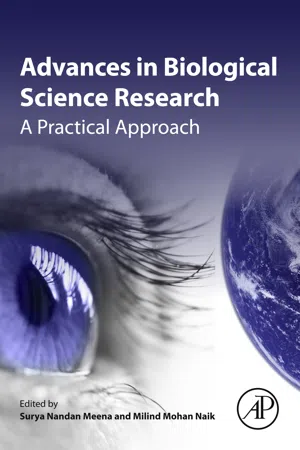
Advances in Biological Science Research
A Practical Approach
- 580 pages
- English
- ePUB (mobile friendly)
- Available on iOS & Android
eBook - ePub
About this book
Advances in Biological Science Research: A Practical Approach provides discussions on diverse research topics and methods in the biological sciences in a single platform. This book provides the latest technologies, advanced methods, and untapped research areas involved in diverse fields of biological science research such as bioinformatics, proteomics, microbiology, medicinal chemistry, and marine science. Each chapter is written by renowned researchers in their respective fields of biosciences and includes future advancements in life science research.
- Discusses various research topics and methods in the biological sciences in a single platform
- Comprises the latest updates in advanced research techniques, protocols, and methods in biological sciences
- Incorporates the fundamentals, advanced instruments, and applications of life science experiments
- Offers troubleshooting for many common problems faced while performing research experiments
Information
Topic
Scienze biologicheSubtopic
MicrobiologiaChapter 1
Bioinformatics methods
Application toward analyses and interpretation of experimental data
Shyamalina Haldar Department of Microbiology, Goa University, Taleigao Plateau, Goa, India
Abstract
The analysis and interpretation of experimental data are the crucial steps in biological research. Multidisciplinary methods through coalition of biological data with statistics are essential for this. Biostatistics and bioinformatics are the platforms that provide support for examination and understanding of the biological information. This chapter focuses on statistical and bioinformatics tools and techniques used to analyze data related to microbial ecology and molecular biology with respect to analysis of nucleotide sequences. Stepwise description of mining, analyses, and interpretation of data is provided in this chapter. This will help to determine the most appropriate method to be applied for a particular analysis to draw the best acceptable inference. In addition, this chapter also enlists the various online available databases and associated tools used to collect and compare biological data and information. Taken altogether, this chapter will enlighten students and researchers with the knowledge on multifarious analytical methods, which will aid better understanding and interpretation of their scientific findings.
Keywords
Analysis; Bioinformatics; Biostatistics; Databases; Ecological; Inference; Information; Interpretation; Mining; Molecular
1.1. Aim of the chapter
This chapter aims to describe the tools and the techniques that are being applied globally for analysis and assessment of biological data. The chapter has been divided into three sections (nucleic acid: 1.2 and 1.3; microbial ecology: 1.4; bio statistics: 1.5).
(1) Section I deals with the bioinformatics methods applied for molecular analyses of nucleic acids. (2) Section II deals with the statistical formulae used to interpret microbial ecological data. (3) Section III describes statistical methods used to compare the biological observations to draw significant conclusions. Care has been taken to present the methods in a stepwise manner with examples for better understanding.
1.2. DNA sequencing
DNA sequencing is the process of determining the order of nucleotides within a DNA molecule. There are two methods of DNA sequencing: Maxam–Gilbert sequencing and Sanger sequencing. The former is a chemical method that chemically modifies the DNA nucleotides and subsequently cleaves the DNA backbone at the sites neighboring to the modified nucleotides [1]. However, due to technical complexity and use of hazardous chemicals, this method is not currently used for standard molecular biology.
Sanger sequencing is the method of DNA sequencing in which dideoxynucleotide phosphates (ddNTPs) are incorporated by DNA polymerase during in vitro DNA replication. Modified ddNTPs terminate DNA strand elongation since they lack a 3′-OH group required for the formation of a phosphodiester bond between two nucleotides, causing DNA polymerase to cease the extension of DNA. Therefore, this is called dye-terminator sequencing. Each of the four ddNTPs (where N = A/T/G/C) is labeled with fluorescent dyes that emit light at different wavelengths and therefore can be captured in the form of colored peaks called a chromatogram.
The nucleotide bases of DNA obtained from a chromatogram are converted to text-based FASTA format using the Applied Biosystems to FASTA converter database (www.dn...
Table of contents
- Cover image
- Title page
- Table of Contents
- Copyright
- Contributors
- Preface
- Acknowledgments
- Chapter 1. Bioinformatics methods: Application toward analyses and interpretation of experimental data
- Chapter 2. Genome sequence analysis for bioprospecting of marine bacterial polysaccharide-degrading enzymes
- Chapter 3. Proteomics analysis of Mycobacterium cells: Challenges and progress
- Chapter 4. Plant proteomics: A guide to improve the proteome coverage
- Chapter 5. Structural analysis of proteins using X-ray diffraction technique
- Chapter 6. Technological advancements in industrial enzyme research
- Chapter 7. Biotechnological implications of hydrolytic enzymes from marine microbes
- Chapter 8. Recent advances in bioanalytical techniques using enzymatic assay
- Chapter 9. Microbial lectins: Roles and applications
- Chapter 10. Biodegradation of seafood waste by seaweed-associated bacteria and application of seafood waste for ethanol production
- Chapter 11. Phosphate solubilization by microorganisms: Overview, mechanisms, applications and advances
- Chapter 12. Metagenomics a modern approach to reveal the secrets of unculturable microbes
- Chapter 13. Halophilic archaea as beacon for exobiology: Recent advances and future challenges
- Chapter 14. Bacterial probiotics over antibiotics: A boon to aquaculture
- Chapter 15. Recent advances in quorum quenching of plant pathogenic bacteria
- Chapter 16. Trends in production and fuel properties of biodiesel from heterotrophic microbes
- Chapter 17. Advances and microbial techniques for phosphorus recovery in sustainable wastewater management
- Chapter 18. Genotoxicity assays: The micronucleus test and the single-cell gel electrophoresis assay
- Chapter 19. Advances in methods and practices of ectomycorrhizal research
- Chapter 20. Photocatalytic and microbial degradation of Amaranth dye
- Chapter 21. Role of nanoparticles in advanced biomedical research
- Chapter 22. Iron-oxygen intermediates and their applications in biomimetic studies
- Chapter 23. Frontiers in developmental neurogenesis
- Chapter 24. Analytical methods for natural products isolation: Principles and applications
- Chapter 25. Advanced bioceramics
- Chapter 26. Production of polyhydroxyalkanoates by extremophilic microorganisms through valorization of waste materials
- Chapter 27. Techniques for the mass production of Arbuscular Mycorrhizal fungal species
- Chapter 28. Metagenomics: A gateway to drug discovery
- Chapter 29. Application of 3D cell culture techniques in cosmeceutical research
- Chapter 30. Advances in isolation and preservation strategies of ecologically important marine protists, the thraustochytrids
- Chapter 31. Advances in sampling strategies and analysis of phytoplankton
- Index
Trusted by 375,005 students
Access to over 1.5 million titles for a fair monthly price.
Study more efficiently using our study tools.
Frequently asked questions
Yes, you can cancel anytime from the Subscription tab in your account settings on the Perlego website. Your subscription will stay active until the end of your current billing period. Learn how to cancel your subscription
No, books cannot be downloaded as external files, such as PDFs, for use outside of Perlego. However, you can download books within the Perlego app for offline reading on mobile or tablet. Learn how to download books offline
Perlego offers two plans: Essential and Complete
- Essential is ideal for learners and professionals who enjoy exploring a wide range of subjects. Access the Essential Library with 800,000+ trusted titles and best-sellers across business, personal growth, and the humanities. Includes unlimited reading time and Standard Read Aloud voice.
- Complete: Perfect for advanced learners and researchers needing full, unrestricted access. Unlock 1.5M+ books across hundreds of subjects, including academic and specialized titles. The Complete Plan also includes advanced features like Premium Read Aloud and Research Assistant.
We are an online textbook subscription service, where you can get access to an entire online library for less than the price of a single book per month. With over 1.5 million books across 990+ topics, we’ve got you covered! Learn about our mission
Look out for the read-aloud symbol on your next book to see if you can listen to it. The read-aloud tool reads text aloud for you, highlighting the text as it is being read. You can pause it, speed it up and slow it down. Learn more about Read Aloud
Yes! You can use the Perlego app on both iOS and Android devices to read anytime, anywhere — even offline. Perfect for commutes or when you’re on the go.
Please note we cannot support devices running on iOS 13 and Android 7 or earlier. Learn more about using the app
Please note we cannot support devices running on iOS 13 and Android 7 or earlier. Learn more about using the app
Yes, you can access Advances in Biological Science Research by Surya Nandan Meena,Milind Naik in PDF and/or ePUB format, as well as other popular books in Scienze biologiche & Microbiologia. We have over 1.5 million books available in our catalogue for you to explore.