eBook - ePub
Magnetism and Spintronics in Carbon and Carbon Nanostructured Materials
- 240 pages
- English
- ePUB (mobile friendly)
- Available on iOS & Android
eBook - ePub
Magnetism and Spintronics in Carbon and Carbon Nanostructured Materials
About this book
Magnetism and Spintronics in Carbon and Carbon Nanostructured Materials offers coverage of electronic structure, magnetic properties and their spin injection, and the transport properties of DLC, graphene, graphene oxide, carbon nanotubes, fullerenes, and their different composite materials. This book is a valuable resource for those doing research or working with carbon and carbon-related nanostructured materials for electronic and magnetic devices.
Carbon-based nanomaterials are promising for spintronic applications because their weak spin-orbit (SO) coupling and hyperfine interaction in carbon atoms entail exceptionally long spin diffusion lengths (~100?m) in carbon nanotubes and graphene. The exceptional electronic and transport features of carbon nanomaterials could be exploited to build multifunctional spintronic devices. However, a large spin diffusion length comes at the price of small SO coupling, which limits the possibility of manipulating electrons via an external applied field.
- Assesses the relative utility of a variety of carbon-based nanomaterials for spintronics applications
- Analyzes the specific properties that make carbon and carbon nanostructured materials optimal for spintronics and magnetic applications
- Discusses the major challenges to using carbon nanostructured materials as magnetic agents on a mass scale
Information
1
The fundamental aspects of spintronics
Abstract
Spintronics, or spin electronics, involve the study of active control and manipulation of spin degrees of freedom in solid-state systems. Electrons have a charge and spin associated with them. While the conventional semiconductor electronics make use of the charge, property of the electron only, the spintronic devices make use of the spin property of an electron. The use of magnetic materials in spintronic devices helps in storing information, to provide nonvolatility and an endurance that is unmatched by other memory technologies such as resistive or phase-change memory. Making use of the spin nature of electrons provides new and effective ways to control the motion of electrons, which helps in writing and reading information. As a result, these memory devices have a huge potential. The aim of this chapter is about the fundamental aspects of the spintronics: spin coherence, spin entanglement, generation of carrier-spin polarization, control spin and charge dynamics, spin injection, spin-polarized transport, etc.
Keywords
Spintronics; spin transport; spin polarization
1.1 Introduction
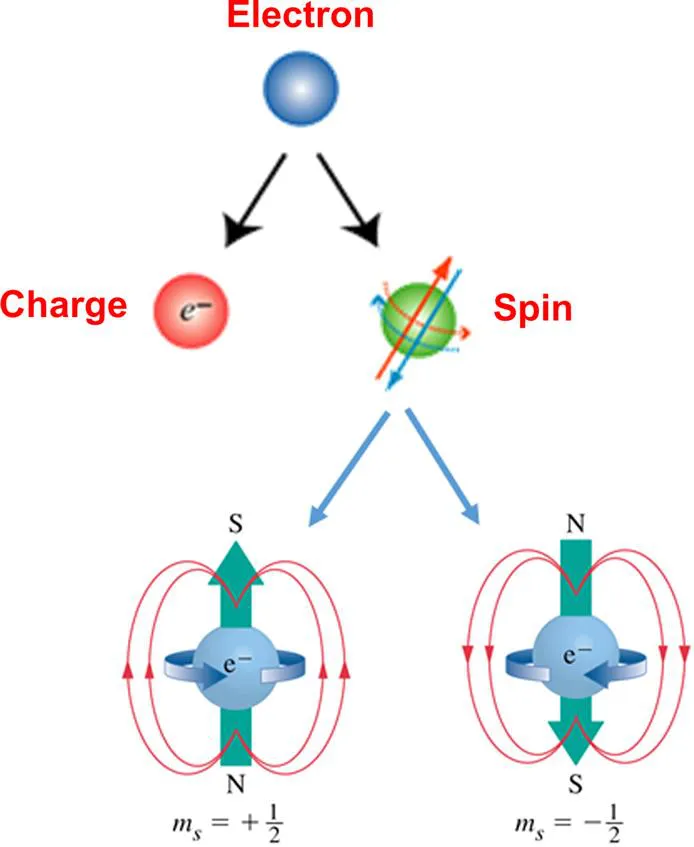
Information technology is one of the important issues in the 21st century. As the Moore law gradually loses its effect, conventional charge-based electronics will come to an end in the near future. Developing alternative high-speed and low-energy-consuming information technology is urgently needed. Many new methodologies have been proposed, such as molecular electronics, nano-electronics, spintronics, and quantum information techniques, among which spintronics is one of the most promising ones. Spintronics is a field of research exploiting the influence of the electron spin on electrical conduction. It is mainly known for the “giant magnetoresistance” (GMR) (Baibich et al., 1998; Binash et al., 1989) and the large increase of the hard disk capacity obtained with the read heads based on GMR. But the research on spintronics has also revealed many other interesting effects and is now developing along promising novel directions. Compared to other methodologies, spintronics is compatible with conventional electronics, thus many techniques used in conventional electronics can be directly extended to spintronics. “Spintronics,” known as spin electronics, involves the study of active control and manipulation of the intrinsic spin of the electrical charge of electron and its associated magnetic moment in solid-state system. The approach in the field of electronics is based on the up- or downspin of the carriers rather than on electrons or holes as in traditional semiconductor electronics. It is different from conventional electronics, which uses the electron’s charge degree of freedom for information processing; spintronics is devoted to incorporating the electron’s spin degree of freedom. In an ideal situation, there will purely be spin current and no charge current in the spintronics circuit, thus no heat will be created and wasted. There has been a great deal of recent interest in the concept of “spintronics” (Prinz, 1995, 1998). Spintronics is a multidisciplinary field whose central theme is the active manipulation of spin degree of freedom in solid-state system. Controlling and probing spin-polarized charge carrier (or manipulation of electron spin) in semiconductors and/or metals via electrical means, an attractive route toward the development of practical semiconductor/metal spintronic devices, which are expected to have a strong impact on future information processing and storage technologies. It is the use of a fundamental property of particles known as spin for information processing. It carries information in both the charge and spin of an electron, potentially offers devices with a great diversity of functionality in solid-state devices and other devices that exploit spin properties. In the case of the electron, the spin can in fact assume only the values +1/2 or −1/2: an eloquent invitation to use it to encode information, in analogy to bits “0” and “1” of the binary code (Fig. 1–1). In ferromagnetic materials, the spin of the electrons can be modified from the outside, applying a magnetic field. When the magnetic field is removed, the new spin values are retained, that is, the encoded information remains firmly stored without need for power and without the risk of demagnetization.
Spin transport and spin relaxation in semiconductors and metals are important solid-state physics issues that are included in the fundamental research along with new technology being implemented in the electronic storage technology. Spintronics helped in creating a prototype device that is used in the industry as a read head, and a memory-storage cell is the giant-magnetoresistive (GMR) sandwich structure, which consists of alternating ferromagnetic and nonmagnetic metal layers. Depending on the relative orientation of the magnetizations in the magnetic layers, the device resistance changes from small (parallel magnetizations) to large (antiparallel magnetizations). This change in resistance (also called magnetoresistance) is used to sense changes in magnetic fields. Electron spin can be identified as a magnetic field having one or two positions, known as “up” and “down”. This gives an extra two binary states to the conventional high and low-logic values, which are represented by simple currents. When the spin state is added to the mix, a bit can have four possible states, which can be called “up-high”, “up-low”, “down-high,” and “down-low.” These four states represent quantum bits or qubits.
Metallic spintronics has already delivered functional devices (GMR read heads in large-capacity hard disk drives), and magnetic random access memory (RAM) (MRAM), of insulator spintronics [magnetic tunnel junctions (MTJs)]. The basic spin valve has evolved to a related thin-layered structure—MTJ—that displays giant tunneling magnetoresistance (TMR), a phenomenon where electrons tunnel through a thin insulator. This means the TMR signal is much larger than that from a GMR spin valve: indeed, it is almost 100 times larger. TMR is also the basis of magnetic RAM (MRAM), a nonvolatile memory that uses magnetic moments to retain data instead of electrical charges.
However, the current basic physics research is mostly focused on semiconductor spintronics. Although creation of inhomogeneous spin distribution does not require energy penalty (in contrast to charge distributions of conventional electronics), spin is not conserved whereas charge is. Thus efforts in semiconductor spintronics research are focused on basic problems, such as coherent manipulation of electron spin at a given location, transporting spins between different locations within conventional semiconductor environment, all-electrical spin control via spin–orbit interactions, diluted magnetic semiconductors, and fixed or mobile spin qubits for quantum computing. Other possible applications of spintronics include high-speed magnetic filters, sensors, quantum transistors, and spin qubits for quantum computers (Steane, 1998; Loss et al., 1998; Burkard et al., 1999). Moreover, these “spintronic” devices might lead to quantum computer and quantum communication based on electronic solid-state devices, thus changing the perspective of information technology in the 21st century. More fundamental research will, however, be needed before a practical spintronic device can be demonstrated, as much remains to be understood about spin coherence, spin entanglement, spin dynamics, spin relaxation, spin transports, etc.—the different fundamental aspects of spintronics.
Spintronics faces a number of challenges, including spin generation and injection, long distance spin transport, and manipulation and detection of spin orientation. In solving these issues, new concepts and spintronics materials were proposed one after another, such as half metals, spin-gapless semiconductors, and bipolar magnetic semiconductors. Topological insulators can also be viewed as a special class of spintronics materials, with their surface states used for pure spin generation and transportation. In designing these spintronics materials, first-principles calculations play a very important role. In this section, we attempt to give a brief discussion on the basic principles and theoretical design of these materials. Meanwhile, we also give some attention to antiferromagnetic (AFM) spintronics, which is mainly based on antiferromagnets and has aroused much interest in recent years.
1.2 Fundamental aspects of spintronics
The fundamental aspects of spintronics are underlying the generation of carrier-spin polarization, spin coherence, spin entanglement, control spin and charge dynamics, spin injection, and spin-polarized transport in semiconducting/metallic electronic materials.
1.2.1 Spin polarization
Spin polarization is the degree to which the spin, that is, the intrinsic angular momentum of elementary particles, is aligned with a given direction. This property may pertain to the spin, hence to the magnetic moment, of conduction electrons in ferromagnetic materials giving rise to spin-polarized currents. Spin polarization, not only of electrons, but also of holes, nuclei, and the excitations, can be defined as PX=XS/...
Table of contents
- Cover image
- Title page
- Table of Contents
- Copyright
- Dedication
- About the author
- Preface
- Acknowledgments
- Introduction
- 1. The fundamental aspects of spintronics
- 2. Introduction: carbon and carbon nanomaterials
- 3. Magnetism and spintronics in amorphous/diamond-like carbon
- 4. Magnetism and spintronics in carbon nanotubes
- 5. Magnetism and spintronics in graphene
- 6. Magnetism and spintronics in graphene oxide
- 7. Magnetism and spintronics in carbon nanoparticle/fullerene
- 8. Magnetism and spintronics in other carbon-based composite materials
- 9. Challenges and emerging direction of carbon nanostructure materials in magnetism and spintronics
- Index
Trusted by 375,005 students
Access to over 1.5 million titles for a fair monthly price.
Study more efficiently using our study tools.
Frequently asked questions
Yes, you can cancel anytime from the Subscription tab in your account settings on the Perlego website. Your subscription will stay active until the end of your current billing period. Learn how to cancel your subscription
No, books cannot be downloaded as external files, such as PDFs, for use outside of Perlego. However, you can download books within the Perlego app for offline reading on mobile or tablet. Learn how to download books offline
Perlego offers two plans: Essential and Complete
- Essential is ideal for learners and professionals who enjoy exploring a wide range of subjects. Access the Essential Library with 800,000+ trusted titles and best-sellers across business, personal growth, and the humanities. Includes unlimited reading time and Standard Read Aloud voice.
- Complete: Perfect for advanced learners and researchers needing full, unrestricted access. Unlock 1.5M+ books across hundreds of subjects, including academic and specialized titles. The Complete Plan also includes advanced features like Premium Read Aloud and Research Assistant.
We are an online textbook subscription service, where you can get access to an entire online library for less than the price of a single book per month. With over 1.5 million books across 990+ topics, we’ve got you covered! Learn about our mission
Look out for the read-aloud symbol on your next book to see if you can listen to it. The read-aloud tool reads text aloud for you, highlighting the text as it is being read. You can pause it, speed it up and slow it down. Learn more about Read Aloud
Yes! You can use the Perlego app on both iOS and Android devices to read anytime, anywhere — even offline. Perfect for commutes or when you’re on the go.
Please note we cannot support devices running on iOS 13 and Android 7 or earlier. Learn more about using the app
Please note we cannot support devices running on iOS 13 and Android 7 or earlier. Learn more about using the app
Yes, you can access Magnetism and Spintronics in Carbon and Carbon Nanostructured Materials by Sekhar Chandra Ray in PDF and/or ePUB format, as well as other popular books in Technology & Engineering & Materials Science. We have over 1.5 million books available in our catalogue for you to explore.