eBook - ePub
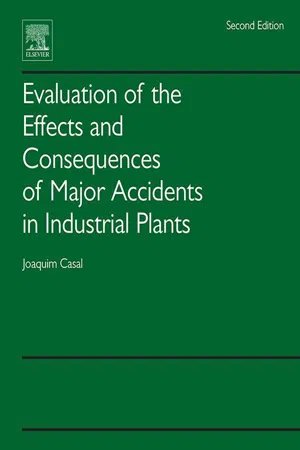
Evaluation of the Effects and Consequences of Major Accidents in Industrial Plants
- 570 pages
- English
- ePUB (mobile friendly)
- Available on iOS & Android
eBook - ePub
Evaluation of the Effects and Consequences of Major Accidents in Industrial Plants
About this book
Evaluation of the Effects and Consequences of Major Accidents in Industrial Plants, Second Edition, covers the essential aspects of a diverse range of major accidents including fires, explosions and toxic clouds, and provides the key models necessary to calculate their effects and consequences with applications to real incidents. New topics in this up-to-date edition include dust explosions, evaluation of frequencies and probabilities, domino effect, transportation of hazardous materials, and analysis of significant accidents.The new edition of Evaluation of the Effects and Consequences of Major Accidents in Industrial Plants is a valuable resource to engineers from the chemical/petrochemical industry and those working with the transportation of hazardous materials (by road, rail, or pipelines), in addition to engineering companies and academics alike.
- Evaluates the expected/probable occurrence frequency of major accidents
- Describes the main features of fires, explosions and toxic releases
- Includes mathematical modeling of major accidents, evaluation of their effects, and consequences on people and equipment
- Explains how to perform a Quantitative Risk Analysis
Information
Chapter 1
Introduction
Abstract
The definition of risk is commented, together with the different categories of risks and the main steps of quantitative risk analysis. The major accidents—fires, explosions, toxic releases—that can occur following a loss of containment of a hazardous material, their effects, and the potential associated damage are presented. Some data on their respective frequencies are given. Finally, after a reference to domino effect and NaTech accidents, the main aspects of mathematical modeling of major accidents are commented.
Keywords
Risk; risk analysis; major accidents; domino effect; NaTech accidents; mathematical modeling
1.1 Risk
Risk is a familiar concept in many fields and activities including economics, business, sport, industry, also in everyday life, but it is not always referred to with exactly the same meaning. A strict definition is required, however, when the term is used in a professional environment. Various definitions have been proposed, for example: “a situation which can lead to an unwanted negative consequence in a given event”; “the probability that a potential hazard occurs”; “the unwanted consequences of a given activity, in relation to their probability of occurrence”; or, more specifically, “a measure of human injury, environmental damage or economic loss in terms of both the incident likelihood and the magnitude of the loss or injury.”
In order to make a thorough risk assessment, it is important to first establish an accurate definition through which the risk can be quantified. In the currently accepted definition, risk is calculated by multiplying the frequency with which an event occurs (or will occur) by the magnitude of its probable consequences:

Therefore if an accident occurs once every 50 years and its consequences are estimated to be 100 fatalities, the risk is two fatalities·year−1. If, with the same frequency, it causes financial losses of 30×106 €, the risk is 6×10⁵ €·year−1.
The concept of risk can be distinguished from hazard (“a chemical or physical condition that has the potential for causing damage to people, property or the environment” [1]) in that it takes into account the frequency of occurrence.
This definition of risk is very convenient, but it also creates several difficulties. The first of these is to establish the units in which risk is measured, since they cannot only be fatalities or money per unit time: the consequences can also be measured in terms of injuries to people or damage to the environment, which are more difficult to assess. It is also difficult to estimate the frequency of occurrence of a given type of accident and the magnitude of its consequences. Fortunately, these difficulties can be overcome by applying appropriate methodologies, which can be used to obtain a final risk estimation.
When analyzing the risk of a given accident, it is likely that exact values will not be known for certain variables, for example, the conditions of the released material (temperature, pressure) and meteorological conditions (wind speed and direction). In addition, it is often difficult to make accurate predictions of some specific circumstances related to the source of the accident; for example, if the accident is caused by the loss of containment of a fluid through a hole in a pipe or tank, where it is only possible to guess the size and location of the hole. As a result, the values obtained are often approximate and we should refer to “estimation” rather than “calculation” (which implies a higher degree of accuracy).
Since there are various types of risk, they can be classified according to different criteria. Generally speaking, risks can be classified into three categories:
• Category A risks: Those that are unavoidable and accepted without any compensation (e.g., the risk of death caused by lightning).
• Category B risks: Those that are, strictly speaking, avoidable but which must be considered unavoidable in everyday life (e.g., the risk of dying in a traffic accident).
• Category C risks: Those that are clearly avoidable but to which people expose themselves because they can be rewarding (e.g., climbing or canoeing).
This classification constitutes a frame of reference that can be used to establish tolerability criteria for certain risks. For example, a widely accepted criterion in several countries sets the tolerability of the risk generated by a given industrial installation at 10−6 fatalities·year−1. This is 10 times the typical Category A risk of death caused by lightning (10−7 year−1) and 10−2 times the risk of death due to any cause for a young person.
Risks are usually classified into three further categories for industrial activities:
• Conventional risks: Those related to activities and equipment typically found in most industries (e.g., electrocution).
• Specific risks: Those associated with handling or using substances that are considered hazardous due to their properties and nature (e.g., toxic or radioactive substances).
• Major risks: Those related to exceptional accidents and situations whose consequences can be especially severe as large amounts of energy or hazardous substances may be released during short periods of time.
Conventional and specific risks usually affect on-site employees. Since these types of risk are not related to exceptional situations, they are relatively easy to predict and can be prevented or mitigated by implementing standard safety measures. However, the effects of major risks can cover much greater distances, which means that they can also affect the external population and are often more difficult to predict and evaluate. As a result, a set of methodologies has been developed to analyze and quantify such risks. These methodologies are referred to collectively as “risk analysis.”
1.2 Risk Analysis
Risk analysis is used to assess the various types of risk associated with a given industrial installation, a particular activity or the transportation of hazardous materials. Risk analysis methodologies can provide reasonably accurate estimates of potential accidents, the frequency of these accidents, and the magnitude of their effects and consequences.
Fig. 1.1 [2] shows a simplified outline of the different steps used to apply risk analysis to a given project, activity, or plant.

The first step is to identify the potential accident types. In this case, it is first necessary to analyze the external events, that is, hazards that are external to the system being studied: these include, for example, the flooding of a nearby river or an explosion in a neighboring process plant. There is no specific methodology for this analysis.
The first step in assessing the hazards associated with the system being analyzed is to apply a historical analysis. Historical analysis consists in studying previous accidents in similar systems to the one under analysis, that is, in a similar plant (e.g., a process plant or a storage area), in the same operation or activity (e.g., loading/unloading tanks), or involving the same material. This is essentially a qualitative approach, although in cases wh...
Table of contents
- Cover image
- Title page
- Table of Contents
- Copyright
- Dedication
- Preface
- Chapter 1. Introduction
- Chapter 2. Source Term
- Chapter 3. Fire Accidents
- Chapter 4. Vapor Cloud Explosions
- Chapter 5. BLEVEs and Vessel Explosions
- Chapter 6. Dust Explosions
- Chapter 7. Atmospheric Dispersion of Toxic or Flammable Clouds
- Chapter 8. Vulnerability
- Chapter 9. Determination of Accident Frequencies
- Chapter 10. Domino Effect
- Chapter 11. Quantitative Risk Analysis
- Chapter 12. Transportation of Hazardous Materials
- Annex 1. Constants in the Antoine Equation
- Annex 2. Flammability Limits, Flash Temperature, and Heat of Combustion (Higher Value) for Different Substances
- Annex 3. Determining the Damage to Humans From Explosions Using Characteristic Curves
- Annex 4. Acute Exposure Guideline Levels (AEGLs)
- Annex 5. Immediately Dangerous to Life and Health (IDLH) Concentrations
- Index
Trusted by 375,005 students
Access to over 1.5 million titles for a fair monthly price.
Study more efficiently using our study tools.
Frequently asked questions
Yes, you can cancel anytime from the Subscription tab in your account settings on the Perlego website. Your subscription will stay active until the end of your current billing period. Learn how to cancel your subscription
No, books cannot be downloaded as external files, such as PDFs, for use outside of Perlego. However, you can download books within the Perlego app for offline reading on mobile or tablet. Learn how to download books offline
Perlego offers two plans: Essential and Complete
- Essential is ideal for learners and professionals who enjoy exploring a wide range of subjects. Access the Essential Library with 800,000+ trusted titles and best-sellers across business, personal growth, and the humanities. Includes unlimited reading time and Standard Read Aloud voice.
- Complete: Perfect for advanced learners and researchers needing full, unrestricted access. Unlock 1.5M+ books across hundreds of subjects, including academic and specialized titles. The Complete Plan also includes advanced features like Premium Read Aloud and Research Assistant.
We are an online textbook subscription service, where you can get access to an entire online library for less than the price of a single book per month. With over 1.5 million books across 990+ topics, we’ve got you covered! Learn about our mission
Look out for the read-aloud symbol on your next book to see if you can listen to it. The read-aloud tool reads text aloud for you, highlighting the text as it is being read. You can pause it, speed it up and slow it down. Learn more about Read Aloud
Yes! You can use the Perlego app on both iOS and Android devices to read anytime, anywhere — even offline. Perfect for commutes or when you’re on the go.
Please note we cannot support devices running on iOS 13 and Android 7 or earlier. Learn more about using the app
Please note we cannot support devices running on iOS 13 and Android 7 or earlier. Learn more about using the app
Yes, you can access Evaluation of the Effects and Consequences of Major Accidents in Industrial Plants by Joaquim Casal in PDF and/or ePUB format, as well as other popular books in Technology & Engineering & Chemical & Biochemical Engineering. We have over 1.5 million books available in our catalogue for you to explore.