eBook - ePub
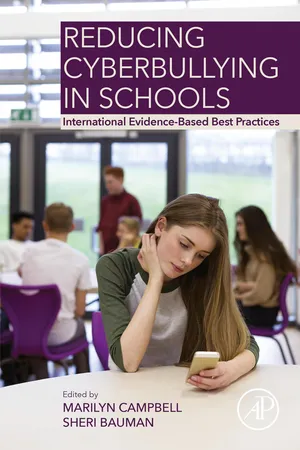
Reducing Cyberbullying in Schools
International Evidence-Based Best Practices
- 314 pages
- English
- ePUB (mobile friendly)
- Available on iOS & Android
eBook - ePub
Reducing Cyberbullying in Schools
International Evidence-Based Best Practices
About this book
Reducing Cyberbullying in Schools: International Evidence-Based Best Practices provides an accessible blend of academic rigor and practical application for mental health professionals, school administrators and educators, giving them a vital tool in stemming the problem of cyberbullying in school settings. It features a variety of international, evidence-based programs that can be practically implemented into any school setting. In addition, the book looks at a broad array of strategies, such as what can be learned from traditional bullying programs, technological solutions, policy and legal solutions, and more.
- Provides overviews of international, evidence-based programs to prevent cyberbullying in schools
- Presents an academically rigorous examination that is also practical and accessible
- Includes technological and legal strategies to stem cyberbullying in schools
- Looks at the prevalence and consequences of cyberbullying
Information
Part One
General Strategies
1
Cyberbullying: Definition, consequences, prevalence
Marilyn Campbell*; Sheri Bauman† * Queensland University of Technology (QUT), Brisbane, QLD, Australia
† University of Arizona, Tucson, AZ, United States
† University of Arizona, Tucson, AZ, United States
Abstract
Although there is now a sizable body of research on many aspects of cyberbullying, what is missing is investigations of promising programs designed to reduce it. This book is an attempt to remedy that deficit and provide readers with information about programs that have at least preliminary evidence of efficacy or effectiveness. While the study of the motivations, mechanisms, and dynamics of cyberbullying is ongoing, we want to bring attention here to successful efforts to do something about the problem. We also want to be sure that adults have accurate information about cyberbullying. Adults often think that there is an epidemic of cyberbullying and believe it is more common than data show it to be. In fact, cyberbullying occurs much less frequently than traditional forms. Furthermore, adults may also mistakenly believe the students are more upset by incidents of cyberbullying than students report being.
Keywords
Cyberbullying; Bullying; Prevalence; Prevention; Consequences of cyberbullying
Introduction
This chapter will set the stage for the remainder of the chapters in the book. Although our focus is on evidence-based solutions to problems associated with cyberbullying, and programs designed to prevent or reduce cyberbullying, we think it is necessary to first provide an overview of what we have learned from cyberbullying research in the last two decades. Although cyberbullying is often described to as a recent phenomenon, a large and growing body of literature has investigated the problem: a Google Scholar search yielded 36,600 hits on the term “cyberbullying” (15,400 having been published since 2013).
Although there is now a sizable body of research on many aspects of cyberbullying, what is missing is investigations of promising programs designed to reduce it. This book is an attempt to remedy that deficit and provide readers with information about programs that have at least preliminary evidence of efficacy or effectiveness. While the study of the motivations, mechanisms, and dynamics of cyberbullying is ongoing, we want to bring attention here to successful efforts to do something about the problem. We also want to be sure that adults have accurate information about cyberbullying. Adults often think that there is an epidemic of cyberbullying and believe it is more common than data show it to be. In fact, cyberbullying occurs much less frequently than traditional forms. Furthermore, adults may also mistakenly believe the students are more upset by incidents of cyberbullying than students report being (Compton, Campbell, & Mergler, 2014).
Cyberbullying definition
Cyberbullying has been defined as intentional harmful behavior carried out by a group or individuals, repeated over time, using modern digital technology to aggress against a victim who is unable to defend him/herself (Juvonen & Gross, 2008; Konig, Gollwitzer, & Steffgen, 2010; Smith et al., 2008). Smith, del Barrio, and Tokunaga (2013) add that the aggressor is more powerful in some way than the target. This definition parallels the definition of traditional bullying, essentially adding “digital technology” as the mechanism by which the harm is inflicted.
In addition to the traditional criteria of intention, repetition, and power imbalance, some researchers have suggested that “anonymity” and “publicity” are additional features that define cyberbullying (Nocentini et al., 2010). For example, Sticca and Perren (2013) found that middle-school children rated public and anonymous cyberbullying as worse than incidents that were private or when the perpetrator was known. While we know these features are important, we disagree with making these qualities defining attributes because anonymity, while definitely easier to accomplish when cyberbullying, is not always the case, and cyberbullies can use private as well as public channels. However, it is important to keep in mind that other unique features of the digital environment may increase risks for cyberbullying. These are: the huge size of the potential audience; the continuous access; the permanence of online content; the ease of copying material and distributing it widely; and the lack of oversight of online behavior. In addition, the inability to view the emotional reactions of the target keeps perpetrators from having empathy for the target. The advent of sexting—sending explicit images or text using digital channels—has created a particularly dangerous opportunity for perpetrators to take images intended for an intimate relationship and broadcast them (without the knowledge or the consent of the target) in order to humiliate the target and damage his/her social relationships.
Historically, cyberbullying was first noticed late last century. Bill Belsey, a Canadian, is widely credited with coining the term cyberbullying on his website, although the earliest use was actually in 1995 in a New York Times article (Bauman, 2011). Although there is still some debate about the definition and whether it is the best term to use to describe the behaviors of interest (cf. Bauman, Underwood, & Card, 2013), the term is so widely accepted in both scholarly and public contexts that we continue to use it here. Since the term is an extension of the term “bullying,” we include a discussion of that definition next.
Bullying definition
Smith and Slonje (2010) define bullying as “an aggressive, intentional act or behaviour that is carried out by a group or an individual repeatedly over time against a victim who cannot easily defend him or herself” (p. 147). This definition is based on Olweus' (1993) original premise that bullying is a subset of aggression with three main characteristics. These are the intention of the perpetrator to hurt, that the behavior is repeated, and the defining characteristic, that there is a power imbalance in the relationship. Three main types of bullying have been identified: physical (hitting, kicking, etc.), verbal (malicious teasing, threatening), and relational (social exclusion, rumor spreading). One of the points of contention is that it is impossible to unambiguously know someone’s intent. In an effort to resolve differences about this, a consensus view has been proposed by Langos (2012), who suggested that bullying should be considered as intentional harm if a “reasonable person” thinks it would be harmful. This is a standard often used in legal cases to determine culpability for an action.
The concept of repetition in defining bullying is probably the most widely debated. Most bullying is low in severity but relentless, meeting that criterion. However, some have argued that one serious incident of aggression may be sufficient to call it bullying (Naylor, Cowie, Cossin, Bettencourt, & Lemme, 2006). Most researchers agree that if the definition says usually repeated that it captures both of these views. Recently, the American organization, the Center for Disease Control (CDC) revised its official definition to say that the action must either be repeated or be “highly likely to be repeated” (Center for Disease Control (CDC), 2016).
The third characteristic—the imbalance of power, the key defining feature, is also the most contentious. The debate about this concept is more divided along European and North American lines. European scholars see the imbalance of power as integral in distinguishing this subset of aggression from fighting and other forms of aggression. Many studies have tried to operationalize the imbalance of power by physical size, psychological strength, or the number of students involved in bullying one person. Researchers in the USA, such as Justin Patchin and Sameer Hinduja (Hinduja & Patchin, 2015, p. 11) do not see the imbalance of power as a key concept in bullying, especially in cyberbullying, mainly because it is difficult to define this concept precisely enough that laws can be clear, i.e., that the legal, school community, and research definitions may vary according to the contexts and requirements. No single definition of bullying is currently able to meet all needs, and it is for this reason that academic, education, and wider community members engaged in these discussions are encouraged to clearly detail the definition they are referring to or drawing from when making comments or claims about these matters (Department of Education & Training, 2015).
However, we believe that using Olweus' (1993) original explanation of the imbalance of power, which is that the student being victimized feels powerless as s/he cannot get the bullying to stop or cannot escape the damage (Menesini, Nocentini, & Camodeca, 2013) is helpful to clarify what is meant by that criterion. Some consensus has now been reached by the United States Center for Disease Control defining bullying as “any unwanted aggressive behaviour(s) by another youth or group of youths who are not siblings or current dating partners that involves an observed or perceived power imbalance and is repeated multiple times or is highly likely to be repeated” (Gladden, Vivolo-Kantor, Hamburger, & Lumpkin, 2014, p. 7). The Australian Research Alliance for Children & Youth (ARACY) also proposed a definition of school-based bullying as “a systematic abuse of power in a relationship formed at school characterized by: (1) Aggressive acts directed (by one or more individuals) towards victims that a reasonable person would avoid; (2) Acts which usually occur repeatedly over a period of time; and (3) Acts in which there is an actual or perceived power imbalance between perpetrators and victims, with victims often being unable to defend themselves effectively from perpetrators” (Hemphill, Heerde, & Gomo, 2014, p. 3). In a study of preservice teachers in the US, Bauman and Del Rio (2006) found that only 6 percent of participants, asked to provide a definition of bullying mentioned repetition, and 28 percent alluded to the imbalance of power.
Is cyberbullying a form of bullying, or something different entirely?
The initial response to the proliferation of cyberbullying from the media and scholars was that this was an entirely new and distinct form of bullying. However, there has been vigorous debate over the last ten years as to whet...
Table of contents
- Cover image
- Title page
- Table of Contents
- Copyright
- Dedication
- About the Editors
- About the Authors
- Part One: General Strategies
- Part Two: Programs
- Part Three: Reflections
- Index
Trusted by 375,005 students
Access to over 1.5 million titles for a fair monthly price.
Study more efficiently using our study tools.
Frequently asked questions
Yes, you can cancel anytime from the Subscription tab in your account settings on the Perlego website. Your subscription will stay active until the end of your current billing period. Learn how to cancel your subscription
No, books cannot be downloaded as external files, such as PDFs, for use outside of Perlego. However, you can download books within the Perlego app for offline reading on mobile or tablet. Learn how to download books offline
Perlego offers two plans: Essential and Complete
- Essential is ideal for learners and professionals who enjoy exploring a wide range of subjects. Access the Essential Library with 800,000+ trusted titles and best-sellers across business, personal growth, and the humanities. Includes unlimited reading time and Standard Read Aloud voice.
- Complete: Perfect for advanced learners and researchers needing full, unrestricted access. Unlock 1.5M+ books across hundreds of subjects, including academic and specialized titles. The Complete Plan also includes advanced features like Premium Read Aloud and Research Assistant.
We are an online textbook subscription service, where you can get access to an entire online library for less than the price of a single book per month. With over 1.5 million books across 990+ topics, we’ve got you covered! Learn about our mission
Look out for the read-aloud symbol on your next book to see if you can listen to it. The read-aloud tool reads text aloud for you, highlighting the text as it is being read. You can pause it, speed it up and slow it down. Learn more about Read Aloud
Yes! You can use the Perlego app on both iOS and Android devices to read anytime, anywhere — even offline. Perfect for commutes or when you’re on the go.
Please note we cannot support devices running on iOS 13 and Android 7 or earlier. Learn more about using the app
Please note we cannot support devices running on iOS 13 and Android 7 or earlier. Learn more about using the app
Yes, you can access Reducing Cyberbullying in Schools by Marilyn Campbell,Sheri Bauman in PDF and/or ePUB format, as well as other popular books in Psychology & Clinical Psychology. We have over 1.5 million books available in our catalogue for you to explore.