eBook - ePub
Alpha-glucosidase Inhibitors
Clinically Promising Candidates for Anti-diabetic Drug Discovery
- 242 pages
- English
- ePUB (mobile friendly)
- Available on iOS & Android
eBook - ePub
Alpha-glucosidase Inhibitors
Clinically Promising Candidates for Anti-diabetic Drug Discovery
About this book
Alpha-glucosidase Inhibitors: Clinically Promising Candidates for Anti-diabetic Drug Discovery presents information that researchers can use to address a whole host of promising leads for the development of novel, oral, anti-diabetic drugs with improved efficacy and fewer side effects. Beginning with a discussion of the huge potential of ? -glucosidase inhibitor leads and adaptations, and highlighting their importance within the field of anti-diabetic drug discovery, the book provides chemical structures, detailed background information and in vivo and in vitro biological activity data, and more economical adaptations of these structures.
Drawing on the author's expert research in the field, this book highlights promising leads for development and helps researchers select the most appropriate inhibitors for their own work. It is a useful tool not only for anti-diabetic drug development researchers, but also for those whose research may be enhanced by an understanding of ? -glucosidase inhibitor chemistry and activity.
- Identifies and presents promising ?-glucosidase inhibitors of natural and synthetic origin that belong to a variety of chemical classes
- Compiles chemical structures and detailed in vivo and in vitro biological activity data that will help researchers select inhibitors for further work
- Discusses promising avenues and potential challenges in the development of new ?-glucosidase inhibitors based on their activity data
Information
Topic
Physical SciencesSubtopic
Organic ChemistryChapter one
Introduction, rationale and the current clinical status of oral α-glucosidase inhibitors
Abstract
The drug discovery community has always been allured by screening the rich and unexplored molecular diversity of chemical entities with potential for becoming therapeutic candidates. Unfortunately, these valuable efforts have been identifying hundreds of compounds reported in research publications without further development. Although the area of drug design and discovery inherently encompass a range of challenges, progress in the field is not only marred by these challenges but also significantly augmented by the fact that majority of the lead compounds identified in the screening process do not go through the optimization cycle that is part of the rational approach to drug discovery. Progress in the drug development area of oral α-glucosidase inhibitors as antidiabetic drugs is essentially at halt since the launch of acarbose, miglitol, and voglibose a few decades ago. There is no shortage of new, promising α-glucosidase inhibitors that, if re-explored, may become antidiabetic drug candidates. This work rakes through that ever-growing haystack of α-glucosidase inhibitors identified to date, selects promising leads and urges the drug discovery scientists to look back, reconsider, and take the challenge of transforming them into potential antidiabetic drugs since diabetes mellitus is still a growing global problem, both clinically and economically
Keywords
α-Glucosidase inhibitor; drug discovery; drug development; diabetes mellitus; antidiabetic; acarbose; voglibose; miglitol; re-exploring
1.1 Introduction
Reducing mortality and improving quality of life is one of the crucial aims of therapeutic agents. Continuing research in the field of drug discovery has been attracting the attention of researchers focusing on development of drugs with safer and better efficacy profiles since these two targets are compulsively explored as part of the drug optimization process. However, need for drugs with safer treatment options and better efficacy has always been challenging to the drug discovery community, which is generally addressed by alluring temptation of screening the rich and still unexplored molecular diversity of candidate compounds of natural and synthetic origins. Despite all these valuable efforts, there exists a downturn in the drug screening process. These efforts have been generating no more than a plethora of active compounds piled up and forgotten in the ether without being given ample consideration for further development into therapeutic candidacy. This perspective is especially important for diseases or clinical conditions including AIDS, cancer, and hepatitis that have been facing a dilemma of limited and inefficacious treatment choices. Even the treatment of a range of diseases with relatively broader spectra of therapeutic options is currently threatened with efficacy problems and unwanted side effects.
It is unfortunate to mention that majority of the lead compounds identified against a number of clinically important targets do not get beyond the bounds of mass production of publications and reports, thus creating a haystack destined to be forgotten in the scientific literature. For one reason, it appears that the bridge connecting the field of drug screening to further development is somewhere broken. Traditionally, research involving drug candidate design and screening against a clinical target follows a rational approach to identifying promising leads, which undergoes kinetic, structure–activity analyses, toxicity, pharmacokinetic, and optimization studies aided by X-ray crystallography or computational and combinatorial chemistry followed by preclinical or clinical trials (Fig. 1.1). The rational approach is designed to rule out unpromising leads with low activity or potency or high toxicity. However, majority of identified promising leads are not subjected to the optimization cycle that involves structure–activity refinement and other studies before being eligible for preclinical or clinical trials. Therefore in the rational approach to discovery and modification of leads, the optimization cycle is missing out in most of the drug screening attempts.
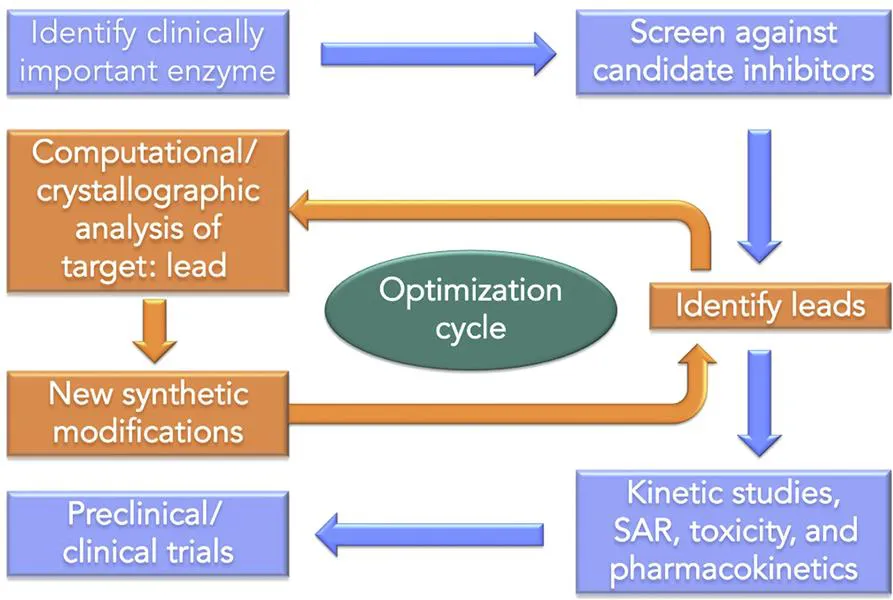
Another approach to drug discovery is to use traditional medicine as a beacon for identification of active compounds against a disease, combined with optimization. The molecular mechanism of action of majority of plant extracts or their active compounds used in traditional medicine is still unknown despite the fact that they possess safe and proven therapeutic effects which people have been witnessing for centuries in different cultures of the world. As mentioned earlier, the most common drug development strategy is to identify targets and leads followed by optimization. However, this approach often results in major obstacles that make the optimization process more challenging chiefly in the areas of synthesis, pharmacokinetics, and toxicity. In order to curb such challenges, it is important to first explore the mechanism of action of plant extracts and the compounds therein because their therapeutic effects in the treatment of diseases have already been proven for centuries, followed by focused optimization cycle involving synthetic chemistry, pharmacokinetics, toxicity, and structural and computational biology.
There exists a spectrum of conceivable reasons to address the challenges in further development of promising leads including, but not limited to, obstacles in the university–industry relationships, conflicts in the practice of intellectual property ethics, limited in-house drug development programs at university level, limited funding for specialized research, and, last but not least, the budget cutdowns. One of the convincing facts that can also aggravate severity of the challenge is that in the perspective of moving forward in the field of drug discovery, the scientific community is somewhat reluctant to look backward to find “needles” in that ever-growing haystack of active compounds. There may be tens or hundreds of compounds that could become promising candidates for drug development if re-explored. Re-exploring is indeed a challenging work, nevertheless, it can be equally rewarding, especially in the perspective of diseases or clinical conditions awaiting promising drugs for their treatment for decades.
One such target that this book intends to highlight to the scientific community is urge for re-exploring α-glucosidase inhibitors for potential development into oral antidiabetic drugs, because this area has been witnessing no significant progress for years. Development of antidiabetic drugs is yet to see launching of new oral α-glucosidase inhibitors since no new drug has been developed in the last two decades.
Therefore, this work intends to create a groundwork for identifying promising α-glucosidase inhibitors of natural and synthetic origins by gauging their potential for becoming suitable candidates for optimization and, if applicable, for preclinical or clinical trials based on available in vitro and in vivo data. Moreover, it will also draw the attention of the scientific community, especially the drug development scientists, to look back, reconsider, and take the challenge of transforming promising lead α-glucosidase inhibitors into potential antidiabetic drugs.
1.2 Diabetes mellitus and the antidiabetic drugs
Diabetes mellitus is one of the most prevalent metabolic diseases in the world. Type 1 diabetes is due to insulin deficiency affecting around 5%–10% of the diabetic population, whereas type 2 is most common and mainly due to insulin resistance [1]. Diabetes is one of the leading causes of morbidity and mortality characterized by hyperglycemia that is associated with a number of complications including neuropathy, nephropathy, heart disease, stroke, and vascular diseases [2]. The worldwide prevalence of diabetes in all age groups has been rising and it is estimated that it might increase from 2.8% (171 million) in the year 2000 to 4.4% (366 million) in the year 2030. According to the World Health Organization projection, there will be a 42% increase in diabetes cases (from 51 to 72 million) in the developed countries, while 170% increase (from 84 to 228 million) in the developing countries. The occurrence of diabetic complications in the developing world is more common and is partly due to socioeconomic reasons [3].
Alarmingly, the Middle East and North Africa have the highest comparative prevalence of diabetes worldwide (11%). In Saudi Arabia alone, approximately 25% of the adult population is suffering from the disease making it seventh highest in the world [3,4]. The trend has been rising, and the country has witnessed a ten-fold increase in the disease over the last three decades. It is estimated that by the year 2030, there will be about 5.5 million cases of diabetes in the country [5–10]. Furthermore, diabetes has been a continuous cause of rising health-care costs globally. According to the American Diabetes Association, in United States alone, the total costs of diagnosed cases of diabetes were estimated to be $245 billion in 2012 compared to $174 billion in 2007 [11].
Current therapeutic approaches to treat type 2 diabetes include oral antidiabetic drugs such as sulfonylureas, thiazolidinediones, metformin, α-glucosidase inhibitors, and glycosurics. New therapies include peptides such as glucagon-like peptide-1 agonists (exenatide and liraglutide), and dipeptidyl peptidase-IV inhibitors (sitagliptin and vildagliptin), whereas emerging t...
Table of contents
- Cover image
- Title page
- Table of Contents
- Copyright
- Quote from the Quran
- Dedication
- About the author
- Preface
- Acknowledgments
- Chapter one. Introduction, rationale and the current clinical status of oral α-glucosidase inhibitors
- Chapter two. Natural and synthetic sugar mimics
- Chapter three. Polyphenols
- Chapter four. Terpenoids and steroids
- Chapter five. Azoles and related derivatives
- Chapter six. Cyclitols and miscellaneous inhibitors
- Chapter seven. Computational and structural biology of α-glucosidase-inhibitor complexes: clues to drug optimization and development
- Appendix. A comprehensive list of promising α-glucosidase inhibitors with the activity data discussed in the book
- Index
Trusted by 375,005 students
Access to over 1.5 million titles for a fair monthly price.
Study more efficiently using our study tools.
Frequently asked questions
Yes, you can cancel anytime from the Subscription tab in your account settings on the Perlego website. Your subscription will stay active until the end of your current billing period. Learn how to cancel your subscription
No, books cannot be downloaded as external files, such as PDFs, for use outside of Perlego. However, you can download books within the Perlego app for offline reading on mobile or tablet. Learn how to download books offline
Perlego offers two plans: Essential and Complete
- Essential is ideal for learners and professionals who enjoy exploring a wide range of subjects. Access the Essential Library with 800,000+ trusted titles and best-sellers across business, personal growth, and the humanities. Includes unlimited reading time and Standard Read Aloud voice.
- Complete: Perfect for advanced learners and researchers needing full, unrestricted access. Unlock 1.5M+ books across hundreds of subjects, including academic and specialized titles. The Complete Plan also includes advanced features like Premium Read Aloud and Research Assistant.
We are an online textbook subscription service, where you can get access to an entire online library for less than the price of a single book per month. With over 1.5 million books across 990+ topics, we’ve got you covered! Learn about our mission
Look out for the read-aloud symbol on your next book to see if you can listen to it. The read-aloud tool reads text aloud for you, highlighting the text as it is being read. You can pause it, speed it up and slow it down. Learn more about Read Aloud
Yes! You can use the Perlego app on both iOS and Android devices to read anytime, anywhere — even offline. Perfect for commutes or when you’re on the go.
Please note we cannot support devices running on iOS 13 and Android 7 or earlier. Learn more about using the app
Please note we cannot support devices running on iOS 13 and Android 7 or earlier. Learn more about using the app
Yes, you can access Alpha-glucosidase Inhibitors by Usman Ghani in PDF and/or ePUB format, as well as other popular books in Physical Sciences & Organic Chemistry. We have over 1.5 million books available in our catalogue for you to explore.