eBook - ePub
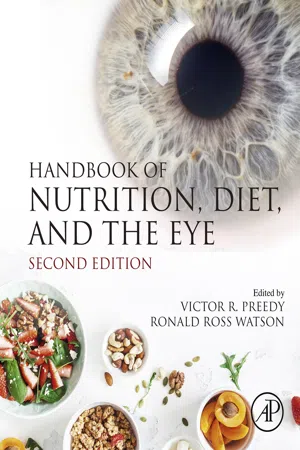
Handbook of Nutrition, Diet, and the Eye
- 668 pages
- English
- ePUB (mobile friendly)
- Available on iOS & Android
eBook - ePub
Handbook of Nutrition, Diet, and the Eye
About this book
Handbook of Nutrition, Diet, and the Eye, Second Edition, thoroughly addresses common features and etiological factors on how dietary and nutritional factors affect the eye. The ocular system is perhaps one of the least studied organs in diet and nutrition, yet the consequences of vision loss are devastating. There are a range of ocular defects that have either their origin in nutritional deficiencies/excess or have been shown to respond favorably to nutritional components. Featuring a new section on animal model studies where both the ocular problem and dietary remedies can be varied, there are also new chapters on dietary supplements.
- Serves as a foundational collection for neuroscience, neurology and nutrition researchers, illustrating the importance of nutrition and diet in eye health and function
- Provides a common language for readers to discuss how nutritional factors and related diseases and syndromes affect the eye
- Features new chapters on infectious diseases of the eye where nutrition is a factor
- Discusses animal model studies, dietary supplements, natural dietary extracts from around the world, and age-related changes in ocular health
Information
Section B
Macular Degeneration
2
Overview of Risk Factors for Age-Related Macular Degeneration
R.A. Armstrong⁎; R.P. Cubbidge† ⁎ Optometry School, Aston University, Birmingham, United Kingdom
† Vision Sciences, Aston University, Birmingham, United Kingdom
† Vision Sciences, Aston University, Birmingham, United Kingdom
Abstract
Age-related macular degeneration (AMD) is a multifactorial disorder and identification of risk factors enables individuals to make lifestyle choices that may reduce disease risk. Genetics plays a significant role in AMD especially in younger patients, with complement system genes and the age-related maculopathy susceptibility protein 2 (ARMS2) gene accounting for a significant proportion of cases. Smoking is the modifiable risk factor most consistently associated with AMD with current smokers having a two to three times higher risk than nonsmokers. There is increasing evidence that dietary factors may influence the risk of AMD, but whether the risk is increased by exposure to sunlight or associated with alcohol is controversial. Synergistic effects occur among the risk factors and therefore, cessation of smoking, dietary changes, and the regular use of dietary supplements should be considered to reduce the lifetime risk of AMD especially in those individuals carrying “at risk” genetic alleles.
Keywords
Age-related macular degeneration (AMD); Risk factors; Genes; Smoking; Sunlight; Diet; Alcohol
List of Abbreviations
aAMD advanced AMD
ABCR ATP-binding cassette rim protein
ACE angiotensin-converting enzyme
AMD age-related macular degeneration
APOE apolipoprotein E
ARDES age-related eye disease study
ARM age-related maculopathy
ARMS2 age-related maculopathy susceptibility protein 2
BDES Beaver Dam Eye Study
BES Beijing Eye Study
BMES Blue Mountain Eye Study
BMI body mass index
C3 factor 3
CACNG3 voltage-dependent calcium channel 3
CBWS Chesapeake Bay Waterman Study
CC case-control study
CFB complement factor B
CFH complement factor H
CI 95% confidence interval
dGI dietary glycemic index
DHA docosahexanoic acid
EDCCSG Eye Disease Case-Control Study Group
ERCC6 DNA excision repair protein
FGF2 fibroblast growth factor 2
HDL high-density lipoprotein
HR hazard ratio
HTRA1 HTRA serum peptidase 1
LOX1 lysyl oxidase-like 1
MPCC matched pairs case-control study
OR odds ratio
PHS Physician’s Health Study
POLA Pathologies Oculaires Liées à l’Age study
PS prospective study
RR relative risk
SA survival analysis
SELP selectin-P
SERPING1 serpin peptidase inhibitor
SiMES Singapore Malay Eye Study
Introduction
Age-related macular degeneration (AMD) is the most important cause of blindness in industrialized countries in individuals over 65 years of age. In the United Kingdom, for example, overall prevalence of late stage AMD is 2.4% of the population and approximately 10% of patients 66–74 years of age exhibit some evidence of macular degeneration, prevalence increasing to 30% in patients 75–85 years of age.1 According to the most recent estimates, there are 513,000 individuals currently in the United Kingdom with the visual impairment characteristic of AMD suitable for registration as seriously visually impaired. This figure is predicted to rise to 679,000 by 2020 as the proportion of older individuals in the population continues to increase, a phenomenon likely to be repeated in many countries.
There are two forms of AMD, viz. the “atrophic” or “dry” form and the “exudative” or “wet” form. The dry form is characterized by degeneration of the macular pigment epithelium, choriocapillaris, and photoreceptor cells. Larger areas of degeneration result from the merging of small areas of atrophy and this state is often referred to as “geographic atrophy.” By contrast, in the wet form, new choroidal vessels are formed (neovascularization) and ultimately retinal detachment, edema, and hemorrhage may occur followed by macular degeneration. Age-related maculopathy (ARM) is a further term often used to describe the early stages of AMD and is characterized by the presence of discrete drusen and increased deposition of retinal pigment in individuals over 50 years of age.
Multiple risk factors are likely to be involved in AMD including genetics, diet, cardiovascular disease, sunlight, smoking, and alcohol.2–4 There are also likely to be synergistic effects among these risk factors, which will ultimately determine the overall risk of disease for an individual. The objective of this chapter is to review the major risk factors associated with AMD and their interactions and to assess their relative contribution to AMD risk.
Genetic Risk Factors
Genetic factors play a highly significant role in AMD, 52 individual gene associations having been detected, including common and rare variants, across 34 gene loci.5 The most important genes linked to AMD are involved in immune modulation and in the complement system such as complement factor H (CFH),6–8 complement factor B (CFB),9 factor 3 (C3),10 and serpin peptidase inhibitor (SERPING1)11 strongly suggesting that inflammatory processes are important. Hence, CFH, C3, and SERPING1 together with HTRA serum peptidase 1(HTRA1), which may regulate the availability of insulin-like growth factor, could account for 45% of the total AMD risk.11 Genes associated with membrane transport such as ATP-binding cassette rim protein (ABCR),12 and voltage-dependent calcium channel 3(CACNG3),12 the vascular system, for example, fibroblast growth factor 2 (FGF2),13 Lysyl oxidase-like 1 (LOX1),14 and selectin-P (SELP),7 and with lipid metabolism, for example, apolipoprotein E (APOE),15 and LOX116 may also be involved. Genes associated with the vascular system are of particular intere...
Table of contents
- Cover image
- Title page
- Table of Contents
- Copyright
- Contributors
- Section A: Introductions and Overviews
- Section B: Macular Degeneration
- Section C: Glaucomas and Cataracts
- Section D: Other Eye Conditions
- Section E: Obesity and Macronutrients
- Section F: Micronutrients
- Section G: Nutraceuticals
- Index
Trusted by 375,005 students
Access to over 1.5 million titles for a fair monthly price.
Study more efficiently using our study tools.
Frequently asked questions
Yes, you can cancel anytime from the Subscription tab in your account settings on the Perlego website. Your subscription will stay active until the end of your current billing period. Learn how to cancel your subscription
No, books cannot be downloaded as external files, such as PDFs, for use outside of Perlego. However, you can download books within the Perlego app for offline reading on mobile or tablet. Learn how to download books offline
Perlego offers two plans: Essential and Complete
- Essential is ideal for learners and professionals who enjoy exploring a wide range of subjects. Access the Essential Library with 800,000+ trusted titles and best-sellers across business, personal growth, and the humanities. Includes unlimited reading time and Standard Read Aloud voice.
- Complete: Perfect for advanced learners and researchers needing full, unrestricted access. Unlock 1.5M+ books across hundreds of subjects, including academic and specialized titles. The Complete Plan also includes advanced features like Premium Read Aloud and Research Assistant.
We are an online textbook subscription service, where you can get access to an entire online library for less than the price of a single book per month. With over 1.5 million books across 990+ topics, we’ve got you covered! Learn about our mission
Look out for the read-aloud symbol on your next book to see if you can listen to it. The read-aloud tool reads text aloud for you, highlighting the text as it is being read. You can pause it, speed it up and slow it down. Learn more about Read Aloud
Yes! You can use the Perlego app on both iOS and Android devices to read anytime, anywhere — even offline. Perfect for commutes or when you’re on the go.
Please note we cannot support devices running on iOS 13 and Android 7 or earlier. Learn more about using the app
Please note we cannot support devices running on iOS 13 and Android 7 or earlier. Learn more about using the app
Yes, you can access Handbook of Nutrition, Diet, and the Eye by Victor R Preedy,Ronald Ross Watson,Victor R. Preedy in PDF and/or ePUB format, as well as other popular books in Biological Sciences & Physiology. We have over 1.5 million books available in our catalogue for you to explore.