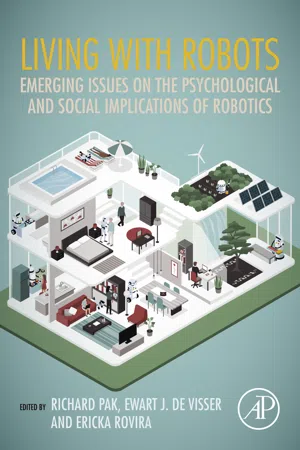
eBook - ePub
Living with Robots
Emerging Issues on the Psychological and Social Implications of Robotics
- 218 pages
- English
- ePUB (mobile friendly)
- Available on iOS & Android
eBook - ePub
Living with Robots
Emerging Issues on the Psychological and Social Implications of Robotics
About this book
Living with Robots: Emerging Issues on the Psychological and Social Implications of Robotics focuses on the issues that come to bear when humans interact and collaborate with robots. The book dives deeply into critical factors that impact how individuals interact with robots at home, work and play. It includes topics ranging from robot anthropomorphic design, degree of autonomy, trust, individual differences and machine learning. While other books focus on engineering capabilities or the highly conceptual, philosophical issues of human-robot interaction, this resource tackles the human elements at play in these interactions, which are essential if humans and robots are to coexist and collaborate effectively.
Authored by key psychology robotics researchers, the book limits its focus to specifically those robots who are intended to interact with people, including technology such as drones, self-driving cars, and humanoid robots. Forward-looking, the book examines robots not as the novelty they used to be, but rather the practical idea of robots participating in our everyday lives.
- Explores how individual differences in cognitive abilities and personality influence human-robot interaction
- Examines the human response to robot autonomy
- Includes tools and methods for the measurement of social emotion with robots
- Delves into a broad range of domains - military, caregiving, toys, surgery, and more
- Anticipates the issues we will encountering with robots in the next ten years
- Foreword by Maggie Jackson, author of Distracted
Information
Topic
PsicologiaSubtopic
Psicologia applicataChapter 1
Transparent interaction and human–robot collaboration for military operations
Shan G. Lakhmani 1 , Julia L. Wright 1 , and Jessie Y.C. Chen 2 1 U.S. Army Research Laboratory, Human Research and Engineering Directorate, Orlando, FL, United States 2 U.S. Army Research Laboratory, Human Research and Engineering Directorate, Aberdeen Proving Ground, MD, United States
Abstract
The future of robotics, envisioned by the US military, is made up of humans teamed with autonomous, intelligent robots. A shift in human–robot interaction (HRI), from the teleoperation of robotic systems to a more teamwork-oriented interaction, concurrently changes the informational requirements of the actors in the interaction. Consequently, military research into robotics is exploring what information fulfills those changed informational requirements, how robots can convey that information to human teammates, and what information do robots need to acquire from those human teammates. In this chapter, we discuss how the conception of a military robot is anticipated to change, how that change influences the interaction between humans and robots, and some of the different lines of research being done to support future HRI.
Keywords
Communication; Human–agent teaming; Human–robot interaction; Military; Transparency
Introduction
The military's idea of what a robot is will change over the next decade. We are in a point of transition, where the future of military robotics lies in pursuit of autonomous teammates, rather than teleoperated tools. This shift in vision, however, changes the way soldiers and robots will interact. Rather than a human soldier having to complete many tasks—some in person, some via robot—to attain a goal, instead, the soldier and robot can share the taskload and fulfill the goal together. This more collaborationist approach, however, introduces the robot as an independent entity, which can act autonomously. Autonomy introduces a level of uncertainty that would not occur with a teleoperated robot. So, as we transition from teleoperated robots to autonomous, intelligent robots, we have to figure out the informational needs that must be established for this future human–robot relationship.
The relationship between humans and robots is relatively unique, given that robots can be independent actors, but only in the ways they have been designed to act independently. While robots are not exactly human, human teamwork is an appropriate metaphor for human–robot interaction (HRI) (Morrow & Fiore, 2012). To accomplish a goal, members of a human team engage in two tracks of behavior. The first track is taskwork, which is the specific, work-related activities needed to accomplish the team's goals (Salas, Shuffler, Thayer, Bedwell, & Lazzara, 2015). The second track is teamwork, which includes coordination, sharing knowledge, and all the other actions needed for interdependent operation (Burke, Salas, Wilson-Donnelly, & Priest, 2004). Robots are already being designed to do taskwork. However, with the expected trend toward greater autonomous capabilities, robots must provide an analog to the teamwork behaviors that human team members perform. Team behaviors, such as communication and coordination, can be simulated by robots to support important facets of HRI, such as mutual predictability and shared knowledge (Demir et al., 2015; Sycara & Sukthankar, 2006).
Transparent HRI can support mutual predictability and shared knowledge. Transparency has been described as an emergent property of the HRI process whereby the human operator has a clear and accurate understanding of how the robot gathers information, processes that information, and makes decisions (Ososky, Sanders, Jentsch, Hancock, & Chen, 2014; Phillips, Ososky, Grove, & Jentsch, 2011). Robot designers can facilitate transparent interactions by implementing elements in the interface that support understanding of the robot's decision-making process (Boyce, Chen, Selkowitz, & Lakhmani, 2015; Chen et al., 2014; Stowers et al., 2016).
In this chapter, we will be exploring the trends of military robotics from teleoperation to autonomy and how that change influences both the human–robot relationship and the informational needs of a human–robot team. Furthermore, we will talk about the flow of information between humans and robots, the patterns between them, and the communication styles it can take. By grappling with these questions now, we prepare ourselves for a future where autonomous robots are more ubiquitous.
Humans and robots in the military
Why robots?
Robots in the military serve many of the same purposes as they do in the private sector: they go where soldiers cannot, do things that soldiers cannot, and increase the soldiers' scope of influence. First and foremost, military robots keep both soldiers and civilians safe. Military robots replace soldiers in a variety of situations: clearing buildings, search and rescue in disaster areas and battlefields, detonation and disposal of explosives, reconnaissance and surveillance, etc. (Chen & Barnes, 2014; Murphy & Burke, 2010). They also augment soldier capabilities, such as gathering data to support soldiers' situation awareness, transporting soldier equipment, distributing supplies to soldiers in the most forward resupply positions, facilitating commanders' decision-making (collecting, organizing, and prioritizing data), and otherwise keeping soldier's safe by providing greater stand-off distance from the enemy for maneuvers and convoys (US Army, 2017). The development and advancement of autonomous robots is a key factor in the Department of Defense's Third Offset Strategy, which seeks to achieve and maintain a technological advantage over the United States' top adversaries (Eaglen, 2016). Currently, most robots fielded by the military are teleoperated.
Teleoperation
Teleoperation is when a human (i.e., teleoperator) can mechanically manipulate items or sense objects at a different location than where they are currently located, using a mechanical or robotic apparatus (Sheridan, 1995). It is important for even semiautonomous and fully autonomous robots to have a teleoperation mode, for those instances where its programming is insufficient to meet the environmental or task challenges at hand, and a human operator is needed for mission success. However, teleoperation presents unique challenges in supporting the human operators' situation awareness (Chen, Haas, & Barnes, 2007). Operators experience issues related to cognitive tunneling, decreased field of vision, degraded sense of spatial orientation, attention switching, and motion sickness. Many of these issues can be addressed by supporting the operator's sense of presence. The sense of presence can be increased through a variety of methods, such as multiple or operator-controlled views and multimodal feedback (Chen et al., 2007).
Supervisory control
Soon, it is expected that military applications of robots and unmanned systems will increase, and as such, humans will find themselves supervising increasingly large numbers of robotic assets. When an operator manages multiple robots by interacting with them individually, multiple performance decrements occur. As the number of robots being supervised increases, the operators' workload increases, their situation awareness decreases, their response times increase, the number of tasks that can be successfully completed within a designated time interval decreases, and the number of system failures and accidents increase ( Adams, 2009; Chen & Barnes, 2012; Chen, Durlach, Sloan, & Bowens, 2008; Squire & Parasuraman, 2010; Wang, Jamieson, & Hollands, 2009; Wang, Lewis, Velagapu...
Table of contents
- Cover image
- Title page
- Table of Contents
- Copyright
- Contributors
- Foreword
- Chapter 1. Transparent interaction and human–robot collaboration for military operations
- Chapter 2. On the social perception of robots: measurement, moderation, and implications
- Chapter 3. Robotics to support aging in place
- Chapter 4. Kill switch: The evolution of road rage in an increasingly AI car culture
- Chapter 5. Development and current state of robotic surgery
- Chapter 6. Regulating safety-critical autonomous systems: past, present, and future perspectives
- Chapter 7. The role of consumer robots in our everyday lives
- Chapter 8. Principles of evacuation robots
- Chapter 9. Humans interacting with intelligent machines: at the crossroads of symbiotic teamwork
- Index
Trusted by 375,005 students
Access to over 1.5 million titles for a fair monthly price.
Study more efficiently using our study tools.
Frequently asked questions
Yes, you can cancel anytime from the Subscription tab in your account settings on the Perlego website. Your subscription will stay active until the end of your current billing period. Learn how to cancel your subscription
No, books cannot be downloaded as external files, such as PDFs, for use outside of Perlego. However, you can download books within the Perlego app for offline reading on mobile or tablet. Learn how to download books offline
Perlego offers two plans: Essential and Complete
- Essential is ideal for learners and professionals who enjoy exploring a wide range of subjects. Access the Essential Library with 800,000+ trusted titles and best-sellers across business, personal growth, and the humanities. Includes unlimited reading time and Standard Read Aloud voice.
- Complete: Perfect for advanced learners and researchers needing full, unrestricted access. Unlock 1.5M+ books across hundreds of subjects, including academic and specialized titles. The Complete Plan also includes advanced features like Premium Read Aloud and Research Assistant.
We are an online textbook subscription service, where you can get access to an entire online library for less than the price of a single book per month. With over 1.5 million books across 990+ topics, we’ve got you covered! Learn about our mission
Look out for the read-aloud symbol on your next book to see if you can listen to it. The read-aloud tool reads text aloud for you, highlighting the text as it is being read. You can pause it, speed it up and slow it down. Learn more about Read Aloud
Yes! You can use the Perlego app on both iOS and Android devices to read anytime, anywhere — even offline. Perfect for commutes or when you’re on the go.
Please note we cannot support devices running on iOS 13 and Android 7 or earlier. Learn more about using the app
Please note we cannot support devices running on iOS 13 and Android 7 or earlier. Learn more about using the app
Yes, you can access Living with Robots by Richard Pak,Ewart J. de Visser,Ericka Rovira in PDF and/or ePUB format, as well as other popular books in Psicologia & Psicologia applicata. We have over 1.5 million books available in our catalogue for you to explore.