eBook - ePub
Nanoemulsions
Formulation, Applications, and Characterization
- 664 pages
- English
- ePUB (mobile friendly)
- Available on iOS & Android
eBook - ePub
About this book
Nanoemulsions: Formulation, Applications, and Characterization provides detailed information on the production, application and characterization of food nanoemulsion as presented by experts who share a wealth of experience. Those involved in the nutraceutical, pharmaceutical and cosmetic industries will find this a useful reference as it addresses findings related to different preparation and formulation methods of nanoemulsions and their application in different fields and products. As the last decade has seen a major shift from conventional emulsification processes towards nanoemulsions that both increase the efficiency and stability of emulsions and improve targeted drug and nutraceutical delivery, this book is a timely resource.
- Summarizes general aspects of food nanoemulsions and their formulation
- Provides detailed information on the production, application, and characterization of food nanoemulsion
- Reveals the potential of nanoemulsions, as well as their novel applications in functional foods, nutraceutical products, delivery systems, and cosmetic formulations
- Explains preparation of nanoemulsions by both low- and high-energy methods
Trusted by 375,005 students
Access to over 1.5 million titles for a fair monthly price.
Study more efficiently using our study tools.
Information
Part I
Nanoemulsion Basics
Chapter 1
General Aspects of Nanoemulsions and Their Formulation
David J. McClements⁎; Seid Mahdi Jafari† ⁎ University of Massachusetts, Amherst, MA, United States
† Gorgan University of Agricultural Sciences and Natural Resources, Gorgan, Iran
† Gorgan University of Agricultural Sciences and Natural Resources, Gorgan, Iran
Abstract
Recently, there has been considerable interest in the utilization of nanoemulsions in a broad range of industries because of their unique physicochemical and physiological properties. The small size of the droplets in nanoemulsions means that they can be transparent, have good stability to droplet aggregation and creaming, have novel textural properties, and have high bioavailability. This chapter provides a brief overview of the most important properties of nanoemulsions, the ingredients and methods used to fabricate them, the analytic tools that can be used to characterize them, and their potential commercial applications. More detailed information about nanoemulsions has been provided in the following chapters of this book.
Keywords
Nanoemulsions; Rheology; Appearance; Stability; Formulation; Fabrication; Characterization
1.1 Introduction
There has been a surge of interest in the utilization of nanoparticle dispersions for a variety of medical and industrial applications in the past decade or so, including within the pharmaceutical, food, agrochemical, cosmetics, and personal care industries (Donsi et al., 2011; Hormann and Zimmer, 2016; Kotta et al., 2012; Lu et al., 2012; McClements and Rao, 2011; Mei et al., 2013; Patel et al., 2016; Salvia-Trujillo et al., 2016; Silva et al., 2012; Wu et al., 2013). In particular, nanoparticles have been widely studied for their ability to encapsulate, protect, and release bioactive agents; to modify material's rheological, optical, and stability properties; and to alter the gastrointestinal fate of encapsulated substances (Lu et al., 2012; McClements, 2011; McClements and Xiao, 2012; Jafari, 2017). Nanoparticles have a number of physicochemical and physiological characteristics that make them particularly suitable materials for these applications, which are related to their small particle size and high surface area (Jafari and McClements, 2017). This book focuses on the design, fabrication, properties, characterization, and applications of a particular type of nanoparticle dispersion: nanoemulsions. Nanoemulsions can easily be produced on a large scale using common industrial operations, and so they are particularly suitable for commercial applications. In this chapter, we provide a brief overview of some of the most important characteristics of nanoemulsions to help orientate the reader. Many of these subjects are then treated in more detail in the later chapters in this book.
1.2 Structure of Nanoemulsions
Nanoemulsions consist of a dispersion of small droplets of one immiscible liquid in another immiscible liquid (McClements, 2011; McClements and Rao, 2011). The two immiscible liquids most widely used in commercial applications are oil and water, and so nanoemulsions are typically of either the oil-in-water (O/W) or the water-in-oil (W/O) type (Fig. 1.1). O/W nanoemulsions consist of small oil droplets dispersed in an aqueous medium, whereas W/O nanoemulsions consist of small water droplets dispersed in an oily medium (Jafari et al., 2017). O/W nanoemulsions are much more commonly utilized than W/O ones, and therefore, they will be the major focus of this book. The droplets in O/W nanoemulsions are typically coated by a hydrophilic emulsifier, whereas those in W/O nanoemulsions are coated by a lipophilic emulsifier. The nature of the emulsifier present at the oil-water interface plays a critical role in determining the overall functional attributes of nanoemulsions and should be carefully selected for each specific application.

O/W nanoemulsions are often used as templates to form other types of structured nanoparticle dispersion (Fig. 1.2). Solid lipid nanoparticles (SLNs) and nanostructured lipid carriers (NLCs) consist of fully or partly crystalline lipid particles dispersed in an aqueous medium, respectively (Muller et al., 2000, 2002; Pyo et al., 2017; Katouzian et al., 2017). Typically, an O/W nanoemulsion is initially formed by homogenizing a high-melting lipid and an aqueous phase containing a hydrophilic surfactant at a temperature above the melting point of the lipid. The system is then cooled below the lipid phase melting point, which results in the crystallization of the oil droplets. The solidified lipid phase in SLNs and NLCs retards molecular diffusion processes, which are useful for inhibiting the chemical degradation or controlling the release of encapsulated substances (Katouzian et al., 2017). The physical state of the lipid droplets may also alter the density and refractive index, which can change the creaming stability and optical properties of nanoemulsions.
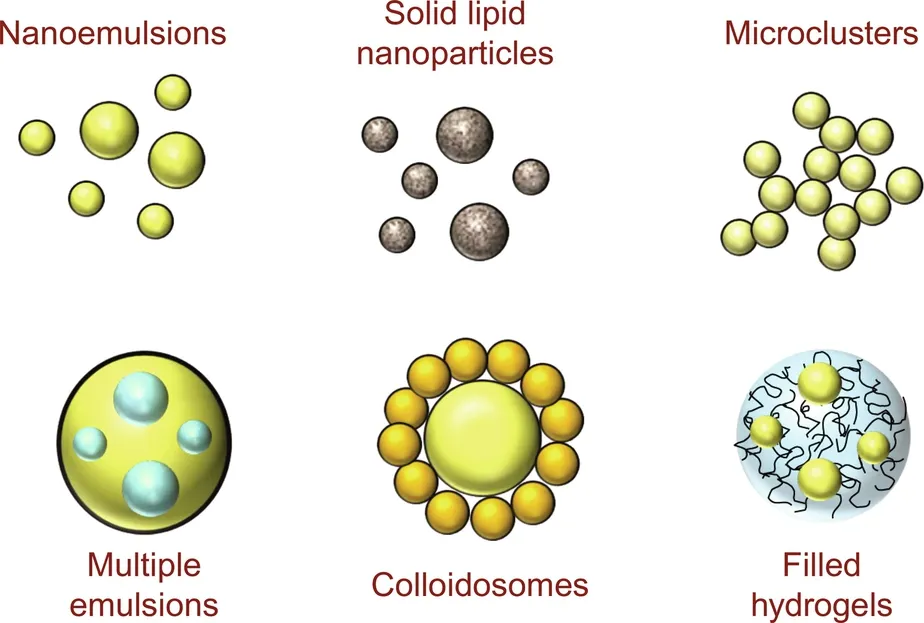
Other types of structures can also be produced using nanoemulsions as building blocks, including multiple emulsions of the water-in-oil-in-water (W/O/W) or oil-in-water-in-oil (O/W/O) type (Fig. 1.1). These systems are usually produced using a two-step process (McClements, 2012a). For example, a W/O/W emulsion is produced by initially forming a W/O nanoemulsion by homogenizing a water phase with an oil phase containing a lipophilic surfactant together, and then, this nanoemulsion is homogenized with a water phase containing a hydrophilic surfactant. Multiple emulsions have advantages for certain applications, such as protecting a hydrophilic substance from the external aqueous phase (Assadpour et al., 2016a,b, 2017a,b), controlling the release of a hydrophilic substance (Esfanjani et al., 2015, 2017), reducing the off-flavor of a hydrophilic substance (such as bitterness or astringency), or reducing the overall fat content of the system (McClements, 2015).
Nanoemulsions can also be used as building blocks for other types of structures, such as filled hydrogels (Fig. 1.2). In this case, an O/W nanoemulsion is mixed with a biopolymer solution that is capable of forming a hydrogel, and then, a two-step process is used to form the filled hydrogels, particle formation and particle gelation (McClements, 2012a; Shewan and Stokes, 2013). Initially, a particle is formed that contains small lipid droplets trapped inside a larger biopolymer-rich water droplet, and then the system conditions are changed to cross-link the biopolymers within the water droplet (Mokhtari et al., 2017). Filled hydrogels can be designed to encapsulate, protect, and release bioactive components b...
Table of contents
- Cover image
- Title page
- Table of Contents
- WITHDRAWN: Dedication
- Copyright
- Contributors
- Preface
- Part I: Nanoemulsion Basics
- Part II: Preparation of Nanoemulsions by Low-Energy Methods
- Part III: Production of Nanoemulsions by Mechanical Methods
- Part IV: Application of Nanoemulsions
- Part V: Characterization and Analysis of Nanoemulsions
- Index
Frequently asked questions
Yes, you can cancel anytime from the Subscription tab in your account settings on the Perlego website. Your subscription will stay active until the end of your current billing period. Learn how to cancel your subscription
No, books cannot be downloaded as external files, such as PDFs, for use outside of Perlego. However, you can download books within the Perlego app for offline reading on mobile or tablet. Learn how to download books offline
We are an online textbook subscription service, where you can get access to an entire online library for less than the price of a single book per month. With over 1.5 million books across 990+ topics, we’ve got you covered! Learn about our mission
Look out for the read-aloud symbol on your next book to see if you can listen to it. The read-aloud tool reads text aloud for you, highlighting the text as it is being read. You can pause it, speed it up and slow it down. Learn more about Read Aloud
Yes! You can use the Perlego app on both iOS and Android devices to read anytime, anywhere — even offline. Perfect for commutes or when you’re on the go.
Please note we cannot support devices running on iOS 13 and Android 7 or earlier. Learn more about using the app
Please note we cannot support devices running on iOS 13 and Android 7 or earlier. Learn more about using the app
Yes, you can access Nanoemulsions by Seid Mahdi Jafari,D. Julian McClements in PDF and/or ePUB format, as well as other popular books in Technology & Engineering & Food Science. We have over 1.5 million books available in our catalogue for you to explore.