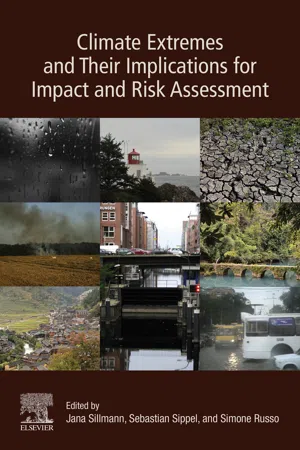
eBook - ePub
Climate Extremes and Their Implications for Impact and Risk Assessment
- 376 pages
- English
- ePUB (mobile friendly)
- Available on iOS & Android
eBook - ePub
Climate Extremes and Their Implications for Impact and Risk Assessment
About this book
Climate extremes often imply significant impacts on human and natural systems, and these extreme events are anticipated to be among the potentially most harmful consequences of a changing climate. However, while extreme event impacts are increasingly recognized, methodologies to address such impacts and the degree of our understanding and prediction capabilities vary widely among different sectors and disciplines. Moreover, traditional climate extreme indices and large-scale multi-model intercomparisons that are used for future projections of extreme events and associated impacts often fall short in capturing the full complexity of impact systems.
Climate Extremes and Their Implications for Impact and Risk Assessment describes challenges, opportunities and methodologies for the analysis of the impacts of climate extremes across various sectors to support their impact and risk assessment. It thereby also facilitates cross-sectoral and cross-disciplinary discussions and exchange among climate and impact scientists. The sectors covered include agriculture, terrestrial ecosystems, human health, transport, conflict, and more broadly covering the human-environment nexus. The book concludes with an outlook on the need for more transdisciplinary work and international collaboration between scientists and practitioners to address emergent risks and extreme events towards risk reduction and strengthened societal resilience.
- Provides an overview about past, present and future changes in climate and weather extremes and how to connect that knowledge to impact and risk assessment under global warming
- Presents different approaches to assess societal-relevant impacts and risk of climate and weather extremes, including compound events, and the complexity of risk cascades and the interconnectedness of societal risk
- Features applications across a diversity of sectors, including agriculture, health, ecosystem services and urban transport
Information
Topic
Physical SciencesSubtopic
Environmental ScienceTable of contents
- Cover image
- Title page
- Table of Contents
- Copyright
- Contributors
- Acknowledgments
- Chapter 1: Climate extremes and their implications for impact and risk assessment: A short introduction
- Chapter 2: Climate scenarios and their relevance and implications for impact studies
- Chapter 3: Changes in climate extremes in observations and climate model simulations. From the past to the future
- Chapter 4: Multivariate extremes and compound events
- Chapter 5: Bias correction of climate model output for impact models
- Chapter 6: Anthropogenic changes in tropical cyclones and its impacts
- Chapter 7: Machine learning applications for agricultural impacts under extreme events
- Chapter 8: Assessing the France 2016 extreme wheat production loss—Evaluating our operational capacity to predict complex compound events
- Chapter 9: Probabilistic drought risk analysis for even-aged forests
- Chapter 10: Projecting health impacts of climate extremes: A methodological overview
- Chapter 11: Climate extremes and their implications for impact modeling in transport
- Chapter 12: Assessing vulnerability and risk of climate change
- Chapter 13: Data challenges limit our global understanding of humanitarian disasters triggered by climate extremes
- Chapter 14: Adaptive capacity of coupled social-ecological systems to absorb climate extremes
- Chapter 15: Impacts of extreme events on medieval societies: Insights from climate history
- Chapter 16: Climate extremes and conflict dynamics
- Chapter 17: Avoiding impacts and impacts avoided: Impact science to inform adaptation action and policy-relevant assessments
- Chapter 18: Outlook: Challenges for societal resilience under climate extremes
- Index
Trusted by 375,005 students
Access to over 1.5 million titles for a fair monthly price.
Study more efficiently using our study tools.
Frequently asked questions
Yes, you can cancel anytime from the Subscription tab in your account settings on the Perlego website. Your subscription will stay active until the end of your current billing period. Learn how to cancel your subscription
No, books cannot be downloaded as external files, such as PDFs, for use outside of Perlego. However, you can download books within the Perlego app for offline reading on mobile or tablet. Learn how to download books offline
Perlego offers two plans: Essential and Complete
- Essential is ideal for learners and professionals who enjoy exploring a wide range of subjects. Access the Essential Library with 800,000+ trusted titles and best-sellers across business, personal growth, and the humanities. Includes unlimited reading time and Standard Read Aloud voice.
- Complete: Perfect for advanced learners and researchers needing full, unrestricted access. Unlock 1.5M+ books across hundreds of subjects, including academic and specialized titles. The Complete Plan also includes advanced features like Premium Read Aloud and Research Assistant.
We are an online textbook subscription service, where you can get access to an entire online library for less than the price of a single book per month. With over 1.5 million books across 990+ topics, we’ve got you covered! Learn about our mission
Look out for the read-aloud symbol on your next book to see if you can listen to it. The read-aloud tool reads text aloud for you, highlighting the text as it is being read. You can pause it, speed it up and slow it down. Learn more about Read Aloud
Yes! You can use the Perlego app on both iOS and Android devices to read anytime, anywhere — even offline. Perfect for commutes or when you’re on the go.
Please note we cannot support devices running on iOS 13 and Android 7 or earlier. Learn more about using the app
Please note we cannot support devices running on iOS 13 and Android 7 or earlier. Learn more about using the app
Yes, you can access Climate Extremes and Their Implications for Impact and Risk Assessment by Jana Sillmann,Sebastian Sippel,Simone Russo in PDF and/or ePUB format, as well as other popular books in Physical Sciences & Environmental Science. We have over 1.5 million books available in our catalogue for you to explore.